
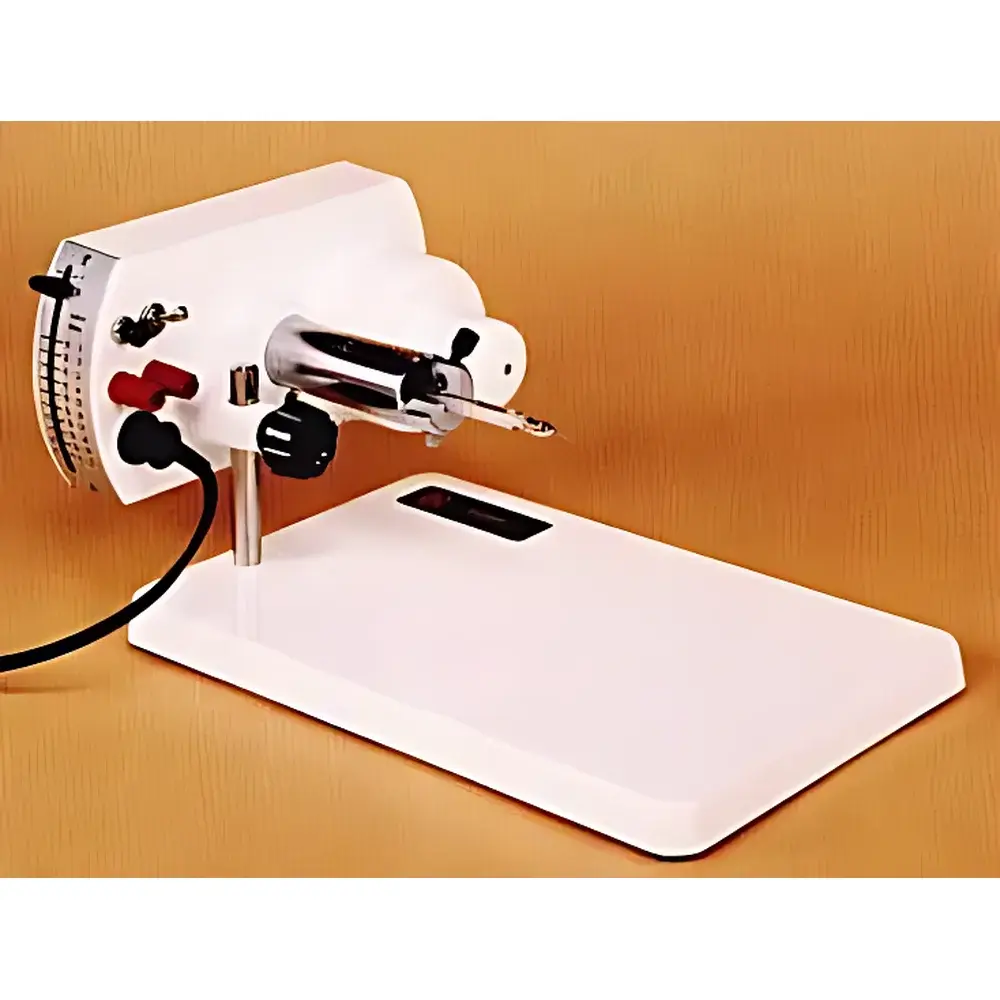
Burkard PDE0006 Automated Micro-Dispenser
| Origin | UK |
|---|---|
| Manufacturer | Burkard Manufacturing Co. Ltd. |
| Model | PDE0006 |
| Power Input | 250 V AC–12 V DC or 110 V AC–12 V DC |
| Maximum Dispense Volume | 350 µL |
| Dimensions (W×D×H) | 230 × 350 × 130 mm |
| Micrometer Base Dimensions | 230 × 230 × 130 mm |
| Net Weight | 4.5 kg |
| Gross Weight | 6.5 kg |
| Dispense Range (1 mL syringe) | 0.1–1.0 µL (10-step), extendable to 1.0–10.0 µL with 10 mL syringe & adapter |
| Actuation | Manual lever + foot switch / ring switch / finger switch |
| Syringe Type | Burkard all-glass precision micrometer syringe |
| Needle | 0.3 mm × 25 mm (3/10″ × 25 mm) subcutaneous stainless steel needle |
| Construction | Non-ferrous materials |
Overview
The Burkard PDE0006 Automated Micro-Dispenser is a precision-engineered laboratory instrument designed for repeatable, low-volume liquid delivery in controlled experimental settings. Operating on the principle of mechanical micrometer-driven plunger displacement within a calibrated all-glass syringe, the PDE0006 delivers highly reproducible micro-doses without reliance on pneumatic or electronic fluidic control systems. Its core architecture eliminates variability introduced by temperature-dependent viscosity changes or pressure fluctuations common in peristaltic or solenoid-based dispensers. The device is specifically optimized for applications requiring trace-level dosing — such as topical bioassays, contact toxicity testing, microbial suspension exposure studies, and micro-scale chemical reaction initiation — where volumetric accuracy below 1 µL and inter-run consistency are critical. Designed and manufactured in the United Kingdom by Burkard Manufacturing Co. Ltd., a globally recognized specialist in environmental and biomedical sampling instrumentation since 1921, the PDE0006 reflects decades of refinement in manual and semi-automated dispensing mechanics.
Key Features
- Mechanically actuated micrometer syringe drive ensures zero drift and long-term calibration stability without software dependency or firmware updates.
- Two-tier dispensing capability: Standard 1 mL all-glass Burkard syringe enables precise 0.1–1.0 µL increments across ten discrete steps; optional 10 mL syringe with dedicated adapter extends range to 1.0–10.0 µL while preserving linearity and repeatability.
- Multi-modal activation: Front-mounted lever for benchtop manual operation; separately configurable foot switch, ring switch, and finger switch allow hands-free or ergonomic positioning during extended assay workflows.
- Non-magnetic construction using anodized aluminum and chromium-plated brass components prevents interference in magnetically sensitive environments (e.g., near NMR spectrometers or magnetic stirrers) and ensures corrosion resistance against organic solvents and aqueous biocides.
- Low-voltage DC operation (12 V) supplied via dual-input AC/DC power adapter (compatible with both 110 V and 250 V mains), minimizing electrical hazard risk and enabling use in laminar flow hoods or biosafety cabinets without grounding complications.
Sample Compatibility & Compliance
The PDE0006 accommodates a wide range of low-to-medium viscosity liquids including ethanol-based insecticide solutions, aqueous disinfectant suspensions, glycerol-diluted microbial cultures, and hydrocarbon solvents — provided they are chemically compatible with borosilicate glass, stainless steel (304/316), and fluorocarbon seals. It is not intended for use with strong oxidizers (e.g., concentrated HNO₃), hydrofluoric acid, or highly viscous polymers (>500 mPa·s at 20°C). While the instrument itself carries no CE marking for medical device classification, its design aligns with GLP (Good Laboratory Practice) documentation requirements for manual dosing apparatus used in OECD 207, 211, and 213 guideline-compliant ecotoxicity testing. All mechanical adjustments are fully traceable via engraved micrometer scale, supporting audit-ready recordkeeping per ISO/IEC 17025:2017 clause 7.7.2.
Software & Data Management
The PDE0006 operates as a standalone electromechanical system with no embedded firmware, network interface, or proprietary software dependency. Dose selection, execution, and verification rely entirely on physical user input and visual scale reading — eliminating cybersecurity vulnerabilities, software validation overhead, and compatibility constraints associated with digital platforms. This analog-first architecture supports seamless integration into regulated environments governed by FDA 21 CFR Part 11 Annex 11, where electronic records are avoided in favor of signed, dated, and witnessed paper-based logbooks documenting syringe calibration, batch number, operator ID, and dispense volume per test unit. Optional third-party digital microscope systems (e.g., Keyence VHX series) may be mounted above the micrometer base for real-time droplet imaging and post-hoc volume estimation via pixel-based area analysis.
Applications
- Contact toxicity assays: Precise deposition of insecticidal formulations onto arthropod cuticles for LD₅₀ determination (OECD 213).
- Fungal spore inhibition testing: Delivery of antifungal agents onto agar plugs or mycelial discs under standardized humidity conditions (ASTM E2149).
- Microbial suspension challenge: Controlled introduction of bacteriophage or antibiotic solutions into microtiter wells for time-kill kinetics (CLSI M26-A).
- Surface coating validation: Reproducible application of nanoliter-scale reference standards for XRF or SEM-EDS calibration.
- Electrophysiology prep: Targeted delivery of neuromodulators to single neurons in slice preparations without mechanical disturbance.
FAQ
Is the PDE0006 suitable for sterile applications?
Yes — all wetted parts (syringe barrel, plunger, needle hub) are autoclavable at 121°C for 20 minutes. Stainless steel needles must be replaced after sterilization cycles exceeding five uses.
Can I calibrate the syringe myself?
Yes — Burkard provides NIST-traceable calibration certificates for each syringe. Users may perform routine verification using gravimetric methods per USP with analytical balances (0.1 µg resolution) and certified water at 20°C.
Does the device support programmable sequences or timed dispensing?
No — the PDE0006 is intentionally non-programmable to maintain regulatory simplicity and reduce validation burden in GLP/GMP labs.
What maintenance is required?
Monthly inspection of micrometer gear backlash, annual replacement of O-rings (Burkard part #OR-PDE), and biannual cleaning of needle lumen with 70% ethanol followed by nitrogen purge.
Is technical support available outside the UK?
Yes — authorized service partners provide on-site calibration and repair in North America, EU, APAC, and ANZ regions under Burkard’s global service agreement framework.



