
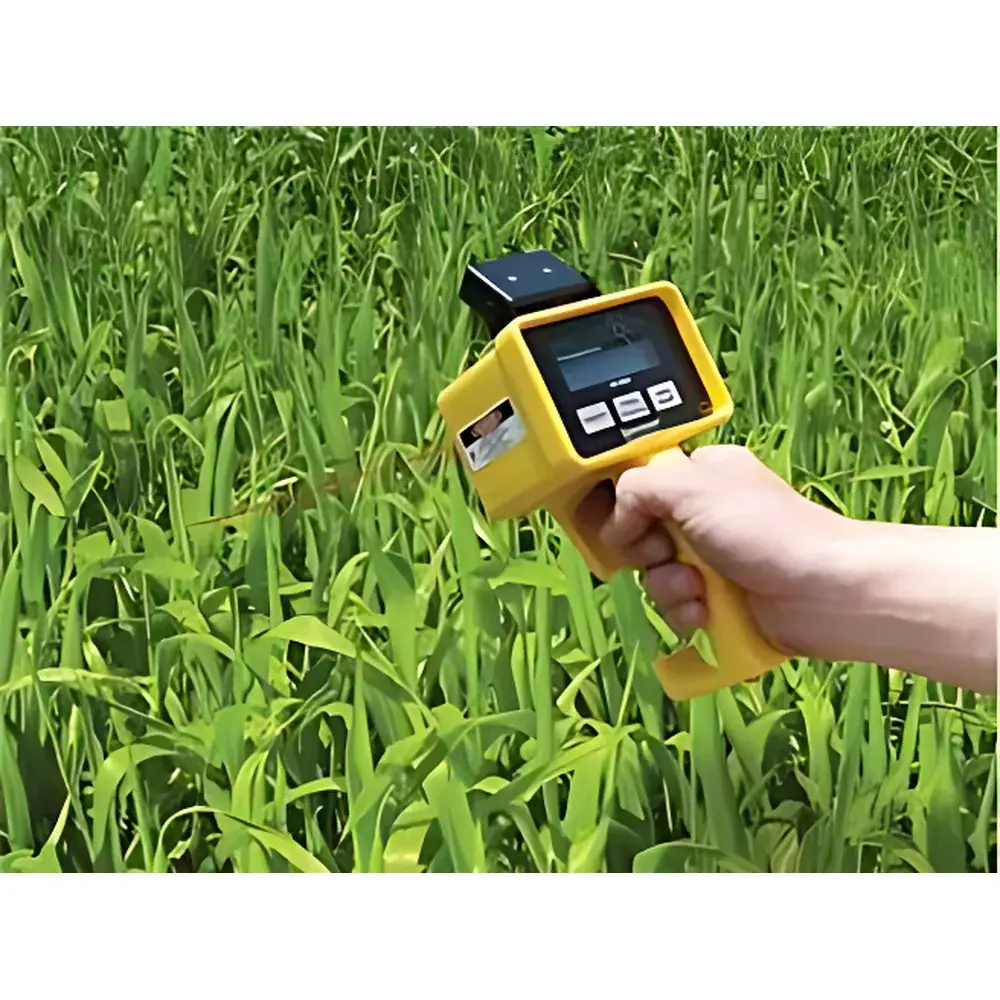
Spectrum CM1000NDVI Portable Chlorophyll and NDVI Meter
| Origin | USA |
|---|---|
| Manufacturer Type | Authorized Distributor |
| Origin Category | Imported |
| Model | CM1000NDVI |
| Price | USD 5,200 (FOB) |
Overview
The Spectrum CM1000NDVI is a handheld, dual-parameter optical meter engineered for rapid, non-destructive assessment of plant physiological status in field and greenhouse environments. It operates on the principle of passive optical reflectance spectroscopy, utilizing two discrete narrow-band optical channels centered at 700 nm (red) and 840 nm (near-infrared) to simultaneously compute both the Chlorophyll Index (CIred-edge) and the Normalized Difference Vegetation Index (NDVI). Unlike destructive chemical extraction methods, the CM1000NDVI delivers real-time, in situ estimates of relative chlorophyll content—correlated with photosynthetic capacity—and canopy structural vigor without leaf removal or sample preparation. Its optical architecture follows the established radiometric design principles defined in ASTM E2653–22 (Standard Practice for Field Measurement of Leaf Chlorophyll Content Using Optical Reflectance) and aligns with ISO 11727:2020 (Plant physiology — Determination of chlorophyll content by optical methods). The device is calibrated against validated reference standards traceable to NIST SRM 2243 (Leaf Reflectance Standard), ensuring metrological consistency across measurement campaigns.
Key Features
- Simultaneous dual-index acquisition: Chlorophyll Index (CI) and NDVI from a single 2-second measurement cycle
- Variable-field-of-view optics: Adjustable measurement diameter (1.35 cm at 3.5 cm working distance; 3 cm at 46 cm; 11.8 cm at 122 cm), enabling flexible sampling across leaf scales and canopy layers
- Robust optical path design: Fixed-wavelength interference filters with <±2 nm spectral bandwidth tolerance and temperature-stabilized photodiode detectors
- Integrated GPS module: Geotagged data logging compliant with WGS84 datum, supporting spatially referenced agronomic analysis
- Non-volatile memory architecture: Stores up to 3,250 measurements without GPS metadata or 1,350 measurements with full geospatial stamping and timestamping (UTC)
- Battery efficiency: Two standard AA alkaline cells support ≥3,000 measurements per set under typical ambient conditions (20–25°C, 40–60% RH)
Sample Compatibility & Compliance
The CM1000NDVI is validated for use on intact, fully expanded leaves of broadleaf angiosperms and monocots—including but not limited to maize, soybean, wheat, rice, tomato, and Arabidopsis thaliana. It is not recommended for highly pubescent, waxy, or senescing tissues where surface scattering may bias reflectance ratios. Device firmware implements automatic gain control to compensate for ambient light variability, meeting the operational requirements of ISO 11727 Annex B for field-deployable optical sensors. Data output conforms to FAO’s CropWat-compatible CSV structure and supports direct ingestion into GIS platforms (QGIS, ArcGIS Pro) and agronomic decision-support systems (e.g., Granular, Climate FieldView). The instrument meets CE marking requirements for electromagnetic compatibility (EN 61326-1) and carries RoHS 2011/65/EU compliance certification.
Software & Data Management
Data retrieval is performed via USB-C interface using Spectrum’s proprietary AcaiaLink™ desktop software (v4.2+), compatible with Windows 10/11 and macOS 12+. Software features include batch calibration validation reports, spatial heat map generation, temporal trend overlays, and export to Excel, JSON, or NetCDF-4 formats. Audit trails record operator ID, instrument serial number, firmware revision, and calibration timestamp—supporting GLP-compliant documentation workflows. For regulated environments, optional 21 CFR Part 11 add-on modules provide electronic signature capability, user access tiers, and immutable audit logs with SHA-256 hash integrity verification.
Applications
- High-throughput phenotyping in breeding programs evaluating chlorophyll stability under drought or nutrient stress
- In-season nitrogen status monitoring for precision fertigation scheduling in row crops
- Longitudinal studies of photosynthetic acclimation in climate change simulation chambers
- Ecological field surveys assessing vegetation health across gradients of soil contamination or urban air pollution
- Validation of satellite-derived NDVI products at ground-truth plot level (e.g., Sentinel-2, Landsat 9)
- Teaching laboratories demonstrating optical plant physiology principles in undergraduate botany and agronomy curricula
FAQ
What is the measurement principle behind the CM1000NDVI?**
It measures spectral reflectance at 700 nm and 840 nm, then computes CI = (R840/R700) − 1 and NDVI = (R840 − R700) / (R840 + R700).
Does the device require daily calibration?**
No—factory calibration is stable for 12 months under normal use; annual recalibration against NIST-traceable standards is recommended.
Can it measure through dew or light rain?**
Surface moisture alters reflectance; measurements should be taken on dry leaf surfaces for optimal accuracy.
Is the GPS module optional or integrated?**
GPS is built-in and cannot be disabled; geotagging is mandatory for all logged records.
How does battery life vary with GPS usage?**
GPS activation increases power draw by ~18%; total measurement count decreases proportionally when geotagging is enabled.



