
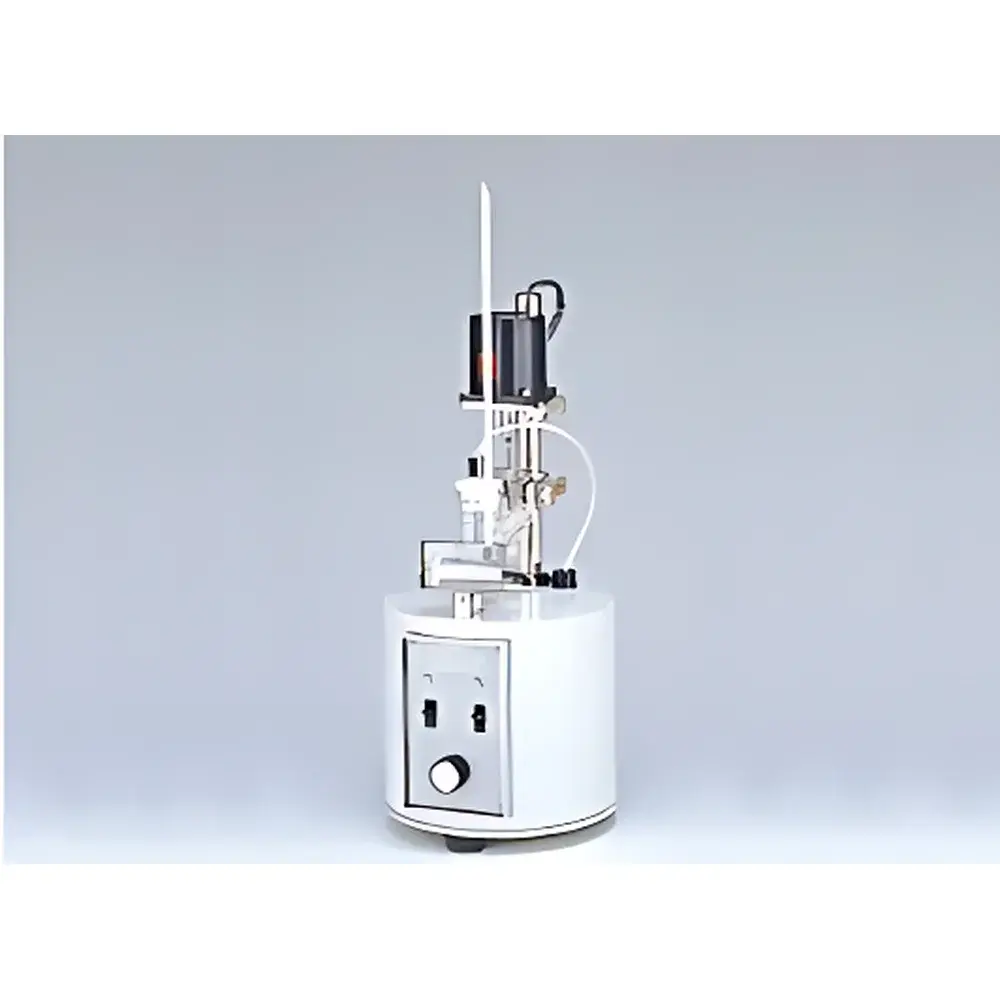
Yamato MP-21 Digital Melting Point Apparatus
| Brand | Yamato |
|---|---|
| Origin | Japan |
| Model | MP-21 |
| Temperature Range | 50–200 °C (with KF-96 100 cP silicone oil) / 90–300 °C (with KF-54 silicone oil) |
| Heating Rate | Adjustable via voltage control (0–98 V output) |
| Max. Temp. Ramp | ~250 °C from ambient in ≤15 min |
| Sample Capacity | 3 capillaries simultaneously |
| Stirring Motor | Capacitor-run, 2-pole, 3 W, high-speed rotation for uniform oil temperature distribution |
| Viewing System | 1.8× magnifying lens with 12 V / 10 W LED illumination |
| Bath Medium | 70 mL silicone oil (KF-54 or KF-96 100 cP) |
| Dimensions | Ø190 × H420 mm |
| Weight | ~6 kg |
| Compliance | Designed for JPC-compliant observation (not validated for JP XV official melting point determination per JP XV General Test 2.10) |
Overview
The Yamato MP-21 Digital Melting Point Apparatus is a precision-engineered thermal analysis instrument designed for reliable, visually confirmed melting point determination of organic crystalline solids in research laboratories, quality control environments, and internal pharmaceutical development settings. It operates on the classical capillary tube method—where solid samples are loaded into thin-walled glass capillaries and immersed in a thermally stabilized silicone oil bath—enabling direct optical observation of phase transition onset and completion. Unlike automated photometric or differential thermal analysis (DTA) systems, the MP-21 emphasizes operator-controlled visual detection under magnification, ensuring traceability and interpretability of melt behavior—including sintering, shrinkage, meniscus formation, and complete liquefaction. Its dual-silicone-oil compatibility (KF-54 for higher-range work up to 300 °C; KF-96 100 cP for standard 50–200 °C applications) provides flexibility across compound classes while maintaining viscosity stability and optical clarity over repeated thermal cycles.
Key Features
- Simultaneous triple-capillary capability enables comparative analysis or replicate measurements within a single thermal run, improving intra-batch reproducibility.
- High-speed, low-inertia capacitor-start stirring motor ensures rapid equilibration and minimal radial/axial temperature gradients (< ±0.3 °C across bath volume), critical for accurate endpoint identification.
- Digital voltage-controlled heating circuit delivers stable, stepless ramp rates—essential for method development and adherence to pharmacopeial heating protocols (e.g., JP, USP & EP guidelines).
- Integrated 1.8× achromatic magnifier with adjustable 12 V / 10 W cold-light illumination provides glare-free, high-contrast visualization of sample morphology changes during melting.
- Compact footprint (Ø190 × 420 mm) and lightweight aluminum-alloy chassis support benchtop deployment in space-constrained QC labs or shared instrumentation facilities.
- Robust construction includes borosilicate glass sample tube housing, corrosion-resistant stainless steel bath housing, and sealed electronics rated for continuous operation at elevated ambient temperatures.
Sample Compatibility & Compliance
The MP-21 accommodates standard 1.0 mm OD × 0.2–0.3 mm ID × 220 mm length capillaries (supplied as 50-unit pack). It supports both anhydrous and hygroscopic compounds, provided samples are dried prior to loading to prevent premature decomposition or boiling artifacts. While the apparatus meets the optical and thermal stability criteria referenced in Japanese Pharmacopoeia (JPC) general chapter 2.10 for *melting point observation*, it is explicitly not validated for JP XV official monograph testing—making it suitable for internal method verification, raw material screening, and R&D-stage purity assessment. For regulated environments operating under GLP or GMP frameworks, users may implement supplementary calibration logs, temperature mapping reports, and operator training records to satisfy audit requirements related to equipment qualification (IQ/OQ).
Software & Data Management
The MP-21 is a standalone analog-digital hybrid instrument with no embedded microprocessor or data export functionality. Temperature is displayed via calibrated analog meter (supplied with three certified reference thermometers: –10–120 °C, 90–220 °C, and 0–360 °C full-immersion types) to ensure traceable, human-readable values without software dependency. This architecture eliminates firmware validation burdens associated with 21 CFR Part 11 compliance—ideal for laboratories seeking simplicity, long-term serviceability, and avoidance of obsolescence-driven hardware upgrades. All calibration documentation, maintenance logs, and observed melt intervals are maintained manually in laboratory notebooks or LIMS-integrated electronic records.
Applications
- Pharmaceutical intermediate and API purity estimation via melting point depression analysis.
- Batch-to-batch consistency evaluation during synthetic process optimization.
- Verification of identity and thermal stability of reference standards and excipients.
- Educational demonstrations of solid-state phase transitions in university chemistry and materials science curricula.
- Polymer additive screening where sharpness and range of melting endotherms inform formulation decisions.
- Forensic and regulatory labs performing non-automated, observer-auditable thermal characterization.
FAQ
Is the MP-21 compliant with USP <741> or EP 2.2.17?
It supports manual execution of these methods but lacks automated data capture or audit-trail features required for full compliance in regulated submissions.
Can I use other silicone oils besides KF-54 and KF-96?
Only oils with verified thermal stability, low volatility, and optical transparency in the target range should be substituted—and recalibration against NIST-traceable references is strongly recommended.
What is the recommended recalibration frequency?
Per ISO/IEC 17025 guidance, annual verification using certified reference materials (e.g., pure caffeine, indomethacin, or vanillin) is advised, supplemented by daily checks with supplied reference thermometers.
Does the unit include temperature gradient validation tools?
No built-in mapping sensors are included; however, the supplied full-immersion thermometer set allows manual multi-point bath profiling during OQ.
Are replacement capillaries and silicone oil available through Yamato authorized distributors?
Yes—genuine Yamato-certified capillaries (specifications: 1.0 ± 0.2 mm OD, 0.25 ± 0.05 mm ID) and KF-54/KF-96 oils are stocked globally via authorized channels with CoA documentation.



