
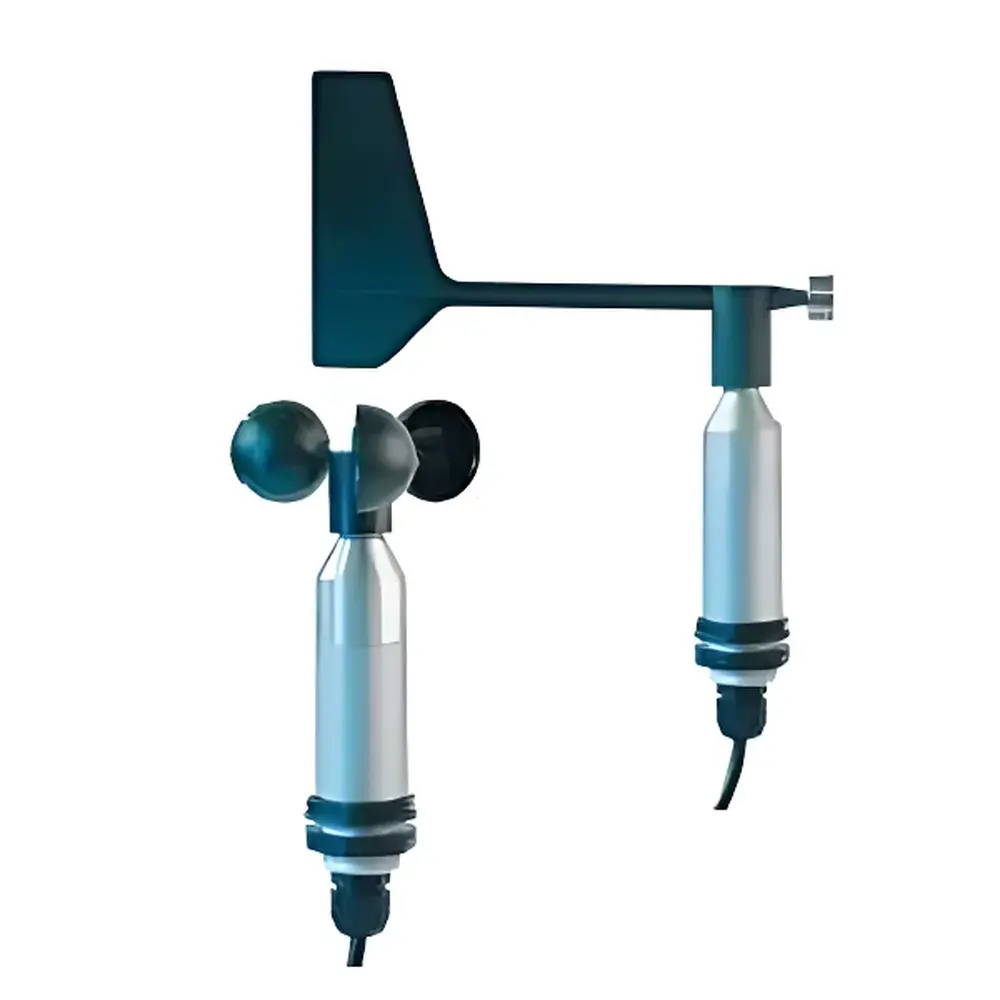
Lambrecht 123-9 Precision Wind Vane Sensor
| Brand | Lambrecht |
|---|---|
| Origin | Germany |
| Model | 123-9 |
| Measurement Range | 0–360° |
| Resolution | 2.5° |
| Output Signals | 4–20 mA (0–360°), 3 × 0–10 VDC (analog waveform) |
| Starting Wind Speed | < 0.7 m/s |
| Supply Voltage | 24 VDC (10–30 VDC) |
| Housing | Anodized Marine-Grade Aluminum |
| Cable | 12 m Pre-terminated Connectable Cable |
| Compliance | CE, RoHS, EN 61326-1 (EMC for Industrial Environments) |
Overview
The Lambrecht 123-9 Precision Wind Vane Sensor is a high-reliability electromechanical directional transducer engineered for continuous, long-term wind direction measurement in demanding environmental and industrial applications. Based on a precision-bearing-supported vane assembly coupled with a robust multi-turn potentiometric or conductive plastic angle encoder, the sensor delivers stable angular output across the full 0–360° azimuthal range. Its design follows classical aerodynamic vane principles—leveraging low-inertia aluminum construction and balanced center-of-pressure geometry to ensure rapid response to directional shifts while minimizing hysteresis and mechanical drift. Unlike optical or magnetic encoders subject to contamination or temperature-induced signal offset, the 123-9 employs a sealed, contact-based analog encoding system optimized for marine, offshore, polar, and military deployments where condensation, salt-laden air, and thermal cycling are routine operational conditions.
Key Features
- Full 0–360° azimuthal measurement with 2.5° mechanical resolution and calibrated linearity ≤ ±1.5° over the entire range
- Dual-output configuration: industry-standard 4–20 mA current loop (scalable 0–360°) plus three independent 0–10 VDC analog channels for redundant or differential signal validation
- Marine-grade anodized aluminum housing (DIN EN ISO 8062, Class AA25) providing corrosion resistance per ISO 9223 C5-M (marine atmospheric exposure)
- Integrated PTC heating element enabling continuous operation at ambient temperatures from –40°C to +60°C, preventing ice accumulation and dew formation on the vane pivot and encoder housing
- Pre-terminated 12 m shielded cable with IP67-rated M12 circular connector (IEC 61076-2-101), supporting direct integration into SCADA, PLC, or data logger systems without field termination
- Compliant with electromagnetic compatibility requirements per EN 61326-1 (industrial environment), including surge immunity up to 2 kV (line-to-earth, 1.2/50 µs)
Sample Compatibility & Compliance
The Lambrecht 123-9 is designed for permanent outdoor installation on meteorological masts, offshore platforms, naval vessels, airport ASOS/ATIS networks, and environmental monitoring stations. It requires no recalibration under normal service conditions and maintains traceable performance against national meteorological standards (e.g., DWD RM-2018, UKMO MTS-11). The sensor conforms to IEC 61000-6-2 (immunity) and IEC 61000-6-4 (emissions), and its mechanical construction satisfies DIN 1343 (meteorological instrumentation mounting interfaces). While not certified to IEC 61508 for functional safety, it is routinely deployed in SIL-2-compatible monitoring architectures when integrated with certified safety controllers. Documentation includes EU Declaration of Conformity, test reports from TÜV Rheinland (EMC & environmental stress), and material compliance certificates (RoHS 2011/65/EU, REACH SVHC-free declaration).
Software & Data Management
The 123-9 operates as a standalone analog transducer and does not require embedded firmware or driver software. Its analog outputs are directly compatible with standard data acquisition hardware (e.g., Campbell Scientific CR1000X, Delta-T DL6, Siemens Desigo CC, or National Instruments CompactDAQ). When integrated into regulated environments—such as EPA-compliant ambient air quality monitoring networks or GLP-aligned climate research observatories—the sensor’s linear 4–20 mA output supports audit-trail-capable scaling within compliant DAQ software (e.g., LabVIEW with FDA 21 CFR Part 11 add-ons or EcoWatch Pro v5.2). Raw voltage or current values are recorded without interpolation; post-processing for true north correction, vector averaging, or gust detection is performed externally per WMO Guide to Meteorological Instruments and Methods of Observation (CIMO Guide, Chapter 8).
Applications
- Primary and secondary wind direction input in automated surface observing systems (ASOS) and automatic weather stations (AWS)
- Directional input for wind resource assessment in pre-construction site surveys and operational wind farm SCADA systems
- Real-time heading stabilization and crosswind compensation in maritime navigation and harbor management systems
- Boundary-layer meteorology studies requiring co-located, time-synchronized wind vector measurements with sonic anemometers
- Environmental impact assessments (EIA) for industrial stack dispersion modeling and emergency response plume tracking
- Military field-deployable meteorological packages (e.g., AN/TMQ-52 variants) where ruggedness, low power draw, and cold-start reliability are critical
FAQ
What is the recommended mounting height and orientation for optimal accuracy?
Mount the sensor at least 10 m above ground level on a non-turbulent mast, aligned to true north using a survey-grade compass or GNSS azimuth reference. Avoid proximity to structures causing flow distortion (>10× obstacle height clearance required per WMO guidance).
Does the sensor support digital communication protocols such as RS-485 or Modbus?
No—the 123-9 provides analog-only outputs. For digital integration, pair with a certified analog-to-Modbus converter (e.g., Acromag 968EN-4AI) validated for Class I, Division 2 hazardous locations if required.
Is calibration traceable to a national metrology institute?
Yes—each unit ships with a factory calibration certificate traceable to PTB (Physikalisch-Technische Bundesanstalt) via accredited third-party lab testing (Dakks-certified). Field recalibration is not necessary under normal operating conditions for up to 5 years.
Can the heating function be controlled externally?
The PTC heater operates autonomously based on internal thermistor feedback; no external control interface is provided. Power must be continuously applied to enable anti-icing functionality.
What is the expected service life under continuous marine exposure?
Based on accelerated salt-spray testing (ISO 9227, 2000 h neutral salt fog), mean time between failures (MTBF) exceeds 15 years in offshore installations when maintained per Lambrecht Service Bulletin SB-123-07.
Related Products







