
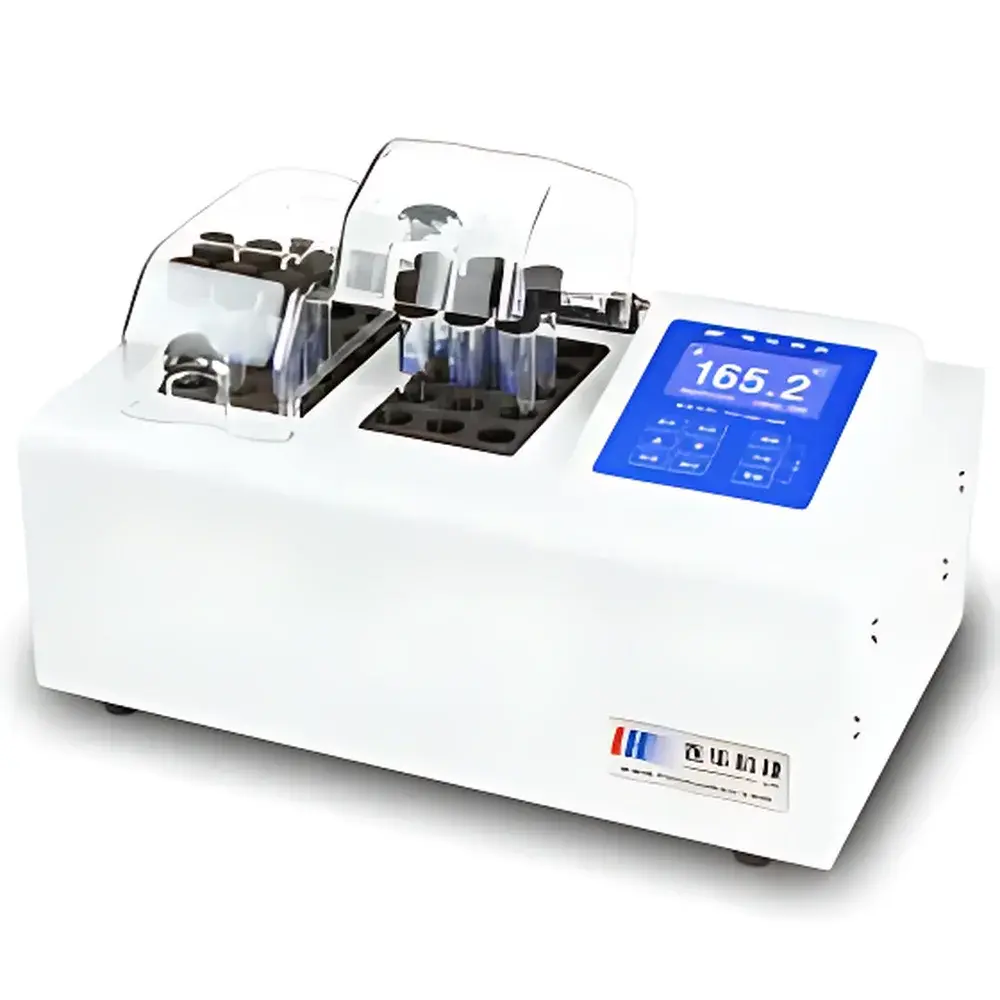
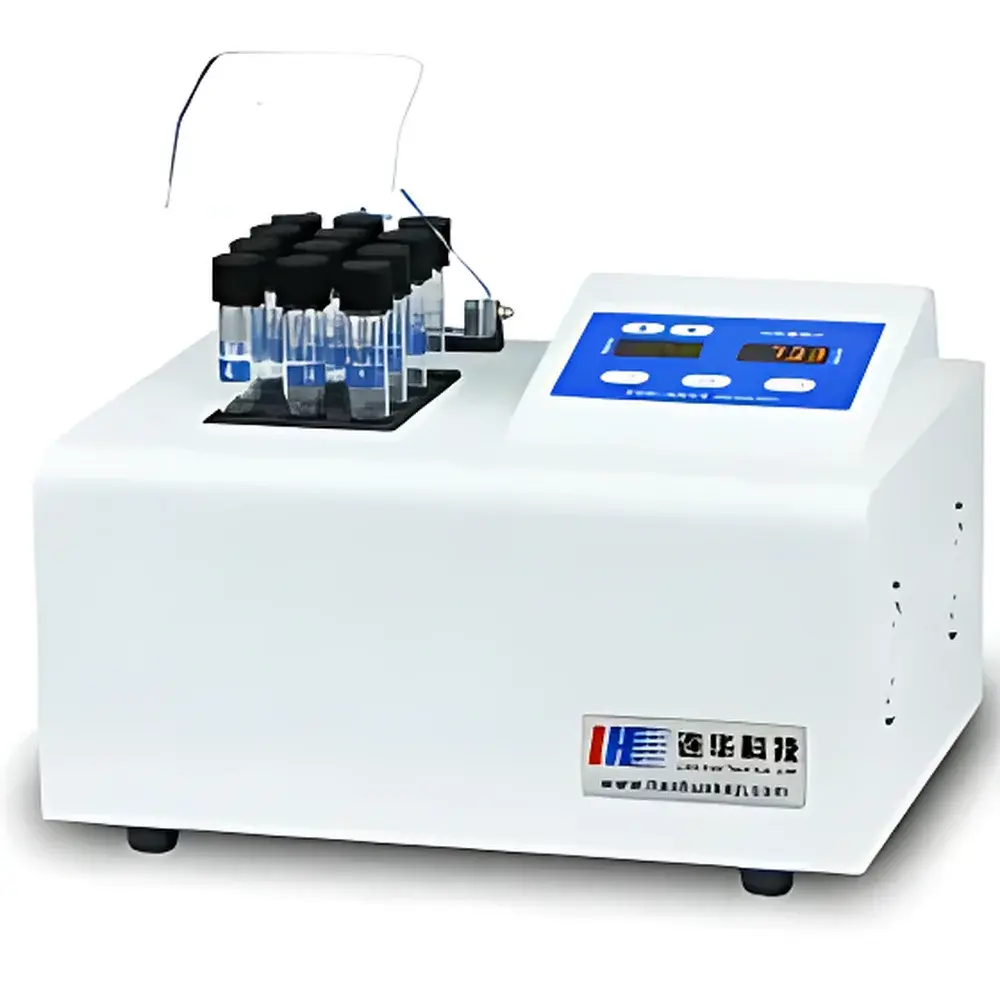
HePu 5B-1B(V8) COD Digestion Block System
| Brand | HePu (Jinan Hepu Instrument Co., Ltd.) |
|---|---|
| Origin | Shandong, China |
| Model | 5B-1B(V8) |
| Digestion Method | Rapid Thermal Digestion |
| Batch Capacity | 30 samples |
| Temperature Range | Ambient to 190 °C |
| Temperature Accuracy | ±0.5 °C |
| Sample Volume Capacity | 0–10 mL |
| Timer Accuracy | ±0.2 s/h |
| Dual-Zone Heating | Yes |
| Digestion Tube Diameter Options | Φ16 mm or Φ20 mm |
| Maximum Tube Height | 150 mm |
| Heating Liquid Depth | 80 mm |
| Safety Shield | Integrated Transparent Heat-Resistant Cover |
| Display | Backlit LCD with Chinese Interface |
| Control Keys | 9-key Membrane Panel |
| Delayed Shutdown Function | Yes |
| Auto-Start Timing (upon target temperature reach) | Yes |
| Numbered Digestion Wells | Yes |
Overview
The HePu 5B-1B(V8) COD Digestion Block System is a benchtop thermal digestion unit engineered for precise, reproducible sample preparation in compliance with standard methods for chemical oxygen demand (COD), total phosphorus (TP), and total nitrogen (TN) analysis in water and wastewater. It operates on the principle of controlled conductive heating via calibrated metal blocks—designed to deliver uniform thermal energy across all 30 digestion positions. Unlike open-flame or oil-bath systems, this solid-state block heater eliminates reagent volatility risks and ensures consistent ramp rates and dwell times critical for method adherence (e.g., ISO 6060, EPA 410.4, HJ 828–2017). The system supports rapid digestion protocols requiring temperatures up to 190 °C, with real-time thermal stability maintained within ±0.5 °C—enabling traceable, GLP-aligned sample conditioning prior to spectrophotometric or titrimetric quantification.
Key Features
- Dual independent heating zones allow simultaneous digestion of two sample sets at different target temperatures—ideal for laboratories processing mixed-parameter batches (e.g., COD at 165 °C and TP at 120 °C) without cross-method interference.
- Integrated transparent heat-resistant safety shield provides full visual monitoring while containing potential splashes or pressure release during high-temperature acid digestion—meeting IEC 61010-1 requirements for laboratory equipment safety.
- Aerospace-grade thermal insulation layer on the upper module surface reduces external surface temperature rise, minimizing operator burn risk during extended operation.
- Intelligent start logic initiates timing only after the block reaches the user-defined setpoint—eliminating manual intervention and reducing inter-operator variability in digestion duration.
- Numbered digestion wells (1–30) and dual tube diameter compatibility (Φ16 mm / Φ20 mm) support flexible method adaptation and unambiguous sample tracking across multi-analyte workflows.
- Programmable delayed shutdown function enables energy-efficient unattended operation—particularly valuable during overnight or weekend digestion cycles.
- Backlit LCD interface with intuitive Chinese menu navigation lowers training burden and minimizes operational errors in routine QC environments.
Sample Compatibility & Compliance
The 5B-1B(V8) accommodates standard borosilicate glass digestion tubes (0–10 mL volume, up to 150 mm height) used in APHA Standard Methods 5220D, ISO 6060, and China’s HJ 828–2017. Its ±0.5 °C temperature accuracy and ≤0.2 s/h timer precision meet the instrumental performance criteria outlined in ISO/IEC 17025:2017 for accredited environmental testing laboratories. While not FDA 21 CFR Part 11–compliant out-of-the-box (as it lacks electronic audit trail functionality), its stable thermal profile and mechanical repeatability support data integrity when paired with validated SOPs and manual logbook documentation per GLP guidelines.
Software & Data Management
This is a standalone hardware-only digestion system with no embedded data logging, USB export, or PC connectivity. All parameter settings—including temperature setpoint, digestion duration, delay time, and zone activation—are configured locally via the 9-key membrane panel and retained in non-volatile memory. Users are expected to record operational parameters and sample IDs manually or integrate the unit into broader LIMS workflows via external procedural controls. No firmware updates or remote diagnostics are supported.
Applications
- Routine COD determination in municipal wastewater influent/effluent per HJ 828–2017 or EPA 410.4 using potassium dichromate digestion under acidic reflux conditions.
- Total phosphorus quantification via persulfate oxidation at 120–150 °C, followed by ascorbic acid/molybdate colorimetry.
- Total nitrogen digestion using alkaline potassium persulfate at elevated temperatures (up to 190 °C), enabling complete oxidation of organic and inorganic nitrogen species.
- Method development and validation studies requiring precise thermal control across variable digestion durations and temperature gradients.
- Teaching laboratories conducting standardized environmental chemistry experiments where safety, visibility, and ease of use are pedagogical priorities.
FAQ
Does the 5B-1B(V8) support automatic data export or connection to laboratory information management systems (LIMS)?
No. It is a manually operated thermal block without digital output interfaces, internal memory storage, or communication ports.
What digestion tube sizes are compatible?
Standard Φ16 mm and Φ20 mm outer-diameter glass tubes, up to 150 mm in length and holding 0–10 mL of sample-reagent mixture.
Is calibration certificate included with shipment?
A factory calibration report verifying temperature accuracy (±0.5 °C) and timer performance (±0.2 s/h) is provided; third-party NIST-traceable calibration is available upon request.
Can the unit be used for mercury digestion or other hazardous applications?
It is not designed for closed-vessel high-pressure digestion (e.g., microwave-assisted); users must implement additional fume hood containment and personal protective equipment when handling concentrated sulfuric/nitric acid mixtures.
What maintenance is required?
Regular cleaning of the heating block surface and safety shield with non-abrasive ethanol wipes; annual verification of thermal uniformity across all 30 wells is recommended for ISO/IEC 17025 compliance.







