
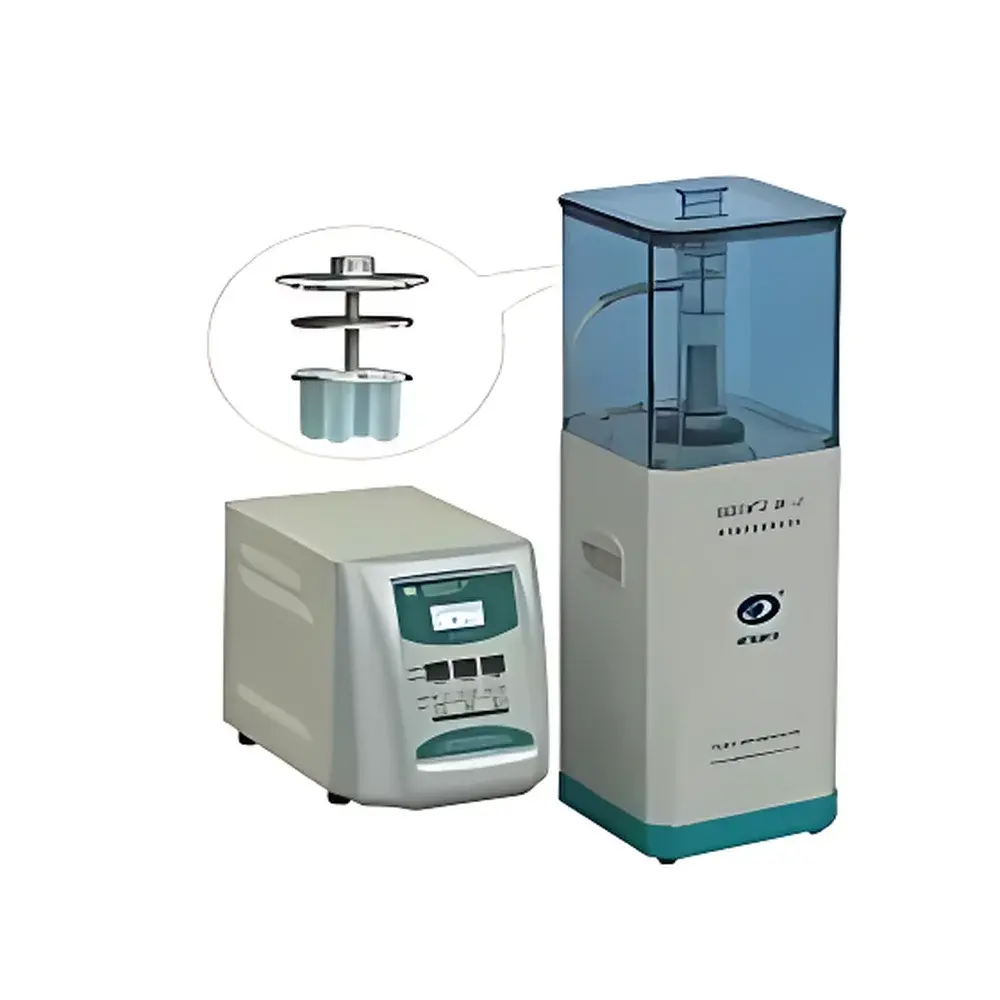
Scientz98-III Ultrasonic Cell Disruptor
| Origin | Zhejiang, China |
|---|---|
| Manufacturer Type | Distributor |
| Origin Category | Domestic (China) |
| Model | Scientz98-III |
| Instrument Type | Ultrasonic Disruptor |
| Sample Type | Soft biological tissues/cells |
| Output Particle Size | 0.01–0.5 mm |
| Maximum Feed Particle Size | <15 mm |
| Sieve Cut-Off | 40 mesh |
| Batch Grinding Volume | 60 mL |
| Ultrasonic Frequency | 19.5–20.5 kHz |
| Total Ultrasonic Power | 1200 W |
| Sonication Capacity per Tube | 0.1–2 mL × 4 tubes |
| Duty Cycle | 1–99% |
| Display | Analog pointer + digital readout |
| Voltage | 220 V ± 0.5 V / 110 V ± 0.5 V, 50/60 Hz |
Overview
The Scientz98-III Ultrasonic Cell Disruptor is an advanced benchtop sonication system engineered for high-fidelity, reproducible lysis of mammalian, bacterial, and yeast cells—particularly in epigenetics and nucleic acid fragmentation workflows such as Chromatin Immunoprecipitation (ChIP) and next-generation sequencing (NGS) library preparation. Unlike conventional probe-type sonicators, the Scientz98-III employs a multi-tube, bath-coupled ultrasonic architecture where each sample resides in a sealed, individual microcentrifuge tube immersed in a temperature-controlled water bath. This design eliminates direct probe contact with samples, thereby eliminating cross-contamination risks and variability caused by inconsistent probe immersion depth or tip erosion. The system operates at a stable frequency range of 19.5–20.5 kHz with a total output power of 1200 W, delivering uniform acoustic energy distribution across all tubes simultaneously. Its ability to process as little as 5 µL per tube makes it suitable for low-input, high-value clinical or single-cell samples requiring maximal recovery and minimal shear-induced DNA degradation.
Key Features
- Multi-sample parallel processing: Simultaneous disruption of up to four 0.1–2 mL samples in sealed tubes—ensuring full containment and biosafety compliance.
- Integrated temperature management: Compatible with optional SDC-6 low-temperature circulator for precise 4 °C water-bath cooling, minimizing thermal denaturation during extended sonication cycles.
- Programmable duty cycle control (1–99%) and adjustable sonication time (s), enabling optimization for diverse cell types—from fragile primary neurons to robust Gram-positive bacteria.
- Dual-display interface: Analog pointer gauge provides real-time power-level feedback; digital display shows elapsed time, cycle count, and active parameter settings.
- Robust stainless-steel construction: Both inner chamber and outer housing fabricated from corrosion-resistant 304 stainless steel for long-term reliability under routine lab use.
- Safety-certified operation: Equipped with over-temperature protection, transducer fault detection, and automatic shutdown upon lid opening or coolant level deficiency.
Sample Compatibility & Compliance
The Scientz98-III is validated for soft biological matrices including cultured cells, tissue homogenates, and microbial pellets. It is not intended for hard or fibrous materials (e.g., plant stems, bone, or mineralized tissue). Sample tubes must be certified for ultrasonic exposure (e.g., polypropylene microcentrifuge tubes rated ≥12,000 × g). The system supports GLP-compliant documentation when used with external data loggers; while the instrument itself does not include FDA 21 CFR Part 11–compliant audit trails, its repeatable parameter sets (time, duty cycle, temperature) facilitate method validation per ISO/IEC 17025 and USP guidelines for analytical instrument qualification. All operational protocols align with standard ChIP-seq SOPs published by ENCODE and the NIH Epigenomics Roadmap Consortium.
Software & Data Management
The Scientz98-III operates via hardware-based parameter programming—no PC connection or proprietary software required. Users predefine up to ten independent methods, each comprising multiple stages with user-specified duration (seconds), duty cycle (%), and on/off states for ultrasonic activation. All settings are retained in non-volatile memory and recalled via front-panel navigation. For traceability, laboratories may integrate external USB data loggers to record bath temperature, cumulative sonication time, and power delivery profiles. While native electronic records are not encrypted or timestamped, the deterministic nature of parameter execution ensures method reproducibility across operators and shifts—critical for QC/QA environments operating under GMP-aligned quality systems.
Applications
- Chromatin shearing for ChIP-qPCR and ChIP-seq assays
- Genomic DNA fragmentation prior to library construction (Illumina, PacBio, Oxford Nanopore)
- Preparation of subcellular fractions (nuclei, mitochondria) from cultured cells
- Exosome isolation via sonication-assisted membrane disruption
- Protein extraction from inclusion bodies under denaturing conditions
- Routine bacterial cell lysis for plasmid purification or protein expression screening
FAQ
Can the Scientz98-III be used for RNA extraction without significant degradation?
Yes—when operated at 4 °C with short pulse durations (e.g., 5 s on / 10 s off) and ≤30% duty cycle, RNA integrity (RIN > 8.5) is routinely maintained in mammalian cell lysates.
Is the system compatible with 1.5 mL Eppendorf-style tubes?
Yes—standard 1.5 mL conical-bottom polypropylene tubes fit securely in the included tube holder array; no adapters required.
Does the unit include a built-in cooling system?
No—the Scientz98-III requires external temperature control; the optional SDC-6 recirculating chiller is recommended for applications demanding strict thermal stability.
What maintenance is required for long-term reliability?
Annual inspection of ultrasonic transducer coupling gel integrity and calibration of the analog power gauge against digital reference standards is advised; no routine consumables beyond replacement tubes.
Can this device replace a focused ultrasonicator (e.g., Covaris)?
It serves complementary roles: the Scientz98-III excels in standardized, multi-sample ChIP workflows with moderate throughput and cost efficiency; focused-ultrasonication platforms offer higher resolution fragment size control for ultra-sensitive NGS applications.



