
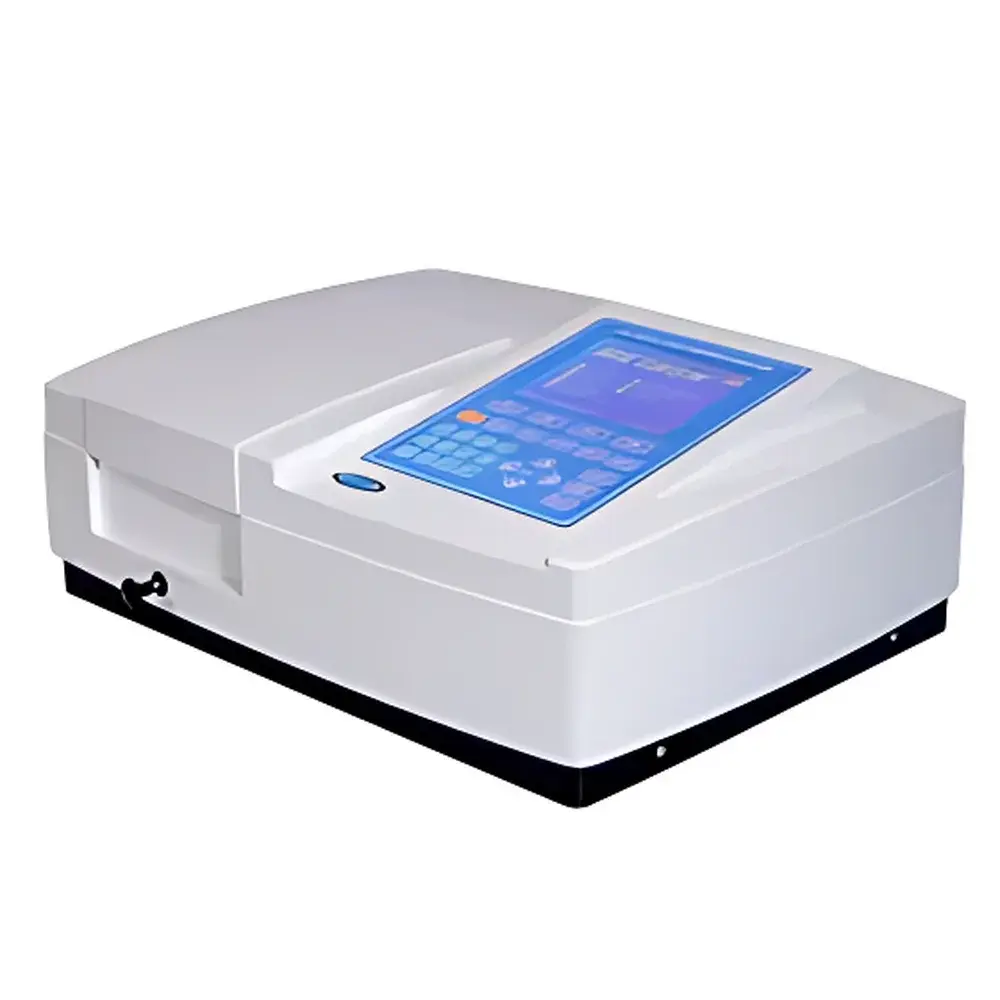
UV-6000 Ultraviolet-Visible Spectrophotometer
| Brand | Jihepu (Jinan Hepu) |
|---|---|
| Wavelength Range | 190–1100 nm |
| Spectral Bandwidth | 1.8 nm |
| Wavelength Accuracy | ±0.5 nm |
| Wavelength Repeatability | ≤0.2 nm |
| Photometric Accuracy | ±0.3% T |
| Photometric Repeatability | ≤0.15% T |
| Stray Light | ≤0.05% T |
| Baseline Flatness | ±0.001 A |
| Drift | ±0.001 A/h at 500 nm |
| Noise Level | ±0.001 A |
| Photometric Range | 0–200% T, –0.3–3 A, 0–9999 C |
| Detector | Imported Silicon Photodiode Array |
| Light Source | Imported Long-Life Tungsten and Deuterium Lamps |
| Optical System | Dual-Beam with Suspended Optics on 8 mm Machined Aluminum Base |
| Wavelength Drive | Synchronous Sine Mechanism |
| A/D Conversion | 24-bit High-Speed |
| Display | 320 × 240 Pixel, 6-inch Backlit LCD |
| Interface | USB, Parallel Port |
| Dimensions | 460 × 380 × 180 mm |
| Weight | 20 kg |
| Power Supply | AC 220 V/50 Hz or 110 V/60 Hz |
Overview
The UV-6000 Ultraviolet-Visible Spectrophotometer is a dual-beam, microprocessor-controlled analytical instrument engineered for precision absorbance, transmittance, and concentration measurements across the ultraviolet, visible, and near-infrared spectral regions (190–1100 nm). It operates on the fundamental principle of Beer–Lambert law-based absorption spectroscopy, where sample-induced attenuation of monochromatic light is quantified to determine analyte concentration, purity, or molecular characteristics. Its suspended optical architecture—rigidly mounted on an 8 mm thick machined aluminum base—eliminates coupling between mechanical vibration and optical path integrity, ensuring long-term baseline stability and measurement reproducibility. The instrument integrates a synchronous sine-wave wavelength drive mechanism and high-resolution 24-bit analog-to-digital conversion, enabling accurate, repeatable spectral acquisition with minimal thermal drift and low electronic noise.
Key Features
- Dual-beam optical design with real-time reference beam compensation, minimizing errors from source fluctuation and detector drift
- Imported long-life deuterium and tungsten-halogen lamps ensure stable output across the full 190–1100 nm range
- High-performance silicon photodiode array detector delivers rapid spectral response and uniform sensitivity
- 1.8 nm nominal spectral bandwidth optimized for resolution–throughput balance in routine QC and research applications
- ARM-based embedded control system with intuitive 320 × 240 pixel, 6-inch backlit LCD interface supports standalone operation without PC dependency
- Robust mechanical construction: all optical components are fixed on a stress-relieved, vibration-isolated aluminum chassis
- Comprehensive onboard functionality—including photometric mode, quantitative analysis, kinetic scanning, multi-wavelength assay, DNA/protein A260/A280 ratio calculation, and spectral mapping
Sample Compatibility & Compliance
The UV-6000 accommodates standard 10 mm pathlength quartz, glass, or plastic cuvettes (including matched pairs for dual-beam referencing), as well as micro-volume adapters and optional fiber-optic probes for non-standard geometries. Its optical performance meets key international specifications for routine spectrophotometric analysis: stray light ≤0.05% T satisfies ASTM E275 and ISO 6223 requirements for trace-level absorbance accuracy; wavelength accuracy (±0.5 nm) and repeatability (≤0.2 nm) align with USP and EP 2.2.25 validation criteria. While not pre-certified for GMP environments, its data integrity features—including timestamped measurement logs, user-accessible audit trails, and exportable CSV/ASCII spectral datasets—support GLP-compliant documentation workflows and internal method validation per ICH Q2(R2).
Software & Data Management
The UV-6000 supports both standalone operation and PC-based control via optional spectral acquisition software. This Windows-compatible application enables extended capabilities including spectral overlay, derivative spectroscopy, peak identification, calibration curve generation (linear, quadratic, polynomial), and automated dilution series calculation. All raw and processed data are stored with metadata (date/time, operator ID, instrument serial number, method name), and exported via USB or parallel port in formats compatible with LIMS integration (e.g., CSV, TXT, JCAMP-DX). The software enforces user-level access controls and maintains immutable records of parameter changes—facilitating compliance with FDA 21 CFR Part 11 when deployed with appropriate IT infrastructure and procedural controls.
Applications
The UV-6000 serves as a foundational tool across pharmaceutical QC labs (active ingredient assay, dissolution testing, excipient verification), environmental monitoring (nitrate, phosphate, COD analysis), biochemical research (enzyme kinetics, protein quantification via Bradford/Lowry/BCA, nucleic acid purity assessment), food and beverage quality control (colorimetric pigment analysis, preservative detection), and academic teaching laboratories. Its broad dynamic range (–0.3 to 3 A) and low noise floor (±0.001 A) enable reliable measurement of highly diluted samples and high-absorbance standards alike. The kinetic scan mode supports time-resolved studies up to 60 points per second, suitable for monitoring rapid enzymatic reactions or ligand-binding events under controlled temperature conditions (when paired with external Peltier cuvette holders).
FAQ
What is the maximum scanning speed in kinetic mode?
Up to 60 data points per second, configurable via software settings based on required temporal resolution and signal averaging.
Does the UV-6000 support GLP/GMP-compliant data handling out of the box?
It provides essential data traceability features (timestamps, operator IDs, exportable logs); full Part 11 compliance requires validated software deployment, network configuration, and administrative SOPs.
Can the instrument be calibrated using NIST-traceable standards?
Yes—certified holmium oxide and didymium filters, as well as neutral density filters, are recommended for wavelength and photometric calibration per manufacturer guidelines.
Is the optical base susceptible to thermal expansion during extended operation?
No—the 8 mm solid aluminum base undergoes precision machining and stress-relief annealing to minimize thermal drift; baseline stability remains within ±0.001 A/h at 500 nm over 1 hour.
What maintenance is required for the deuterium and tungsten lamps?
Lamp lifetime exceeds 2,000 hours; replacement is user-performed using alignment-free sockets and guided by on-screen prompts during warm-up diagnostics.





