
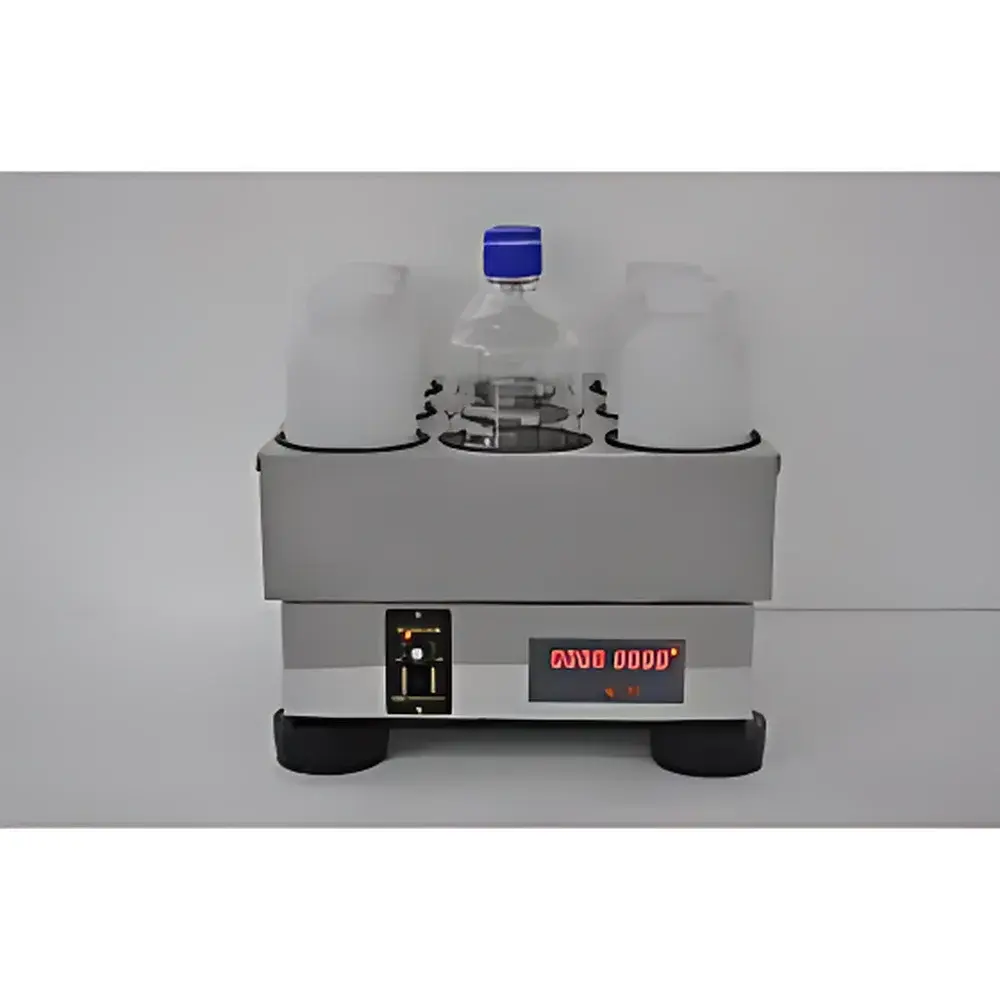
English Product Name
| Brand | Jihepu |
|---|---|
| Origin | Shandong, China |
| Model | GGC-9 |
| Speed Range | 0–200 cycles/min |
| Oscillation Mode | Horizontal circular motion |
| Amplitude | 40 mm |
| Display | Digital speed readout (0–200 cycles/min) |
| Power Rating | 160 W |
| Timer Range | 0–99 h 99 min |
| Dimensions (W×D×H) | 450 × 450 × 300 mm |
| Net Weight | 30 kg |
| Compliance | HJ 557–2010, HJ/T 2009, ISO 9001 & ISO 14001 certified |
| Sample Capacity | Up to 9 × 2 L bottles (PE, glass, or PTFE) |
Overview
The Jihepu GGC-9 Horizontal Shaker is a precision-engineered laboratory shaker designed specifically for regulatory-compliant leaching tests of solid waste in environmental laboratories. It operates on the principle of horizontal circular oscillation—generating controlled, uniform mechanical agitation across multiple sample containers simultaneously—to simulate field-relevant leaching conditions as defined in the Chinese Environmental Protection Standard HJ 557–2010, “Leaching Toxicity Test Method for Solid Waste – Horizontal Oscillation Method”. This standardized agitation mechanism ensures reproducible contact between solid-phase samples (e.g., soil, sludge, incineration ash, industrial residues) and aqueous leachants under defined amplitude (40 mm), frequency (0–200 cycles/min), and duration parameters. Unlike orbital or reciprocating shakers, the GGC-9’s horizontal circular motion minimizes splashing and phase separation while maintaining consistent shear distribution—critical for accurate quantification of metal ions, organic pollutants, and other leachable contaminants. Its design supports both batch processing and long-duration stability testing (up to 99 hours 99 minutes), making it suitable for Tier 1 screening as well as method validation studies required under national hazardous waste identification frameworks.
Key Features
- Digital LED display with real-time speed readout (0–200 cycles/min), enabling precise parameter verification and traceable operation logs.
- High-torque imported motor delivering stable rotational output across full speed range—even under maximum load (9 × 2 L bottles)—with low thermal drift and noise emission (<55 dB(A) at 1 m).
- Full mirror-finish stainless steel housing (AISI 304 grade) resistant to acid, alkali, and organic solvent exposure; seamless welds and rounded internal corners facilitate decontamination and meet GLP cleaning validation requirements.
- Modular platform accommodating up to nine 2 L containers—including PE, borosilicate glass, and PTFE bottles—without requiring adapters or clamps; platform surface features non-slip silicone inserts to prevent lateral displacement during extended runs.
- Robust mechanical architecture with reinforced base frame and vibration-damping rubber feet, ensuring operational stability on standard laboratory benches without anchoring.
Sample Compatibility & Compliance
The GGC-9 is validated for use with heterogeneous solid matrices including contaminated soils, municipal solid waste (MSW) fractions, fly ash, foundry sand, and pharmaceutical manufacturing residues. It meets the mechanical performance criteria specified in HJ/T 2009 “Technical Specifications for Leaching Equipment Used in Solid Waste Testing”, including amplitude tolerance (±2 mm), speed accuracy (±3 cycles/min), and platform flatness (≤0.2 mm deviation over 400 mm). The device is routinely employed in accredited environmental testing laboratories conducting analyses per GB/T 30892–2014 (leachate analysis), EPA Method 1311 (TCLP), and ISO 16620–2 (plastics leaching), where horizontal oscillation is mandated for representative mass transfer kinetics. Its dual ISO 9001 (quality management) and ISO 14001 (environmental management) certifications confirm adherence to documented calibration, maintenance, and change-control procedures required for audit readiness.
Software & Data Management
While the GGC-9 operates as a standalone instrument without embedded software, its digital timer and speed display support manual data recording in accordance with 21 CFR Part 11–aligned laboratory notebooks or LIMS-integrated log sheets. Users may integrate external USB data loggers (e.g., HOBO UX120-006M) via optional analog voltage output (0–5 V DC proportional to speed) for time-stamped run verification. All operational parameters—including start/stop timestamps, set speed, and elapsed time—are manually recorded alongside sample IDs and matrix descriptions to satisfy GLP documentation standards for leaching study reports submitted to MEE (Ministry of Ecology and Environment) or provincial environmental monitoring centers.
Applications
- Hazardous waste classification per China’s Directory of Hazardous Wastes (2021 Edition) and leaching toxicity threshold evaluation (e.g., As > 5 mg/L, Pb > 5 mg/L, Cd > 1 mg/L).
- Development and optimization of stabilization/solidification (S/S) treatments for heavy metal–contaminated soils.
- Regulatory compliance testing for landfill liner material compatibility and leachate generation modeling.
- Academic research on contaminant speciation, pH-dependent solubility, and kinetic release profiles of emerging pollutants (e.g., PFAS, microplastics additives).
- QC/QA of remediation end-points in brownfield redevelopment projects governed by HJ 25.1–2019.
FAQ
Is the GGC-9 compatible with EPA Method 1311 (TCLP)?
Yes—the horizontal oscillation mode satisfies TCLP’s requirement for “end-over-end tumbling or horizontal shaking” when used with appropriate bottle geometry and fill volume (typically 1:10 solid-to-leachant ratio). Validation data per ASTM D5233 confirms equivalence within ±8% recovery variance vs. certified reference shakers.
Can the unit be calibrated externally?
Yes—third-party metrology labs can verify speed accuracy using optical tachometers traceable to NIM (National Institute of Metrology, China) standards. A calibration certificate template compliant with ISO/IEC 17025 is available upon request.
What maintenance intervals are recommended?
Motor bearing lubrication every 2,000 operating hours; visual inspection of platform mounting bolts and silicone inserts before each use; annual verification of timer accuracy and speed linearity across 0–200 cycles/min range.
Does the GGC-9 support variable amplitude settings?
No—it is fixed at 40 mm amplitude per HJ 557–2010 specifications to ensure inter-laboratory comparability. Custom amplitude modification voids regulatory compliance and warranty coverage.



