
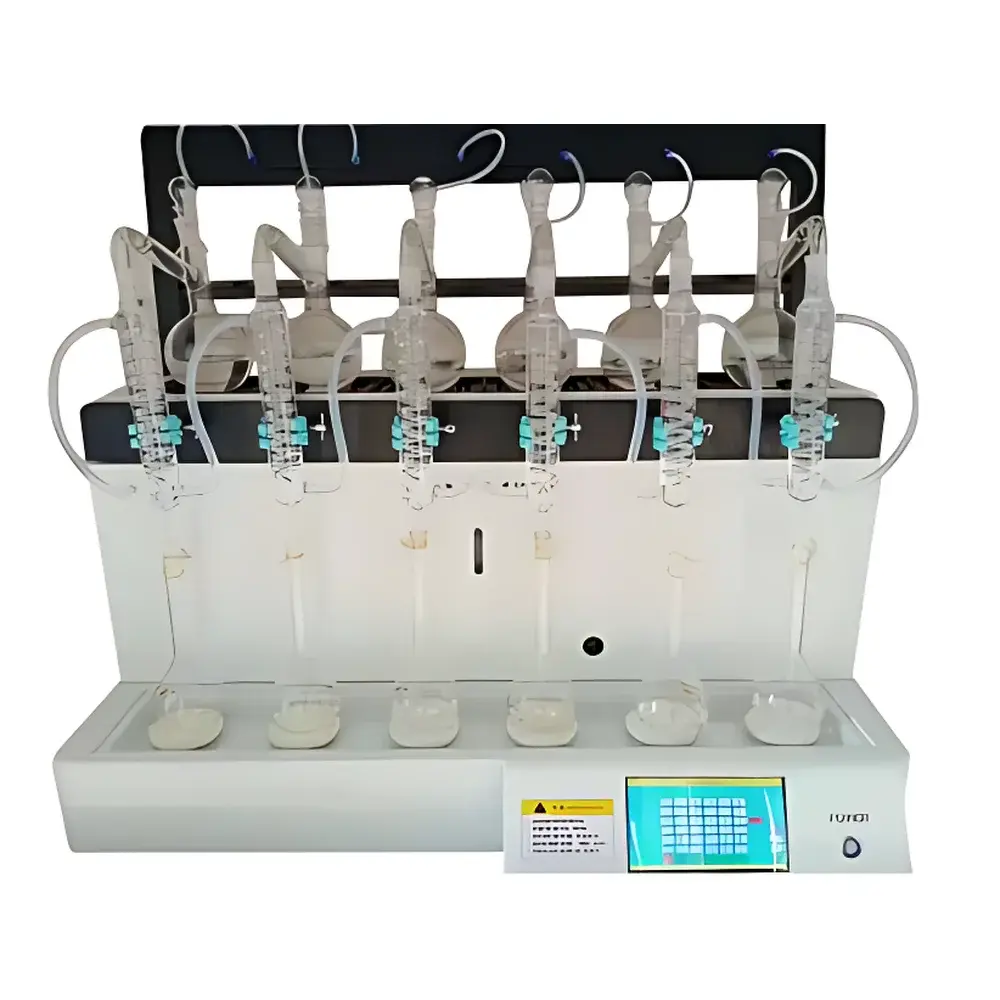
HEB-J06 Integrated Intelligent Sub-Boiling Distillation Apparatus
| Brand | Jihepu (Jinan Hopu) |
|---|---|
| Origin | Shandong, China |
| Manufacturer Type | Authorized Distributor |
| Country of Manufacture | China |
| Model | HEB-J06 |
| Instrument Type | Sub-Boiling Distillation Apparatus |
| Heating Method | Far-Infrared Ceramic Heater (Flame-Free, Waterproof) |
| Display | LCD Touchscreen Interface |
| Heating Units | 1–6 Independent Channels |
| Ramp Time | 5–8 min |
| Distillation Rate | 12 mL/min |
| Endpoint Control | Dual-Mode (Time + Mass), ±2 mL Precision |
| Max Power per Unit | 0–800 W (Adjustable) |
| Total Max Power | 0–4800 W (Adjustable) |
| Cooling System | Closed-Loop Internal Recirculation with Fan + Compressor Refrigeration |
| Anti-Suckback Protection | Solenoid Vacuum Valve |
| Timer Range | 0–200 min |
| Distillation Flask Capacity | 500 mL × 6 (Optional Configurations Available) |
| Receiving Flask Capacity | 250 mL × 6 (Optional Configurations Available) |
| Rated Voltage/Frequency | 220 V / 50 Hz |
Overview
The HEB-J06 Integrated Intelligent Sub-Boiling Distillation Apparatus is an engineered solution for standardized, high-reproducibility distillation pretreatment in analytical laboratories. Designed around sub-boiling (also known as low-temperature or vapor-phase) distillation principles, it operates below the boiling point of the target analyte—minimizing thermal decomposition and ensuring selective volatilization of compounds such as phenols, cyanides, ammonia nitrogen, Kjeldahl nitrogen, and moisture in oils. Unlike conventional boiling distillation, sub-boiling methodology reduces co-distillation of non-volatile interferences and improves analyte integrity, particularly critical for trace-level environmental and regulatory testing. The system integrates three core functional modules—precision temperature-controlled heating, real-time endpoint detection, and closed-loop active cooling—into a single compact chassis, eliminating external water supply dependencies and enhancing spatial efficiency in ISO/IEC 17025-compliant lab environments.
Key Features
- Fully independent control of up to six distillation channels, each equipped with a far-infrared ceramic heating element—ensuring uniform thermal distribution without open flame, spark risk, or water ingress vulnerability.
- Dual-mode endpoint detection: programmable time-based termination combined with real-time mass monitoring via integrated load cells; final volume accuracy maintained within ±2 mL across all channels.
- Closed-loop refrigeration system featuring a centrifugal fan and hermetic compressor—capable of maintaining stable coolant temperature (typically 5–10 °C) without external tap water or chiller connections.
- Automated anti-suckback protection activated via solenoid vacuum valve during pressure equalization, preventing backflow into distillate traps—essential for cyanide and volatile phenol analyses per EPA Method 4500-CN⁻ and ISO 6439.
- LCD touchscreen interface with intuitive workflow navigation, parameter logging, and user-accessible calibration menus compliant with GLP documentation requirements.
- Adjustable power output per channel (0–800 W) and total system power (0–4800 W), enabling method-specific optimization for low-energy sub-boiling protocols or accelerated distillation cycles.
Sample Compatibility & Compliance
The HEB-J06 supports standard volumetric glassware configurations—including 500 mL round-bottom distillation flasks and 250 mL receiving vessels—with optional adaptability for alternative sizes (e.g., 250 mL flasks or 100 mL receivers) via interchangeable support fixtures. It is validated for use in methods requiring strict recovery performance: certified laboratory intercomparisons demonstrate ≥95% average analyte recovery for phenol (ASTM D1783), cyanide (ISO 6703-1), and ammonia nitrogen (ISO 5664). The apparatus meets electrical safety standards IEC 61010-1 and is compatible with laboratory quality management systems adhering to ISO/IEC 17025:2017, USP , and EPA Contract Lab Program (CLP) reporting frameworks. All firmware logs—including start/stop timestamps, power profiles, and endpoint triggers—are timestamped and exportable for audit trails under FDA 21 CFR Part 11–aligned data integrity practices.
Software & Data Management
The embedded control firmware records operational metadata for each run: channel ID, setpoint temperature, actual power draw, elapsed time, detected endpoint volume, and system status flags (e.g., “coolant temp out of range”, “vacuum valve actuated”). Data export is supported via USB 2.0 port in CSV format, preserving column headers for direct import into LIMS or statistical analysis platforms (e.g., JMP, Minitab). No proprietary software installation is required; configuration and diagnostics are managed exclusively through the onboard interface. Audit trail functionality includes immutable event logging with operator ID tagging (via optional PIN login), supporting GLP/GMP-aligned record retention policies.
Applications
This apparatus is routinely deployed in environmental testing labs for preparation of samples prior to colorimetric, ion-selective electrode (ISE), or spectrophotometric quantification. Key applications include: determination of volatile phenols in wastewater per ISO 6439; total cyanide analysis following APHA Standard Methods 4500-CN⁻ B; ammonia nitrogen measurement in drinking water per ISO 5664; moisture content in lubricants and biofuels (ASTM D6304); and Kjeldahl nitrogen digestion intermediates where controlled distillate collection is required. Its modular architecture also accommodates method development workflows in academic research settings—particularly for optimizing distillation kinetics or evaluating matrix interference suppression.
FAQ
What distinguishes sub-boiling distillation from conventional boiling distillation?
Sub-boiling distillation maintains sample temperature below its atmospheric boiling point, relying on controlled vapor pressure differentials to drive selective analyte transfer—reducing degradation of thermally labile compounds and minimizing co-distillation of non-volatiles.
Is external cooling water required for operation?
No. The HEB-J06 employs an integrated closed-loop refrigeration circuit with compressor-assisted heat exchange, eliminating dependency on municipal water supply or auxiliary chillers.
Can individual heating units be operated independently?
Yes. Each of the six channels features isolated power regulation, temperature sensing, and endpoint logic—allowing heterogeneous sample batches (e.g., varying matrices or target analytes) to be processed simultaneously under distinct protocols.
How is data integrity ensured during long-duration runs?
All operational parameters are logged at 1-second intervals with hardware-timestamped entries. Power interruptions trigger automatic resume-from-checkpoint behavior upon restoration, preserving method continuity and audit compliance.
Does the system support third-party LIMS integration?
Data export is provided in vendor-neutral CSV format. While no native API is included, the structured output enables straightforward ingestion via LIMS middleware or custom ETL pipelines compliant with ASTM E1467 or ISO/IEC 17025 Annex A.3 requirements.



