
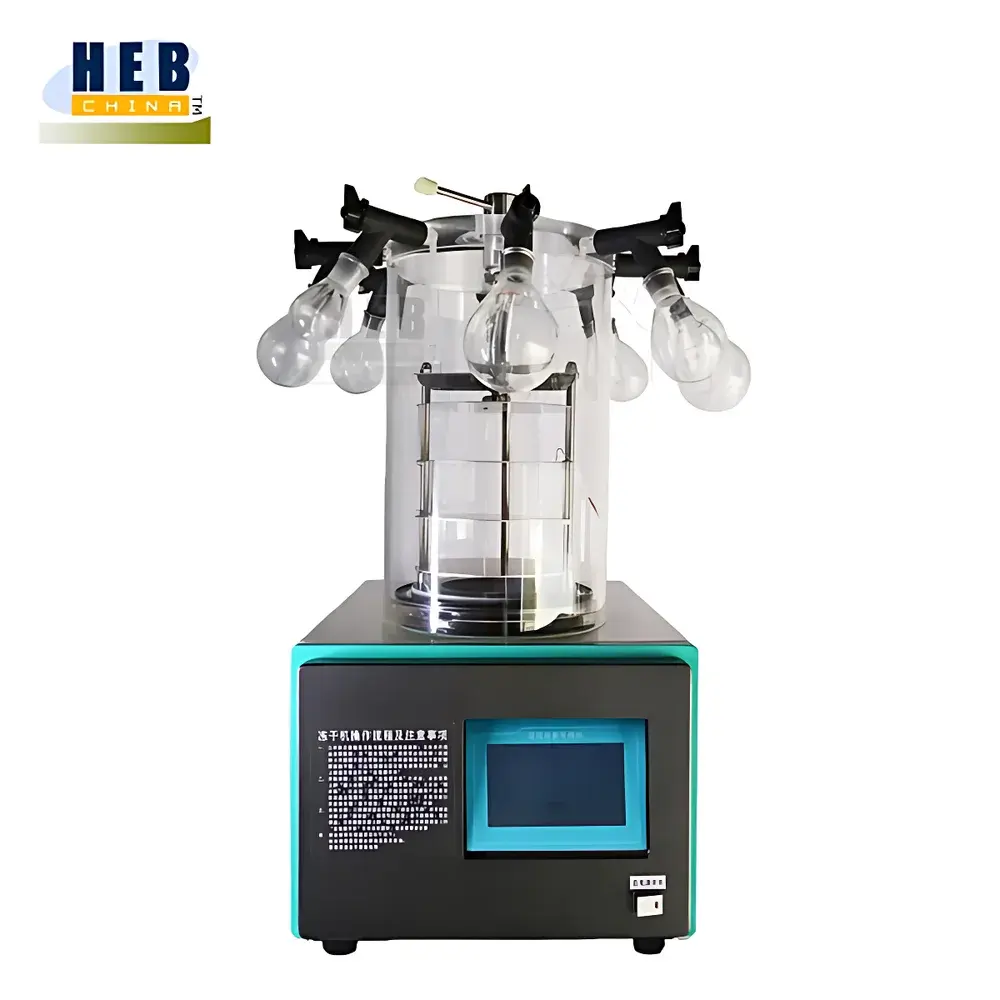
Hebei Jihepu ZLGJ-10 Stoppering Vacuum Freeze Dryer
| Brand | Jihepu (Jinan Hebei Jihepu) |
|---|---|
| Origin | Shandong, China |
| Type | Stoppering (Hydraulic or Manual Lid-Sealing) Benchtop Freeze Dryer |
| Application | Laboratory-Scale Lyophilization |
| Shelf Area | 0.08 m² |
| Ultimate Vacuum | ≤5 Pa (empty chamber) |
| Condenser Temperature | −55 °C (standard), optional −80 °C |
| Water Capture Capacity | 3–4 kg/24 h |
| Condenser Surface | Stainless Steel, No Internal Coils |
| Refrigeration | Air-Cooled |
| Pump Speed | 2 L/s |
| Power Input | 950 W |
| Dimensions (W×D×H) | 520 × 600 × 400 mm |
| Net Weight | 48 kg |
| Control System | 7″ Full-Color Industrial Touchscreen + SH-HPSC-II Modular Controller |
| Data Logging | Real-Time Curves for Condenser Temp., Chamber Pressure, and Sample Temp. (Exportable CSV) |
| Compliance | Designed for GLP Environments |
| Safety Features | Vacuum Pump Interlock (Start Delay Based on Condenser Temp.), Password-Protected User Levels, Sensor Calibration Traceability |
Overview
The Hebei Jihepu ZLGJ-10 Stoppering Vacuum Freeze Dryer is a compact, integrated benchtop lyophilization system engineered for reproducible, small-batch freeze-drying of heat-sensitive biologicals, pharmaceuticals, and research-grade samples under controlled vacuum and sub-zero conditions. It operates on the fundamental principle of sublimation—removing water from frozen samples by reducing ambient pressure below the triple point of ice while maintaining low condenser temperatures to trap liberated vapor. This unit is specifically configured with a stoppering mechanism (manual or hydraulic lid-sealing) that enables in-chamber vial capping post-drying, eliminating secondary exposure to moisture or contaminants during transfer. Its all-in-one architecture minimizes footprint and eliminates external refrigeration or vacuum line leakage points—critical for lab environments where space, reliability, and regulatory traceability are prioritized.
Key Features
- Monolithic stainless steel condenser chamber with large-diameter opening and coil-free design—enables uniform ice capture, simplifies cleaning, and supports direct pre-freezing of trays or flasks without auxiliary cryogenic equipment.
- Patented gas flow path optimization ensures laminar vapor migration from shelves to condenser surface, maximizing ice trapping efficiency and minimizing re-deposition on samples.
- High-efficiency air-cooled compressor (international brand) delivers stable −55 °C condenser temperature (−80 °C optional), with low acoustic emission (<62 dB(A)) and extended service life under continuous operation.
- Dual-stage vacuum system with 2 L/s rotary vane pump achieves ≤5 Pa ultimate vacuum in empty chamber; integrated vacuum pump interlock prevents pump startup until condenser reaches safe operating temperature (e.g., <−40 °C), extending oil life and reducing maintenance frequency.
- 7-inch industrial-grade capacitive touchscreen running SH-HPSC-II modular control firmware—supports PID-regulated shelf temperature (via external probe input), programmable multi-step drying cycles, and real-time deviation alarms.
- Comprehensive data integrity architecture: time-stamped logging of condenser temperature, chamber pressure, and optional sample thermocouple signals; encrypted CSV export compliant with basic 21 CFR Part 11 audit trail expectations (user ID, timestamp, parameter changes).
- Three-tier user access control (Operator / Technician / Administrator) with password protection and configurable permission sets for cycle execution, parameter editing, and calibration functions.
Sample Compatibility & Compliance
The ZLGJ-10 accommodates diverse primary containers: four φ180 mm stainless steel trays; eight standard Erlenmeyer flasks (100 mL ×2, 150 mL ×2, 250 mL ×2, 500 mL ×2); or up to 560 × 12 mm, 285 × 16 mm, or 165 × 22 mm serum vials per batch. All wetted surfaces—including condenser walls, shelf supports, and door gaskets—are constructed from electropolished 304 stainless steel or USP Class VI-certified elastomers, ensuring chemical resistance, non-reactivity, and cleanability per ISO 13485 and GLP Annex 11 guidance. The system meets mechanical safety requirements per IEC 61010-1 and electromagnetic compatibility per EN 61326-1. While not FDA-cleared as a medical device, its design aligns with foundational elements of pharmaceutical lyophilization process validation (e.g., consistent shelf temperature uniformity, pressure stability, and documentation fidelity).
Software & Data Management
The embedded SH-HPSC-II controller provides deterministic real-time cycle execution with millisecond-level timing resolution. Users define multi-phase protocols—including freezing ramp rates, hold durations at eutectic temperature, primary drying pressure setpoints, and secondary drying ramp profiles—with independent monitoring of up to three thermocouple inputs. All operational events—including alarm triggers, manual interventions, and parameter modifications—are logged with ISO 8601 timestamps and operator IDs. Exported CSV files retain full metadata (cycle ID, version number, instrument serial, firmware revision) and are compatible with common scientific analysis tools (MATLAB, Python pandas, Excel). Optional USB-to-PC synchronization enables long-term archival and QC review without proprietary software dependencies.
Applications
This freeze dryer serves laboratories engaged in formulation development of monoclonal antibodies, vaccines, and diagnostic reagents; preservation of microbial cultures and enzyme preparations; preparation of standards for analytical chemistry (e.g., LC-MS reference materials); and stabilization of nanomaterial dispersions or porous scaffolds for tissue engineering. Its stoppering capability is particularly valuable for aseptic processing simulations, stability studies requiring hermetic closure, and GMP-aligned pilot-scale feasibility testing where container closure integrity must be assured prior to storage.
FAQ
What types of samples can be processed in the ZLGJ-10?
Biological buffers, protein solutions, bacterial suspensions, PCR master mixes, and small-molecule APIs—provided they do not contain high concentrations of volatile solvents (e.g., acetone, chloroform) or strong acids/bases outside pH 3–11.
Is pre-freezing required before loading into the chamber?
No—integrated pre-freeze functionality allows direct freezing of loaded trays or flasks inside the condenser chamber, eliminating dependency on external ultra-low temperature freezers.
Can the system operate continuously for extended periods?
Yes—designed for unattended overnight runs; however, natural defrost mode requires manual initiation after each cycle, and condenser capacity limits maximum daily throughput to ~4 kg of ice.
Does the unit support validation documentation (IQ/OQ)?
Factory-provided test certificates cover electrical safety, vacuum integrity, and temperature uniformity verification; full IQ/OQ protocol templates and third-party qualification support are available upon request.
What maintenance intervals are recommended?
Vacuum pump oil replacement every 500 operating hours; condenser cleaning after every 10–15 batches; annual calibration of pressure transducer and temperature sensors using NIST-traceable references.



