
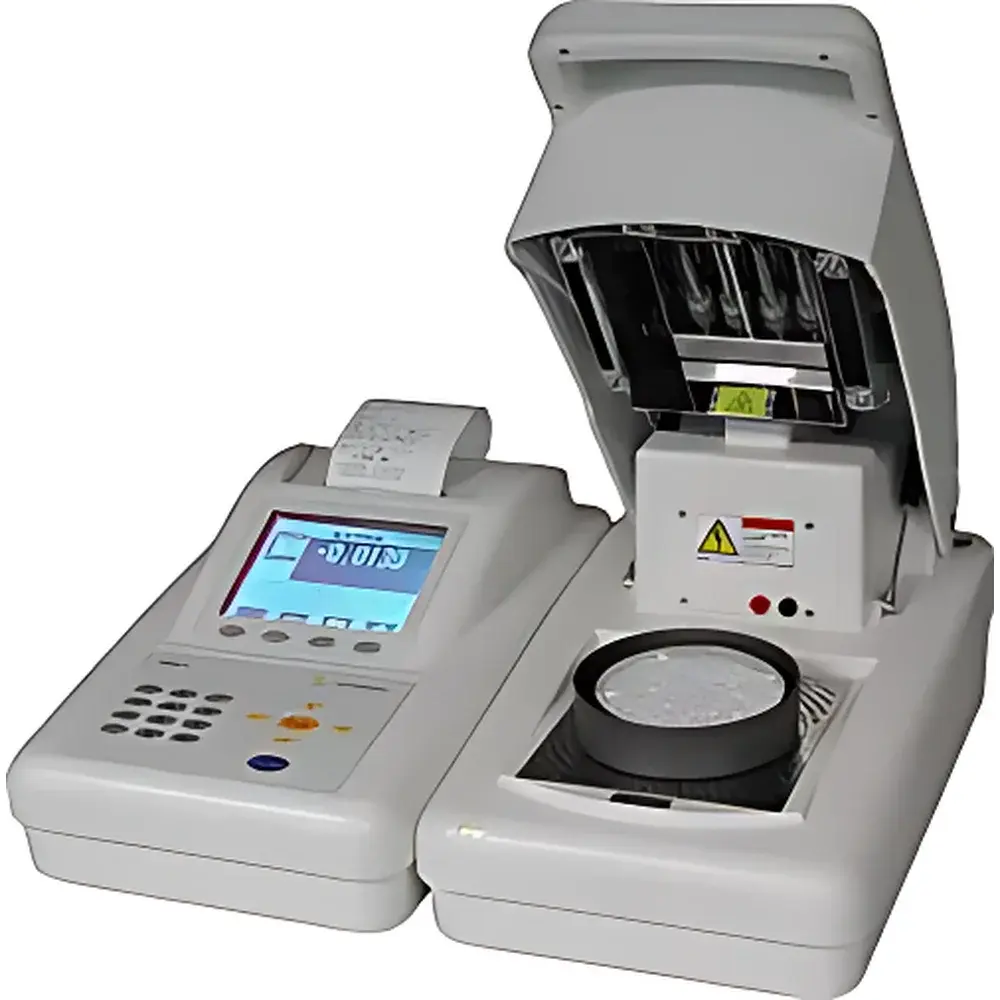
Sartorius LMA100P Mark 3 Moisture Analyzer
| Brand | Sartorius |
|---|---|
| Origin | Germany |
| Model | Mark 3 |
| Measurement Principle | Loss-on-Drying (LOD) |
| Heating Technology | Quartz Infrared |
| Max. Sample Capacity per Module | 100 g |
| Modular Architecture | Up to 4 Heating Modules Controlled by Single Control Unit |
| Compliance | ASTM D6980, ISO 15512, USP <921> |
| Data Output | Integrated Thermal Printer |
| User Access Control | Role-Based Module Assignment |
| Environmental Safety | Reagent-Free, No Hazardous Emissions |
| Typical Detection Limit | 50 ppm (for Polymeric Materials) |
Overview
The Sartorius LMA100P Mark 3 Moisture Analyzer is a modular, industrial-grade loss-on-drying (LOD) instrument engineered for high-throughput moisture determination in demanding production and quality control environments—particularly within polymer, plastic compounding, and injection molding facilities. Unlike volumetric or coulometric Karl Fischer titration systems, the LMA100P Mark 3 relies exclusively on thermogravimetric analysis: precise mass loss upon controlled infrared heating is measured in real time using a high-stability analytical balance integrated into each heating module. The system’s dual-module architecture—comprising independent heating and control units—enables scalable deployment: a single control unit can synchronize up to four infrared heating modules, allowing concurrent, parameter-independent analysis of up to four samples (identical or dissimilar). This design eliminates sequential bottlenecks without compromising measurement integrity, making it suitable for routine QC release testing, incoming raw material verification, and in-process moisture monitoring where trace-level sensitivity (<50 ppm) and method reproducibility are critical.
Key Features
- Quartz infrared heating technology ensures rapid, uniform thermal energy transfer—minimizing thermal gradients and reducing drying time versus conventional halogen or hotplate methods.
- Modular scalability: one control unit manages up to four heating modules, each programmable with independent temperature profiles, drying times, endpoint criteria (e.g., mass change rate ≤0.1 mg/min), and auto-shutdown logic.
- Role-based user access control: measurement parameters and module assignments are governed by password-protected user profiles stored in the instrument’s internal configuration table—supporting audit-ready GLP/GMP workflows.
- Integrated thermal printer provides immediate hard-copy documentation of weight curves, final moisture content (% w/w), drying time, peak temperature, and operator ID—fully compliant with 21 CFR Part 11 when paired with optional electronic signature software.
- Reagent-free operation eliminates consumable costs, hazardous waste disposal, and operator exposure risks associated with Karl Fischer reagents (e.g., sulfur dioxide, pyridine derivatives).
- ASTM D6980–validated performance for hygroscopic polymers including PET, PA6, PC, ABS, and PBT—demonstrating correlation with reference Karl Fischer results across moisture ranges from 50 ppm to 2.0%.
Sample Compatibility & Compliance
The LMA100P Mark 3 accommodates solid granules, pellets, flakes, and powders typical of thermoplastic resin supply chains. Its 100 g maximum sample capacity per module supports statistically representative sampling per ISO 15512 and ASTM D6980 Annex A requirements. The instrument meets essential regulatory expectations for pharmaceutical excipients (USP ), food-grade polymers (FDA 21 CFR 177), and automotive-grade engineering plastics (SAE J2022). All firmware and calibration routines adhere to ISO/IEC 17025 traceability standards; factory calibration certificates include uncertainty budgets referenced to NIST-traceable mass standards. Built-in diagnostics monitor heater stability, balance drift, and ambient humidity interference—logging events automatically for root-cause analysis during QA investigations.
Software & Data Management
Data export is supported via RS232 and USB interfaces to Sartorius’ optional LabX® software, enabling centralized method management, automated report generation (PDF/CSV), electronic signatures, and full audit trail functionality—including user action timestamps, parameter modifications, and raw weight-time datasets. All measurement records retain metadata: sample ID, operator, module serial number, environmental conditions (optional external sensor input), and version-controlled method name. When deployed in regulated environments, LabX facilitates compliance with FDA 21 CFR Part 11, EU Annex 11, and ISO 13485 requirements through configurable electronic signatures, role-based permissions, and immutable data archiving.
Applications
Primary use cases include pre-drying validation of hygroscopic resins prior to extrusion or injection molding; moisture specification verification of recycled polymer flake batches; QC release testing of masterbatches and additives; and stability studies tracking moisture uptake during packaging shelf-life trials. In manufacturing settings, the LMA100P Mark 3 reduces dependency on off-site Karl Fischer labs—cutting turnaround time from hours to minutes—and directly informs dryer setpoint optimization, thereby lowering energy consumption and minimizing thermal degradation of heat-sensitive polymers. Its robust IP54-rated enclosure and vibration-resistant mounting options support permanent installation adjacent to drying hoppers or feed lines.
FAQ
Does the LMA100P Mark 3 require daily recalibration?
No—factory calibration remains valid for 12 months under normal operating conditions; however, daily performance verification using certified reference weights (e.g., 10 g and 100 g Class E2) is recommended per ISO 17025 and internal SOPs.
Can it measure moisture in conductive or carbon-filled polymers?
Yes—the quartz infrared emitter operates at wavelengths that avoid interference from carbon black or metallic fillers; no arcing or uneven heating has been observed in validated test protocols for conductive PA6 and PEEK composites.
Is method transfer from Karl Fischer possible?
Yes—Sartorius provides ASTM D6980–aligned correlation protocols and application notes demonstrating R² >0.995 between LOD and coulometric KF results for 12+ common engineering resins.
What maintenance is required beyond routine cleaning?
Annual verification of heater spectral output and balance linearity by an authorized Sartorius service engineer is advised; no user-serviceable optical or electronic components exist within the sealed heating module.
How is data integrity ensured during power interruption?
All active measurements write to non-volatile memory every 2 seconds; recovery resumes from last saved state upon reboot—with no data loss—even during unexpected mains failure.
Related Products





