
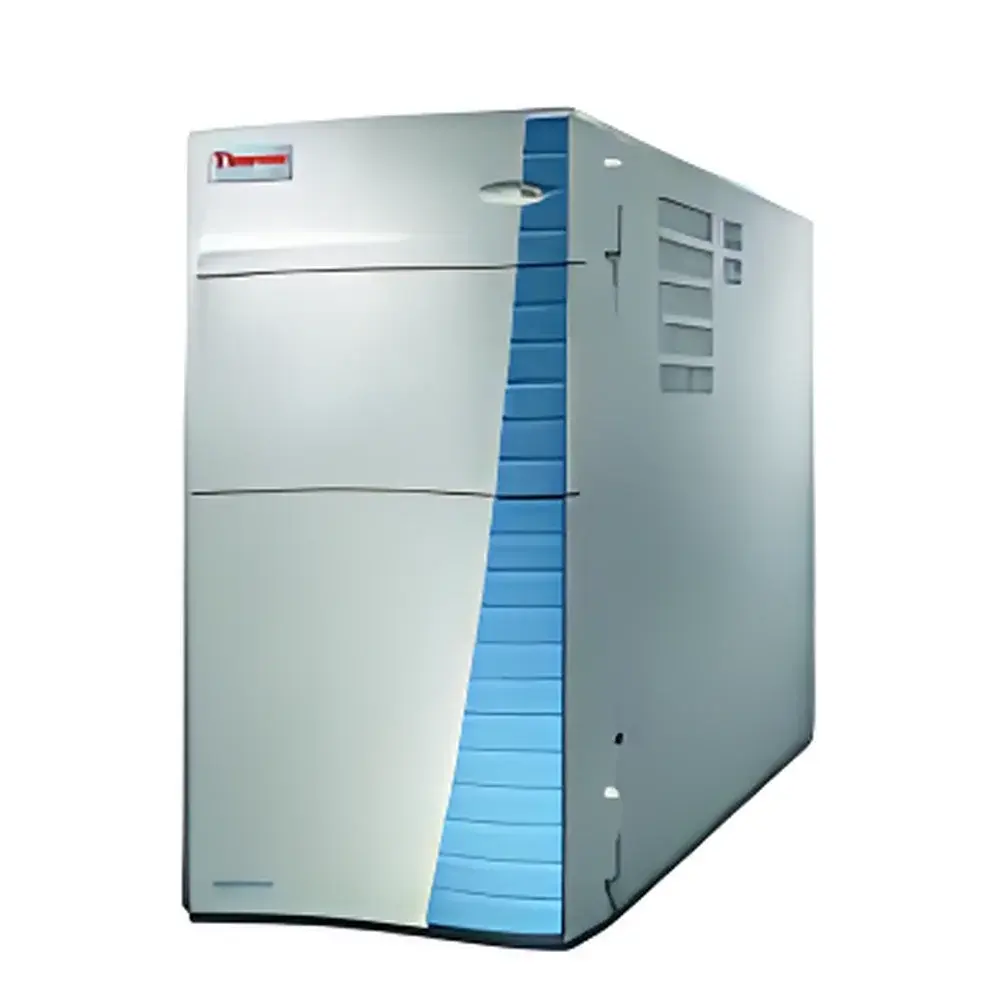
Thermo Fisher MSQ Plus Single Quadrupole Mass Spectrometer
| Brand | Thermo Fisher |
|---|---|
| Origin | Germany |
| Manufacturer Type | Original Equipment Manufacturer (OEM) |
| Origin Category | Imported |
| Model | MSQ Plus |
| Instrument Type | Single Quadrupole Mass Spectrometer |
| Mass Range | m/z 17–2000 |
| Ionization Sources | Electrospray Ionization (ESI) and Atmospheric Pressure Chemical Ionization (APCI) |
| ESI Flow Rate Range | 10 µL/min – 2 mL/min |
| APCI Flow Rate Range | 200 µL/min – 2 mL/min |
| Desolvation Gas Temperature | Ambient to 650 °C |
| Nebulizing Gas | Nitrogen, 12 L/min |
| Ion Source Geometry | M-Path™ Triple-Angle Ion Optics |
| Detector | Ion Bright™ Dual-Polarity Detector |
| Quadrupole Architecture | RF-Stabilized Mass Filter with Pre-Filter |
| Cone Material | Titanium Alloy |
| Cone Cleaning System | Patented Auto-Cleaning Mechanism |
| Compatibility | Salt-Containing Mobile Phases, Phosphate Buffers, Ion-Pair Reagents |
Overview
The Thermo Fisher MSQ Plus is a compact, high-sensitivity single quadrupole mass spectrometer engineered for robust integration with liquid chromatography (LC) and ion chromatography (IC) systems. Operating on the principle of mass-selective ion transmission through a radiofrequency (RF)-stabilized quadrupole mass filter, the MSQ Plus delivers precise unit-mass resolution across a broad mass range of m/z 17–2000. Its design prioritizes analytical reliability in demanding routine environments—particularly where samples contain high concentrations of salts, ion-pairing reagents, or complex biological matrices. Unlike conventional benchtop MS systems requiring frequent source maintenance or method re-optimization, the MSQ Plus achieves stable, unattended operation over extended acquisition cycles—enabling high-throughput laboratories to maintain consistent data quality without operator intervention.
Key Features
- M-Path™ Triple-Angle Ion Optics: A proprietary ion path geometry that eliminates neutral species and background chemical noise prior to mass analysis, significantly enhancing signal-to-noise ratio (S/N) for real-world samples.
- Patented Cone Cleaning System: Enables continuous operation with non-volatile mobile phases—including phosphate-buffered eluents—without cone clogging or performance degradation, extending operational uptime between maintenance intervals.
- Titanium Alloy Sampling Cone: Offers superior corrosion resistance against acidic, basic, and high-salt LC effluents, ensuring long-term mechanical integrity and reproducible ion transmission.
- Ion Bright™ Dual-Polarity Detector: Delivers optimized S/N for both positive- and negative-mode ions, supporting simultaneous polarity switching during a single LC run for comprehensive fragment characterization.
- Square RF Lens Assembly: Improves ion transmission efficiency from source to quadrupole, contributing to improved detection limits without increasing instrument footprint.
- Tool-Free Ion Source Access: Allows rapid source exchange or cleaning in under two minutes—minimizing instrument downtime and maximizing laboratory throughput.
- Integrated ESI/APCI Dual Ionization: No flow splitting required; seamless switching between electrospray and atmospheric pressure chemical ionization within a single analytical sequence.
Sample Compatibility & Compliance
The MSQ Plus is validated for use with a wide range of LC-compatible mobile phases, including aqueous buffers containing sodium phosphate, ammonium acetate, and trifluoroacetic acid. Its tolerance for ion-pair reagents and high-conductivity matrices makes it especially suitable for pharmaceutical impurity profiling, environmental residue screening, and food safety testing. The system complies with GLP and GMP documentation requirements when operated with Thermo Scientific Chromeleon Chromatography Data System (CDS), supporting full audit trails, electronic signatures, and 21 CFR Part 11 compliance configurations. All hardware components meet IEC 61010-1 safety standards and RoHS directives.
Software & Data Management
Controlled via Thermo Scientific Xcalibur software or Chromeleon CDS, the MSQ Plus supports automated calibration, method validation, and scheduled acquisition protocols. Built-in mass calibration routines utilize internal reference compounds to maintain long-term mass accuracy (<±0.2 Da). Data files are stored in open-format .RAW containers compatible with third-party processing tools (e.g., Compound Discoverer, Sieve, or OpenMS). Batch processing workflows support peak integration, library searching (NIST, Wiley), and quantitative reporting aligned with ISO/IEC 17025 and ASTM D7893-14 guidelines for LC-MS quantitation.
Applications
- Pharmaceutical quality control: Residual solvent analysis, extractables/leachables, and stability-indicating assays.
- Environmental monitoring: Pesticide multiresidue screening in water and soil extracts per EPA Method 1694.
- Clinical research: Targeted metabolite quantification in plasma, urine, and cerebrospinal fluid.
- Food and beverage safety: Mycotoxin detection, veterinary drug residues, and adulterant identification.
- Academic proteomics: Peptide mapping and post-translational modification screening in bottom-up workflows.
FAQ
Does the MSQ Plus support quantitative analysis under regulated conditions?
Yes—it is routinely deployed in GLP- and GMP-compliant laboratories when configured with validated Chromeleon CDS and appropriate system suitability protocols.
Can the instrument operate continuously with 10 mM phosphate buffer at pH 2.5?
Yes—the patented cone cleaning system and titanium alloy interface enable uninterrupted operation with such high-salt, low-pH mobile phases.
Is polarity switching possible during a single LC gradient run?
Yes—real-time polarity reversal and dynamic cone voltage adjustment are supported to maximize fragment ion coverage per injection.
What is the typical maintenance interval for the ion source under routine use?
With standard sample loads and proper mobile phase selection, source cleaning is typically required every 2–4 weeks; the tool-free design reduces cleaning time to under 120 seconds.
Does the system require external calibration gases or tuning compounds?
No—internal calibration is performed using built-in reference ions; external tuning is optional for method-specific optimization.





