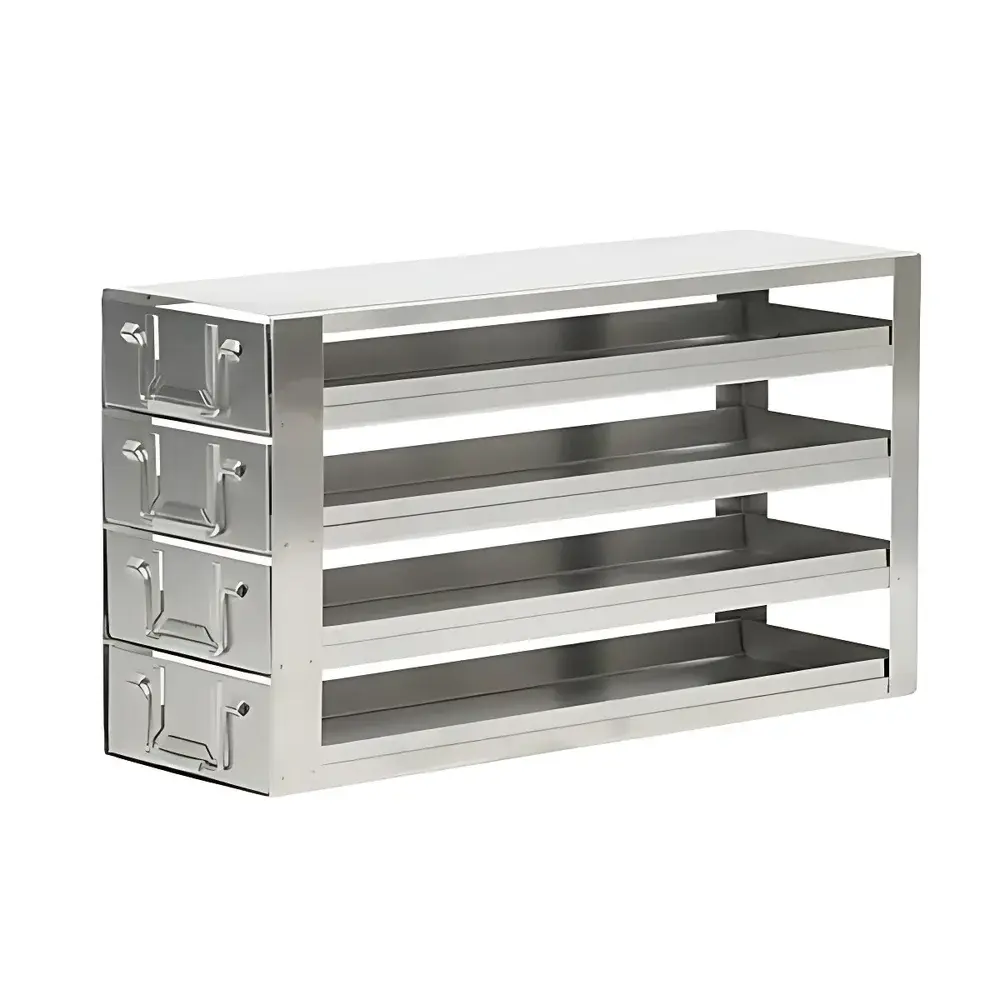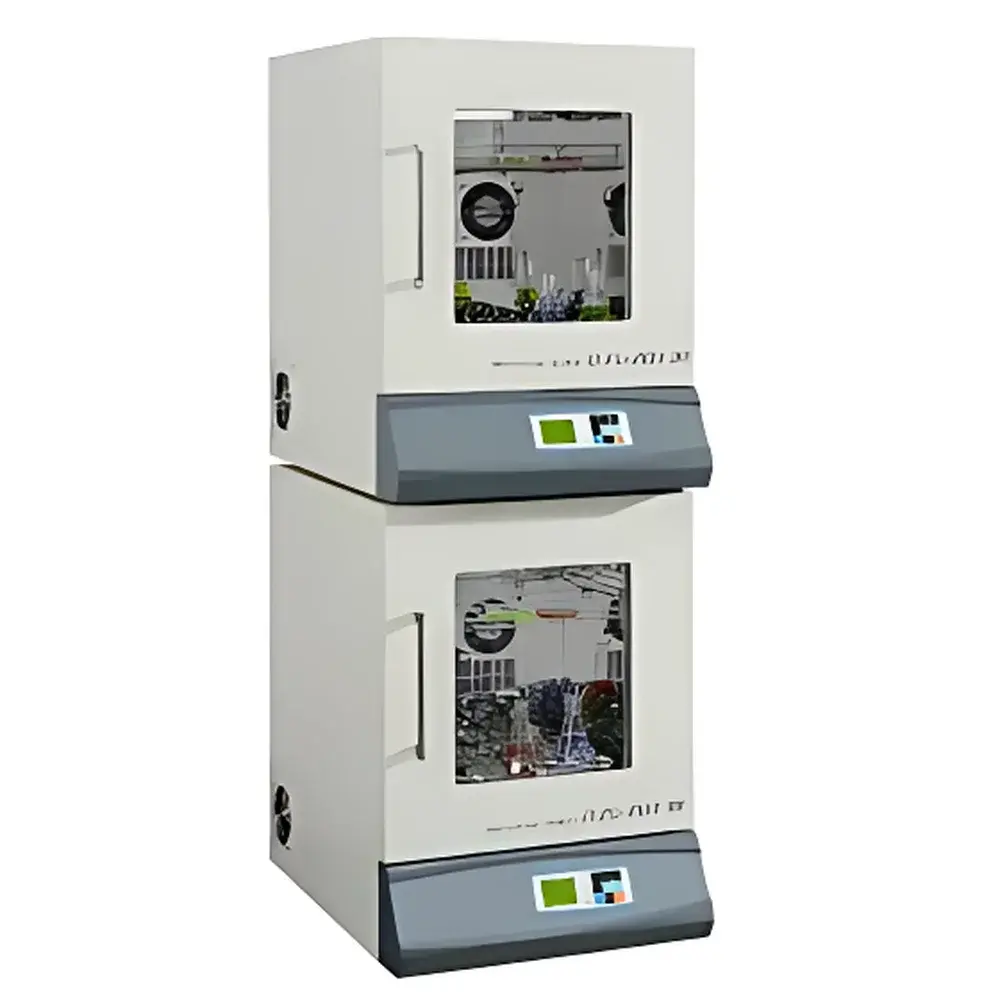
HePu DJS-2013 Stackable High-Capacity Vertical Incubated Orbital Shaker
| Brand | HePu (Jihepu) |
|---|---|
| Origin | Shandong, China |
| Model | DJS-2013 |
| Timer Range | 0–500 min |
| Oscillation Frequency | 50–300 rpm |
| Orbit Diameter | Φ25 mm |
| Temperature Range | Ambient +5°C to 60°C |
| Shelf Quantity | 1 |
| Platform Dimensions | 480 × 400 mm |
| Max Capacity | 4 × 5000 mL or 9 × 1000 mL or 9 × 500 mL or 16 × 250 mL |
| Temp. Uniformity | ±0.25°C |
| Temp. Accuracy | ±0.1°C |
| Rotation Accuracy | ±1 rpm |
| Power | 960 W |
| Voltage/Frequency | AC 200–240 V, 50–60 Hz |
| Chamber Material | Imported Stainless Steel Mirror Finish |
| Safety Certifications | Over-Temp/Over-Speed Alarms, Independent Thermal Cut-Off, Door-Interlock Stop, Leakage Protection, PID Microprocessor Control, Auto-Recovery After Power Failure |
Overview
The HePu DJS-2013 Stackable High-Capacity Vertical Incubated Orbital Shaker is an engineered platform for precise, reproducible, and scalable incubation-based agitation in life science laboratories. Designed around orbital motion with selectable reciprocating/rotational switching—enabled by a patented single-axis drive mechanism—the instrument delivers uniform mixing energy across large-volume cultures while maintaining tight thermal control. Its P.I.D.-regulated microprocessor controller continuously monitors chamber temperature and motor performance, ensuring stable operation within ±0.1°C accuracy and ±0.25°C uniformity across the entire stainless-steel interior (550 × 480 × 550 mm H). The system operates without refrigerant, relying on passive ambient heat dissipation and optimized airflow distribution, making it suitable for continuous use in standard lab environments (5–25°C ambient, 20–90% RH). As a vertically oriented stackable unit, the DJS-2013 supports modular laboratory expansion—multiple units may be safely stacked with structural reinforcement and independent ventilation pathways, minimizing floor space while preserving operational integrity.
Key Features
- Patented dual-mode oscillation: seamless switching between orbital and reciprocating motion via a single-axis mechanical drive—eliminating gear backlash and enhancing long-term rotational stability.
- Wide-speed range: digitally controlled frequency from 50 to 300 rpm with ±1 rpm repeatability; ramp-up acceleration profile prevents sample splashing and ensures cell viability during initiation.
- Intelligent safety architecture: independent over-temperature cutoff, door-interlocked motor shutdown, real-time current monitoring for leakage/overload protection, and dual-stage acoustic-optical alarms for upper/lower limits of temperature and speed.
- Memory-retentive PID controller: retains user-defined protocols—including timer settings, setpoints, and calibration offsets—across power cycles; auto-recovery resumes operation post-interruption without manual reconfiguration.
- Robust electromechanical design: brushless AC induction motor with constant-torque output across full speed range; rated for >20,000 hours MTBF under continuous duty at 300 rpm and 60°C.
- Ergonomic and compliant enclosure: ABS engineering polymer chassis with tempered curved glass viewport; stainless steel mirror-finish chamber meets ISO 14644-1 Class 7 cleanroom-compatible surface standards for ease of decontamination.
Sample Compatibility & Compliance
The DJS-2013 accommodates diverse vessel configurations on its 480 × 400 mm platform—including 4 × 5 L baffled flasks, 9 × 1 L Erlenmeyer flasks, or up to 16 × 250 mL culture bottles—enabling parallel processing for upstream bioprocessing, microbial fermentation, and recombinant protein expression workflows. Its temperature and agitation parameters align with common pharmacopeial methods (e.g., USP , EP 2.6.27) for dissolution testing and suspension homogenization. While not certified to IEC 61000-6-3 or UL 61010-1 out-of-the-box, the device incorporates design elements supporting GLP/GMP traceability: non-volatile parameter logging, time-stamped alarm records, and configurable audit trails when integrated with external LabVantage or Thermo Fisher SampleManager systems. It complies with RoHS Directive 2011/65/EU and REACH Annex XVII regarding restricted substances.
Software & Data Management
The DJS-2013 features embedded firmware with RS-232 and optional RS-485 interfaces for bidirectional communication with laboratory information management systems (LIMS). Through ASCII protocol commands, users can remotely query real-time temperature, RPM, elapsed time, and alarm status; initiate start/stop/pause sequences; and upload new setpoint profiles. All operational data—including deviation logs, thermal drift events, and motor current fluctuations—are timestamped and stored in internal flash memory (retains ≥10,000 entries). When connected to compliant enterprise software, the shaker supports 21 CFR Part 11-compliant electronic signatures via role-based access control and encrypted session handshakes—facilitating FDA-submission-ready documentation for QC/QA environments.
Applications
- Bacterial and yeast fermentation: optimization of OD600 growth kinetics under controlled aeration and thermal conditions.
- Mammalian cell suspension culture: maintenance of low-shear environments for CHO or HEK293 lines during transient transfection and harvest preparation.
- Nucleic acid and plasmid purification: consistent mixing during alkaline lysis, neutralization, and binding steps to maximize yield and minimize shearing.
- Immunoblotting workflows: uniform antibody incubation, washing, and blocking across multi-well membranes and gels.
- Environmental microbiology: enrichment of heterotrophic plate count (HPC) organisms from water samples per ISO 6222:2021 protocols.
- Enzyme kinetics assays: stabilization of reaction mixtures at defined temperatures during spectrophotometric monitoring of substrate conversion.
FAQ
Does the DJS-2013 support remote monitoring via Ethernet or Wi-Fi?
No—standard configuration includes only RS-232/RS-485 serial connectivity. Ethernet or wireless modules are available as OEM add-ons but require factory integration and firmware validation.
Can the shaker operate continuously at 60°C and 300 rpm for 72+ hours?
Yes—validated for uninterrupted operation under maximum load conditions; thermal management and motor cooling systems are rated for extended duty cycles per IEC 60068-2-2.
Is the stainless steel chamber electropolished or passivated?
The interior uses imported mirror-finish austenitic stainless steel (AISI 304), mechanically polished to Ra ≤ 0.4 µm and passivated per ASTM A967 for corrosion resistance and cleanability.
What is the maximum flask fill volume recommended for 5 L vessels at 250 rpm?
For optimal oxygen transfer and minimal foaming, fill volume should not exceed 30% of total capacity (i.e., ≤1.5 L per 5 L flask) when operating above 200 rpm.
Are calibration certificates traceable to NIST or equivalent national metrology institutes?
Factory calibration reports include uncertainty budgets referenced to ISO/IEC 17025-accredited secondary standards; NIST-traceable thermistor and tachometer calibrations are available upon request with additional lead time.