
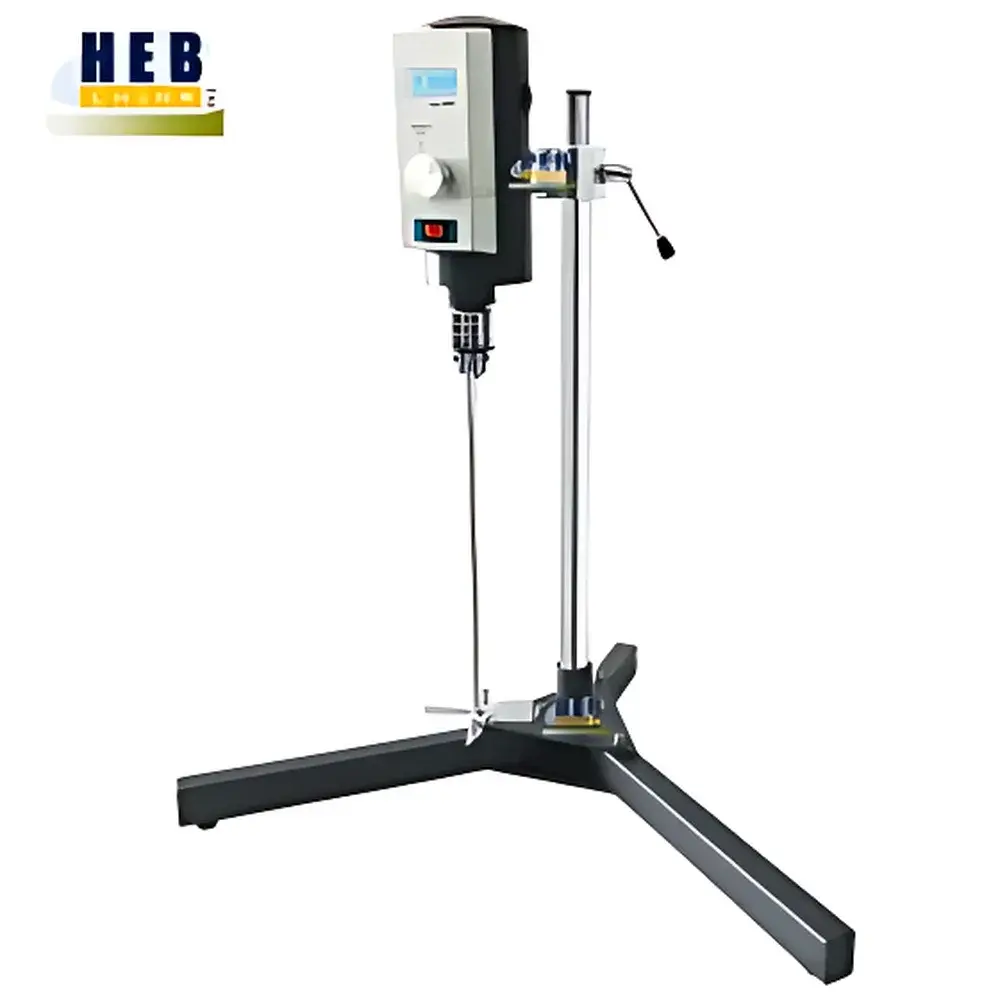
English Product Name
| Brand | HePu (Jihepu) |
|---|---|
| Origin | Shandong, China |
| Model | E60-H |
| Power Supply | 220 V / 50 Hz |
| Motor Power | 750 W |
| Speed Range | 100–1800 rpm |
| Max. Mixing Volume (Water) | 1–100 L |
| Torque | 290 N·cm |
| Display | 3-digit LED |
| Speed Control | Electronic stepless adjustment |
| Timer Function | Yes (memory-enabled) |
| Overheat Protection | Yes |
| Shaft Clamp Type | Chuck-type |
| Clamp Diameter Range | Ø0.3–10 mm |
| Wetted Materials | SUS304 (SUS316L optional) |
| Standard Impeller | Stainless steel paddle-type (1 pc, interchangeable) |
| Dimensions (W×D×H) | 660 × 450 × 760 mm |
| Net Weight | 10 kg |
| Housing Material | Die-cast aluminum |
Overview
The HePu E60-H High-Power Digital Display Laboratory Stirrer is an engineered solution for reproducible, scalable mixing and dispersion tasks in research and quality control laboratories. Designed around a robust Couette-flow principle—where rotational torque is transmitted from a motor-driven shaft to a submerged impeller—the E60-H delivers consistent shear input across a wide viscosity range (up to 10,000 cP), enabling reliable homogenization of low-to-medium-viscosity liquids. Its 750 W brushless motor provides stable torque output even under prolonged load, minimizing speed drift during extended operation—a critical requirement for kinetic studies, formulation development, and batch consistency validation. The device is purpose-built for laboratory-scale processes where volumes span 1–100 L, making it particularly suited for pilot-scale feasibility testing prior to scale-up in pharmaceutical, chemical, and materials science workflows.
Key Features
- Die-cast aluminum housing: Ensures structural rigidity, efficient thermal dissipation, and long-term mechanical stability under continuous operation.
- Electronic stepless speed control with memory function: Enables precise rpm selection within the 100–1800 rpm range; retains last-used setting after power cycle for workflow continuity.
- Integrated digital timer and start/stop control: Supports programmable run durations and on-demand activation without manual intervention—essential for unattended overnight mixing or standardized protocol execution.
- Three-digit LED display: Provides real-time, high-contrast rpm readout with ±2 rpm typical repeatability, facilitating documentation traceability in GLP-compliant environments.
- Reinforced Y-shaped support stand: Adjustable height configuration accommodates vessels up to 760 mm tall; includes dual-axis leveling feet for alignment stability on uneven surfaces.
- Overload and overtemperature protection circuitry: Automatically disengages motor drive if current draw exceeds safe threshold or internal temperature rises beyond 85 °C—preventing coil damage and ensuring operational safety.
Sample Compatibility & Compliance
The E60-H is compatible with aqueous, organic, and semi-aqueous systems including buffer solutions, polymer dispersions, emulsions, colloidal suspensions, and low-viscosity resins. Its SUS304 wetted components meet general corrosion resistance requirements for pH 2–12 environments; optional SUS316L shaft and impeller upgrades extend compatibility to chloride-containing media and mild oxidizing agents. While not certified to IEC 61000-6-3 or UL 61010-1 as a standalone unit, the stirrer conforms to fundamental electrical safety and EMC principles applicable to Class I laboratory equipment. It supports adherence to ASTM D2196 (viscosity measurement procedures), ISO 2557-2 (mixing performance evaluation), and internal SOPs requiring documented speed calibration and maintenance logs.
Software & Data Management
The E60-H operates as a standalone analog-digital hybrid instrument with no embedded firmware or network interface. All operational parameters—including setpoint rpm, elapsed time, and activation history—are manually recorded by the user. For regulated environments, its LED display output may be integrated into external data acquisition systems via optional analog voltage output modules (0–10 V proportional to rpm). Audit trails, electronic signatures, and 21 CFR Part 11 compliance are achieved only when paired with validated third-party LIMS or ELN platforms that capture timestamped operator inputs and system status flags. Routine calibration verification (e.g., using a handheld tachometer traceable to NIST standards) is recommended every six months or per internal QA schedule.
Applications
- Pharmaceutical: Dissolution testing of solid dosage forms, excipient blending, and buffer preparation for bioprocessing.
- Materials Science: Dispersion of nanomaterials (e.g., graphene oxide, TiO₂ nanoparticles) in solvent matrices prior to rheological or spectroscopic analysis.
- Chemical R&D: Emulsification of silicone oils, synthesis of polyurethane prepolymers, and catalyst suspension in heterogeneous reactions.
- Food & Cosmetics: Homogenization of emulsions (e.g., mayonnaise analogs, lotion bases) and hydration of hydrocolloids such as xanthan or carrageenan.
- Environmental Testing: Preparation of standard suspensions for turbidity calibration, slurry mixing in wastewater treatment simulations, and reagent blending for EPA Method 200.7 analyses.
FAQ
What is the maximum viscosity this stirrer can handle reliably?
The E60-H maintains rated torque output up to 10,000 cP at lower speeds (≤300 rpm); effective mixing efficiency declines above this threshold depending on impeller geometry and vessel aspect ratio.
Is the chuck compatible with non-standard shaft diameters?
The standard chuck accepts shafts from Ø0.3 mm to Ø10 mm; custom collet adapters (e.g., for Ø12 mm or hex-shaft impellers) are available upon request.
Can the timer function be disabled for continuous operation?
Yes—the timer defaults to “infinite” mode unless actively set; pressing the timer button toggles between timed and continuous modes.
Does the unit include calibration documentation?
No factory calibration certificate is supplied; users must perform initial speed verification using an external reference tachometer and retain records per internal quality system requirements.
What maintenance intervals are recommended?
Inspect carbon brushes annually (if applicable), clean dust from ventilation grilles quarterly, and verify chuck jaw integrity before each high-torque application.



