
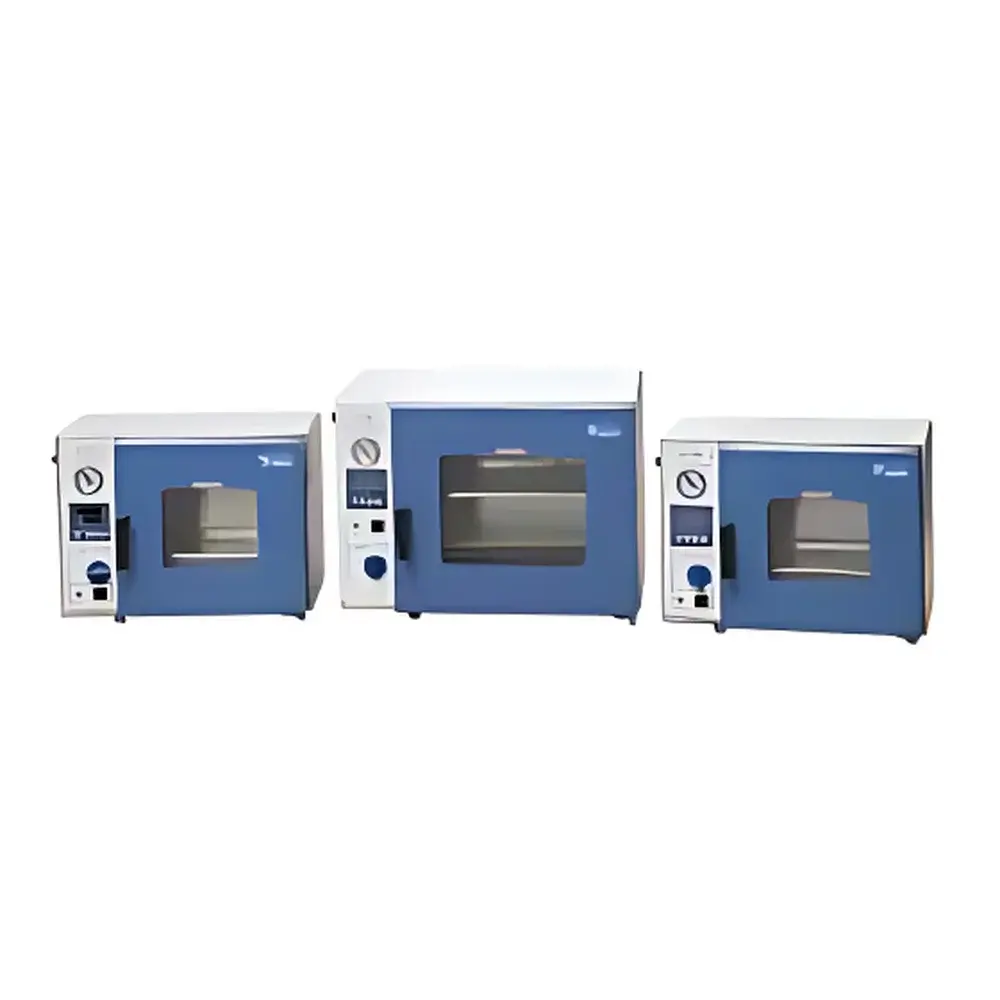
HePu DZF-6030B Vacuum Drying Oven
| [Brand | HePu (Jinan Hepu) |
|---|---|
| Origin | Shandong, China |
| Model | DZF-6030B |
| Type | Vacuum Drying Oven |
| Temperature Range | +5 °C to 65 °C |
| Temperature Uniformity | ±1 °C |
| External Dimensions | 630 × 510 × 490 mm |
| Internal Chamber Dimensions | 320 × 320 × 300 mm |
| Chamber Material | Stainless Steel or Galvanized Steel |
| Heating Method | Forced-Air Convection |
| Power Supply | 220 V, 50 Hz |
| Input Power | 450 W |
| Vacuum Level | <133 Pa (at ambient 20 °C, 50% RH, empty chamber) |
| Timer Range | 1–9999 minutes |
| Standard Shelf | 1 stainless steel tray] |
Overview
The HePu DZF-6030B Vacuum Drying Oven is an engineered solution for low-temperature, oxygen-sensitive drying applications where thermal degradation, oxidation, or decomposition must be rigorously avoided. Operating on the principle of reduced-pressure evaporation—where lowering the ambient pressure decreases the boiling point of solvents and moisture—the DZF-6030B enables gentle, uniform dehydration of thermolabile compounds without compromising structural integrity or chemical stability. Its optimized temperature range (+5 °C to 65 °C) and tight thermal control (±1 °C fluctuation) make it especially suitable for pharmaceutical intermediates, biological extracts, polymer precursors, and electronic components requiring residue-free, non-oxidative conditioning. Unlike conventional hot-air ovens, this vacuum system eliminates convective heat transfer limitations and minimizes surface hardening, ensuring consistent mass loss kinetics across heterogeneous samples.
Key Features
- Microprocessor-based digital temperature controller with programmable 10-segment ramp-soak profiles (D-series intelligent controller), supporting precise thermal scheduling for multi-stage drying protocols.
- Reinforced double-layer tempered glass door with integrated silicone gasket—fully adjustable compression mechanism ensures long-term vacuum integrity (<133 Pa) and visual monitoring without process interruption.
- Rectangular stainless steel or electrogalvanized inner chamber (320 × 320 × 300 mm) designed for maximum usable volume-to-footprint ratio; smooth, weld-free surfaces facilitate cleaning and reduce particle retention.
- Forced-air convection heating system with rear-mounted fan and symmetrically distributed air inlets—enhances temperature homogeneity and accelerates solvent removal under vacuum without localized overheating.
- Robust external housing with powder-coated cold-rolled steel construction; ergonomic door latch and reinforced hinges support daily laboratory use in regulated environments.
- Integrated timer with 1–9999 minute range and auto-shutdown function—enables unattended operation while maintaining compliance with GLP documentation requirements for time-stamped drying cycles.
Sample Compatibility & Compliance
The DZF-6030B accommodates a broad spectrum of sample formats—including Petri dishes, weighing boats, glass vials, aluminum pans, and custom trays—within its 30.7 L internal chamber. Its low-temperature capability supports drying of hygroscopic APIs, lyophilized excipients, botanical extracts (e.g., volatile oil-rich herbs), and moisture-sensitive catalysts. While not certified to ISO 17025 or ASTM E2018 as a standalone metrological instrument, the oven’s design aligns with common validation prerequisites for equipment used in GMP-compliant manufacturing (e.g., ICH Q5C, USP ). The absence of internal fans operating under full vacuum mitigates vibration-induced sample disturbance—a critical factor for crystalline or particulate materials. Optional inert gas purging (N₂ or Ar) via dedicated inlet port allows controlled atmosphere processing per ASTM D6984 guidelines for oxidative stability testing.
Software & Data Management
This model operates via embedded firmware without proprietary PC software. All operational parameters—including setpoint, actual chamber temperature, elapsed time, and cycle status—are displayed on a high-contrast LCD interface with 0.1 °C resolution. Real-time data logging is not natively supported; however, analog output (0–5 V or 4–20 mA) can be added via optional retrofit modules for integration into centralized SCADA or LIMS platforms. For audit-trail compliance (e.g., FDA 21 CFR Part 11), external USB data loggers with calibrated NIST-traceable sensors may be deployed alongside the unit. The controller retains last-used settings after power interruption, and password-protected parameter locking prevents unauthorized modification during routine QC workflows.
Applications
- Pharmaceutical R&D: Drying of heat-labile active ingredients prior to HPLC analysis or tablet formulation; residual solvent removal from coated granules.
- Biotechnology: Dehydration of enzyme preparations, vaccine adjuvants, and nucleic acid storage matrices without denaturation.
- Materials Science: Conditioning of MOFs, aerogels, and battery electrode slurries under inert vacuum to preserve porosity and electrochemical activity.
- Electronics Manufacturing: Moisture evacuation from PCB assemblies and encapsulated semiconductors prior to hermetic sealing.
- Academic Research: Solvent exchange in hydrogel synthesis, vacuum-assisted gelation, and low-temperature polymer crosslinking studies.
FAQ
Does the DZF-6030B include a vacuum pump?
No—the unit requires an externally connected vacuum pump (e.g., two-stage rotary vane or diaphragm type). A compatible pump must achieve ≤133 Pa base pressure and include an oil mist filter for clean chamber evacuation.
Can the chamber temperature be validated per IQ/OQ protocols?
Yes—its uniformity and stability meet typical qualification criteria for Class II laboratory ovens. Users should perform sensor mapping using calibrated PT100 probes at ≥9 locations per ISO 14644-3 Annex B.
Is the stainless steel chamber electropolished or passivated?
Standard configuration uses AISI 304-grade stainless steel with brushed finish; electropolishing is available as a factory option upon request.
What maintenance intervals are recommended for long-term vacuum integrity?
Silicone door gasket inspection every 6 months; vacuum gauge calibration annually; chamber interior cleaning with ethanol or isopropanol after each use involving organic solvents.
Can the DZF-6030B operate continuously for >72 hours?
Yes—designed for extended duty cycles under load. Continuous operation requires stable mains voltage (±5%), ambient temperature ≤35 °C, and adequate ventilation around rear exhaust grilles.



