
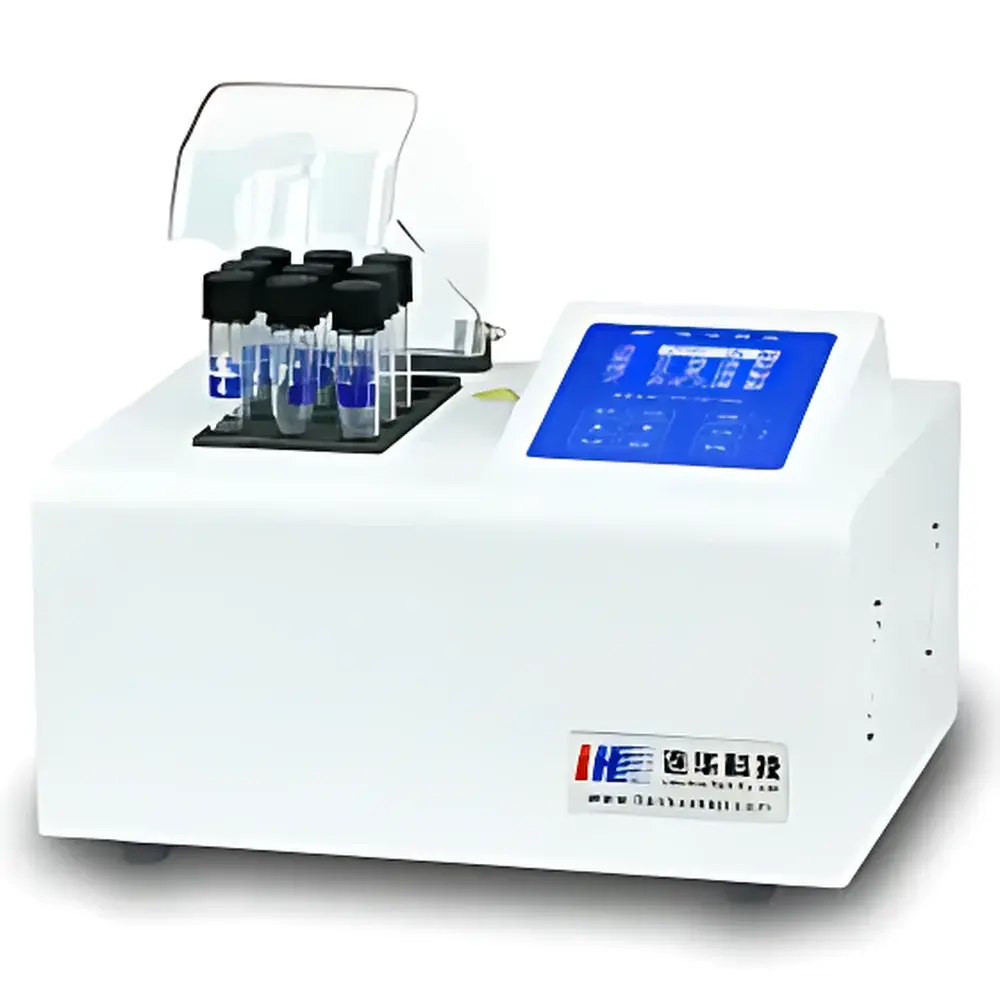
Jihepu 5B-1(V8) Smart COD Digestion Block
| Brand | Jihepu |
|---|---|
| Origin | Shandong, China |
| Model | 5B-1(V8) |
| Digestion Method | Rapid Digestion |
| Heating Modules | Dual Independent Heating Blocks |
| Batch Capacity | 15 Samples |
| Temperature Range | Ambient to 190 °C |
| Temperature Accuracy | ±0.5 °C |
| Sample Volume Capacity | 0–10 mL |
| Timer Accuracy | ±0.2 s/h |
| Pre-stored Digestion Programs | COD, Total Phosphorus, Total Nitrogen |
| Tube Compatibility | Φ16 mm or Φ20 mm (interchangeable) |
| Maximum Tube Height | 150 mm |
| Heating Depth | 80 mm |
| Safety Shield | Integrated Transparent Heat-Resistant Splash Guard |
| Delayed Auto-Shutoff | Yes |
| Intelligent Start-on-Temp | Yes |
| Digital Well Labeling | Yes |
| Display | Backlit LCD with Chinese Interface |
| Keypad | 9-key Membrane Panel |
| Compliance | Designed for ASTM D1252, ISO 6060, and HJ 828–2017 (China EPA) |
Overview
The Jihepu 5B-1(V8) Smart COD Digestion Block is a precision-engineered thermal digestion system designed for standardized chemical oxygen demand (COD), total phosphorus (TP), and total nitrogen (TN) analysis in environmental water quality laboratories. It operates on the principle of controlled high-temperature acid digestion—typically using potassium dichromate (for COD) or persulfate (for TP/TN) under acidic conditions—to oxidize organic and inorganic reductants in aqueous samples. The instrument employs dual independent heating blocks with PID-controlled thermal regulation, enabling consistent, reproducible heating profiles across all 15 digestion wells. Its design conforms to key international and national digestion protocols—including ASTM D1252 (Methods A & B), ISO 6060 (COD determination), and China’s HJ 828–2017 standard—ensuring methodological alignment for regulatory reporting and inter-laboratory comparability.
Key Features
- Dual-zone thermal architecture: Two independently controlled heating blocks allow parallel digestion of heterogeneous sample sets—e.g., COD and TP batches at different target temperatures—without cross-contamination or thermal interference.
- Intelligent temperature-triggered timing: Automatically initiates the digestion timer only upon reaching the user-defined setpoint (e.g., 165 °C for COD), eliminating manual intervention and reducing operator-induced variability.
- Integrated safety enclosure: A fully transparent, borosilicate-reinforced heat-resistant shield provides real-time visual monitoring while containing potential splashes during vigorous reflux, meeting IEC 61010-1 requirements for laboratory electrical equipment safety.
- Ergonomic human interface: Backlit 128×64-pixel LCD with native Chinese menu navigation, 9-key tactile keypad, and well-specific numeric labeling (1–15) simplify operation for routine QC personnel and field technicians alike.
- Energy-optimized thermal management: Programmable delayed auto-shutoff (up to 99 hours) and auto-power cutoff at timer completion minimize standby energy consumption and mitigate overheating risks during unattended operation.
- Modular tube compatibility: Interchangeable well inserts support both Φ16 mm and Φ20 mm digestion tubes (standard 10–15 mL capacity), accommodating legacy glassware and newer low-volume disposable vials per USP or EPA Method 365.4 guidelines.
Sample Compatibility & Compliance
The 5B-1(V8) is validated for use with common digestion chemistries employed in municipal wastewater, surface water, industrial effluent, and drinking water source monitoring. It supports open-reflux (HJ 828–2017), sealed-tube (ISO 6060), and microwave-compatible pre-digestion workflows. All thermal profiles are traceable to NIST-traceable RTDs calibrated at three points (ambient, 100 °C, 165 °C). The system meets GLP documentation prerequisites for audit readiness: timer logs, temperature setpoints, and run durations are retained in non-volatile memory for ≥500 cycles. While not FDA 21 CFR Part 11-compliant out-of-the-box, its deterministic timer logic and immutable parameter logging support validation under ISO/IEC 17025:2017 Clause 7.8.2 (data integrity).
Software & Data Management
This standalone digestion block does not include embedded PC connectivity or cloud-based data export. However, its deterministic timer accuracy (±0.2 s/h) and persistent parameter storage enable full integration into LIMS environments via external barcode-scanned run sheets or manual logbook entry. Pre-programmed methods for COD (165 °C/120 min), TP (120 °C/30 min), and TN (105 °C/60 min) comply with method-specific ramp-and-hold profiles defined in HJ 828–2017, GB 11893–89, and HJ 636–2012. Calibration certificates (temperature uniformity across wells: ≤±1.0 °C at 165 °C) are provided with each unit.
Applications
- Routine COD analysis in wastewater treatment plant (WWTP) influent/effluent monitoring per China’s GB 18918–2002 discharge limits.
- Total phosphorus quantification in eutrophication studies of lakes and reservoirs using ascorbic acid/molybdate colorimetry (GB 11893–89).
- Total nitrogen digestion prior to UV–Vis or chemiluminescent detection (HJ 636–2012).
- Method development and validation labs requiring precise, repeatable thermal conditioning of aqueous matrices prior to spectrophotometric or ICP-MS analysis.
- Environmental education and vocational training where robustness, safety, and intuitive operation are prioritized over automation.
FAQ
Does the 5B-1(V8) support USB or RS232 data export?
No. It is a stand-alone thermal controller without digital communication interfaces. Data must be recorded manually or via external time-stamped lab notebooks.
Can the heating blocks operate at different temperatures simultaneously?
Yes—the dual-block architecture allows independent setpoint configuration (e.g., Block A at 165 °C for COD, Block B at 120 °C for TP), provided both remain within the ambient-to-190 °C range.
Is calibration traceable to national standards?
Yes. Each unit ships with a factory calibration report referencing NIST-traceable reference thermometers, verified at three temperature points per block.
What maintenance is required for long-term accuracy?
Annual verification of temperature uniformity across all 15 wells using a calibrated immersion probe is recommended. No consumable parts require replacement under normal use.
Does it meet ISO/IEC 17025 requirements for accredited testing?
When operated within documented SOPs—including daily temperature uniformity checks and logged run parameters—it satisfies Clause 7.8.2 (equipment suitability) and Clause 7.7.1 (environmental condition control) for digestion instrumentation.
Related Products







