
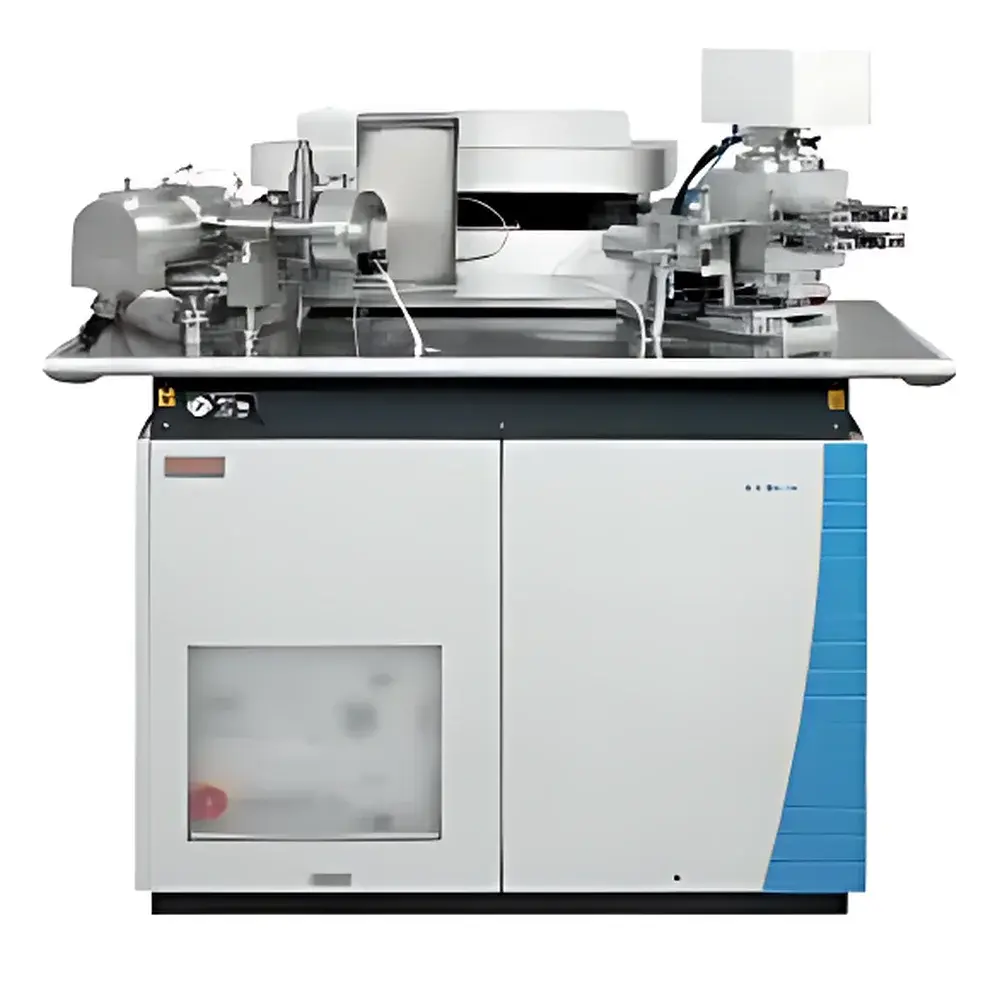
Thermo Scientific HELIX MC Plus Multi-Collector Noble Gas Mass Spectrometer
| Brand | Thermo Fisher |
|---|---|
| Origin | Germany |
| Manufacturer | Thermo Fisher Scientific |
| Instrument Type | Multi-Collector Static Vacuum Noble Gas Isotope Ratio Mass Spectrometer |
| Model | HELIX MC Plus |
| Isotopes Measured | Ne, Ar, Kr, Xe (up to 5 simultaneously) |
| Mass Range | Full noble gas isotopic range (1–132 amu) |
| Resolution | >750 (10% valley, standard receivers), >1,500 (10% valley, high-resolution receivers) |
| Detector Configuration | Faraday cups + CCD multi-collector array with configurable amplifier gains (10¹⁰ Ω, 10¹¹ Ω, 10¹² Ω, 10¹³ Ω) |
| Dynamic Range | >12 orders of magnitude (Faraday + CCD hybrid detection) |
| Application Focus | High-precision noble gas isotope ratio analysis in geochronology, cosmochemistry, nuclear forensics, and mantle geochemistry |
Overview
The Thermo Scientific HELIX MC Plus is a high-resolution, multi-collector static vacuum noble gas mass spectrometer engineered for ultra-precise isotope ratio measurements of neon, argon, krypton, and xenon. Built upon over two decades of dedicated noble gas MS development at Thermo Fisher Scientific’s facility in Bremen, Germany, the HELIX MC Plus implements magnetic sector mass analysis coupled with a fully static ultra-high vacuum (UHV) ion optical system. Its core architecture enables simultaneous detection of up to five noble gas isotopes without peak jumping—eliminating time-dependent instrumental drift and maximizing internal precision. The instrument operates under <1×10⁻¹⁰ mbar base pressure, minimizing background contributions and ensuring exceptional signal-to-noise ratios for sub-picomole sample quantities. Designed specifically for applications requiring radiogenic and nucleogenic isotope systematics (e.g., ⁴⁰Ar/³⁹Ar, ²¹Ne/²⁰Ne, ¹²⁹Xe/¹³⁰Xe), it supports rigorous metrological traceability in compliance with ISO/IEC 17025 requirements for calibration and measurement uncertainty evaluation.
Key Features
- Simultaneous 5-isotope multi-collection: Configurable Faraday cup and CCD detector array allows concurrent measurement of Ne, Ar, Kr, or Xe isotopes—enabling full interference correction and internal normalization without temporal interpolation.
- High mass resolution capability: Dual-resolution receiver options: standard receivers deliver >750 resolution (10% valley) for routine interference separation (e.g., ⁴⁰Ar⁺ vs. ⁴⁰CaH⁺); high-resolution receivers exceed 1,500 resolution to resolve critical isobaric overlaps such as ⁸⁶Kr⁺/⁸⁶Rb⁺ and ¹²⁹Xe⁺/¹²⁹I⁺.
- Extended dynamic range detection: Integrated Faraday cup amplifiers with selectable feedback resistors (10¹⁰ Ω to 10¹³ Ω) provide linear response across 12 orders of magnitude—supporting both low-abundance cosmogenic nuclides and high-concentration crustal gases on the same run.
- Helium-compatible peak-jumping mode: Dedicated high-sensitivity electron multiplier channel enables rapid, high-precision ³He/⁴He and ²¹Ne/²²Ne analyses with real-time baseline subtraction and dead-time correction.
- UHV-compatible sample introduction: Integrated all-metal, bakeable inlet system with cryo-trapping and getter-pumped purification stages ensures quantitative noble gas extraction from mineral separates, meteorites, or reactor coolant samples.
- Modular magnet and ion optics: Permanent-magnet-stabilized 90° double-focusing geometry minimizes hysteresis and improves long-term mass stability—critical for multi-day geochronological dating sequences.
Sample Compatibility & Compliance
The HELIX MC Plus interfaces with industry-standard extraction lines (e.g., Thermo’s HELIX MC Extraction System or third-party UHV-compatible setups) for solid, fluid, and gaseous samples. It routinely analyzes laser-heated step-heating fractions from single-crystal sanidine, fusion-derived noble gases from iron meteorites, and dissolved gases from deep-ocean basalts. All hardware and firmware comply with IEC 61000-6-2/6-4 electromagnetic compatibility standards. Data acquisition and processing adhere to GLP principles, with full audit trail support for 21 CFR Part 11-compliant electronic records when deployed with Thermo Scientific Qtegra ISM software. Instrument performance verification follows ASTM D7789 (Standard Guide for Isotopic Analysis of Noble Gases) and ISO 17025-accredited calibration protocols using NIST SRM 1400 (Ar), IRMM-017 (Kr), and ETH-He-1 (He).
Software & Data Management
Controlled via Thermo Scientific Qtegra ISM v3.5+, the HELIX MC Plus supports method-driven acquisition with automated tuning, mass calibration, and intensity normalization routines. Real-time isotope ratio calculation includes offline interference correction matrices (e.g., ³⁶Ar–³⁷Ar–³⁸Ar for ⁴⁰Ar* quantification), mass fractionation modeling (exponential or power law), and error propagation per ISO/IEC Guide 98-3. Raw data files (.raw) are stored in vendor-neutral HDF5 format with embedded metadata (sample ID, extraction temperature, beam intensity, integration time). Export modules generate compliant .csv outputs for integration into IsoplotR, Squid2, or custom Python-based geochronology pipelines. Secure user authentication, role-based access control, and encrypted database logging ensure regulatory readiness for GMP or nuclear safeguards environments.
Applications
- Geochronology: High-precision ⁴⁰Ar/³⁹Ar dating of volcanic minerals with <±0.1% (2σ) external reproducibility; ³⁹Ar–⁴⁰Ar plateau and isochron analysis with full covariance handling.
- Cosmochemistry: Quantification of spallation-produced ²¹Ne, ²²Ne, and ³⁸Ar in extraterrestrial materials; exposure age modeling of lunar regolith and chondritic meteorites.
- Mantle geochemistry: Measurement of ³He/⁴He gradients across mid-ocean ridge basalts; identification of primordial versus radiogenic helium components in plume-derived lavas.
- Nuclear forensics: Isotopic fingerprinting of xenon fission products (¹³¹Xe, ¹³²Xe, ¹³⁴Xe, ¹³⁶Xe) from atmospheric sampling networks with detection limits below 10⁻¹⁸ mol.
- Environmental tracing: Krypton-85 monitoring in groundwater systems; dual-isotope (⁸¹Kr/⁸⁵Kr) dating of paleogroundwater up to 1.5 Ma.
FAQ
What vacuum level does the HELIX MC Plus maintain during analysis?
The instrument achieves and sustains a base pressure of ≤5×10⁻¹¹ mbar in the source and analyzer regions, verified by calibrated Bayard-Alpert and cold cathode gauges.
Can the system measure helium isotopes with the same precision as argon?
Yes—using the dedicated electron multiplier channel and optimized ion optics, ³He/⁴He ratios are measured with external reproducibility of ±0.2% (2σ) on 10¹² atoms of ⁴He.
Is remote diagnostics supported?
Yes—Qtegra ISM includes secure TLS-encrypted remote access for preventive maintenance alerts, spectral diagnostics, and firmware updates under ITAR-controlled deployment conditions.
How is mass calibration performed?
Automated calibration uses internal reference gases (Ar, Ne, Kr) introduced via the UHV leak valve; daily calibration drift is monitored against NIST-traceable standards with <0.0005 amu long-term stability.
Does the system support custom detector configurations?
Yes—users may configure Faraday cup positions and CCD pixel mapping via Qtegra’s hardware abstraction layer, enabling application-specific multi-collection geometries for novel isotope systems.




