
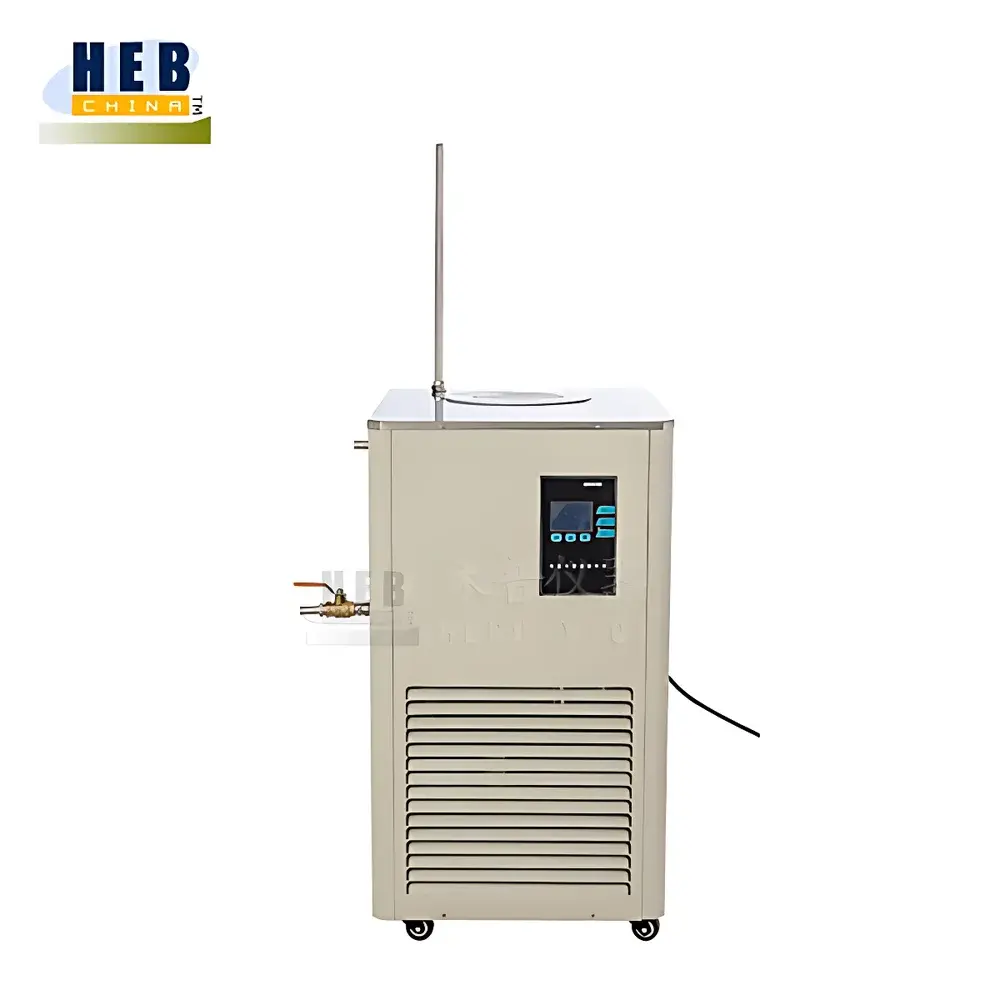
Hebei Jihepu DLSB-10/10 Low-Temperature Circulating Chiller
| Brand | Jihepu (Jinan Hebei Jihepu Instrument Co., Ltd.) |
|---|---|
| Model | DLSB-10/10 |
| Temperature Range | −10 °C to Ambient |
| Power Supply | 220 V AC, 50 Hz |
| Cooling Capacity | 2324 W |
| Compressor Power | 735 W |
| Circulation Pump Flow Rate | 20–40 L/min |
| Max. Head | 6 m |
| Pressure Limit | ≤0.4 MPa |
| Reservoir Volume | ~14 L |
| Control Accuracy | ±0.1 °C |
| Sensor Type | PT100 |
| Display | LCD with Keypad Interface |
| Safety Protections | Delay Start, Overcurrent, Overtemperature |
| Refrigerant | R22 |
| Condenser | Air-Cooled, 90 W, 6.9 m² Heat Exchange Area, 1030 m³/h Airflow |
| Construction | Powder-Coated Cold-Rolled Steel |
| Net Weight | 58 kg |
| Dimensions (W×D×H) | 490×570×730 mm (+500 mm Vertical Rod) |
| External Port | Φ16 mm Barb Fitting (Left Side) |
Overview
The Hebei Jihepu DLSB-10/10 Low-Temperature Circulating Chiller is a compact, air-cooled refrigeration system engineered for precise thermal management in laboratory-scale chemical synthesis, rotary evaporation, and condensation applications. It operates on a closed-cycle vapor-compression principle using R22 refrigerant, circulating chilled fluid through an internal copper coil embedded in the stainless-steel-lined reservoir. The unit integrates a hermetically sealed 1 HP compressor, high-efficiency finned-tube air-cooled condenser (6.9 m² surface area, 1030 m³/h airflow), and a robust centrifugal circulation pump capable of delivering 20–40 L/min at up to 6 m head pressure. With a stable operating range from −10 °C to ambient temperature (5–35 °C ambient, ≤70% RH), it maintains ±0.1 °C temperature stability via PID-controlled feedback from a calibrated PT100 resistance thermometer. Its design prioritizes reliability under continuous duty cycles common in QC labs, pilot reactors, and university teaching laboratories.
Key Features
- Integrated dual-function architecture: simultaneous cooling of external jacketed vessels (e.g., double-layer reactors) and internal bath immersion applications
- LCD interface with tactile keypad for intuitive setpoint adjustment, real-time temperature monitoring, and status diagnostics
- Multi-layer safety system including compressor delay start, overcurrent protection, and thermal cutoff to prevent dry-run or overheating failure
- Corrosion-resistant powder-coated cold-rolled steel chassis and nickel-plated copper refrigerant tubing (Φ10 mm) for long-term compatibility with aqueous and mild organic coolants
- Modular external port configuration: single Φ16 mm barb fitting on left side enables direct connection to standard lab equipment inlet/outlet manifolds
- Optimized thermal mass design: 14 L reservoir volume supports stable load response during transient heat influx from exothermic reactions or solvent distillation
Sample Compatibility & Compliance
The DLSB-10/10 is compatible with standard laboratory heat-transfer fluids including water, 30% ethylene glycol/water mixtures, and silicone oils rated for operation down to −15 °C. Its mechanical construction meets IEC 61010-1:2010 requirements for electrical safety in laboratory equipment. While not certified for Class I Div 1 hazardous locations, its sealed compressor and non-sparking motor meet general-purpose use criteria under UL 61010B-1 and EN 61010-1. The unit supports GLP-aligned operational traceability when paired with external data loggers; however, it does not include FDA 21 CFR Part 11-compliant audit trails or electronic signature functionality. All materials in contact with coolant are RoHS-compliant and free of restricted substances per Directive 2011/65/EU.
Software & Data Management
This chiller operates as a standalone analog-controlled instrument without embedded firmware-based communication protocols (e.g., RS-485, Modbus, or USB). Temperature setpoints and status indicators are managed exclusively via the front-panel LCD and keypad interface. For integration into automated workflows, users may connect third-party temperature controllers or PLCs using dry-contact alarm outputs (available upon request with optional relay module). Real-time process data logging requires external thermocouple-based DAQ systems interfaced to the PT100 sensor output terminals. No proprietary software suite, cloud connectivity, or mobile application support is provided.
Applications
- Cooling jackets of glass reactor vessels (5–50 L capacity) during controlled exothermic Grignard or lithiation reactions
- Condenser cooling in rotary evaporators processing low-boiling solvents (e.g., diethyl ether, dichloromethane, pentane)
- Thermal stabilization of cryogenic probes in FTIR or UV-Vis spectrophotometer accessories
- Direct immersion cooling of sample holders in physical property testing (e.g., viscosity measurements, polymer crystallization studies)
- Supporting vacuum distillation setups where precise condensate temperature control prevents vapor breakthrough
- Pre-cooling feed streams prior to entry into microreactor or flow chemistry modules
FAQ
What is the minimum achievable temperature with this chiller using water as coolant?
When operated with deionized water under optimal ambient conditions (≤25 °C, <60% RH), the unit reliably achieves −10 °C at the reservoir outlet. Lower temperatures require antifreeze mixtures (e.g., 30% ethylene glycol/water), which extend the effective range to −15 °C but reduce heat transfer efficiency by ~12%.
Can this chiller be used with flammable solvents like acetone or THF in the external loop?
No. The DLSB-10/10 is not rated for use with flammable or volatile organic coolants. Only non-flammable, low-vapor-pressure heat transfer fluids compliant with ISO 6743-20 classification for industrial coolants should be employed.
Is the reservoir volume sufficient for continuous operation with a 20-L rotary evaporator?
Yes. The 14 L reservoir provides adequate thermal inertia to buffer transient heat loads typical of rotary evaporation at ≤200 mbar vacuum and 40 °C bath temperature, assuming proper insulation of external tubing and ≤3 m total loop length.
Does the unit include a built-in filtration system for the circulating fluid?
No. Users must install an inline particulate filter (e.g., 50 µm mesh) in the return line if using reclaimed or non-distilled coolants to prevent pump impeller abrasion and valve clogging.
What maintenance intervals are recommended for long-term reliability?
Compressor oil inspection every 12 months; condenser coil cleaning every 3 months in dusty environments; annual verification of PT100 calibration against NIST-traceable reference; replacement of R22 refrigerant only after leak detection and repair—subject to local environmental regulations governing ozone-depleting substances.
Related Products



