
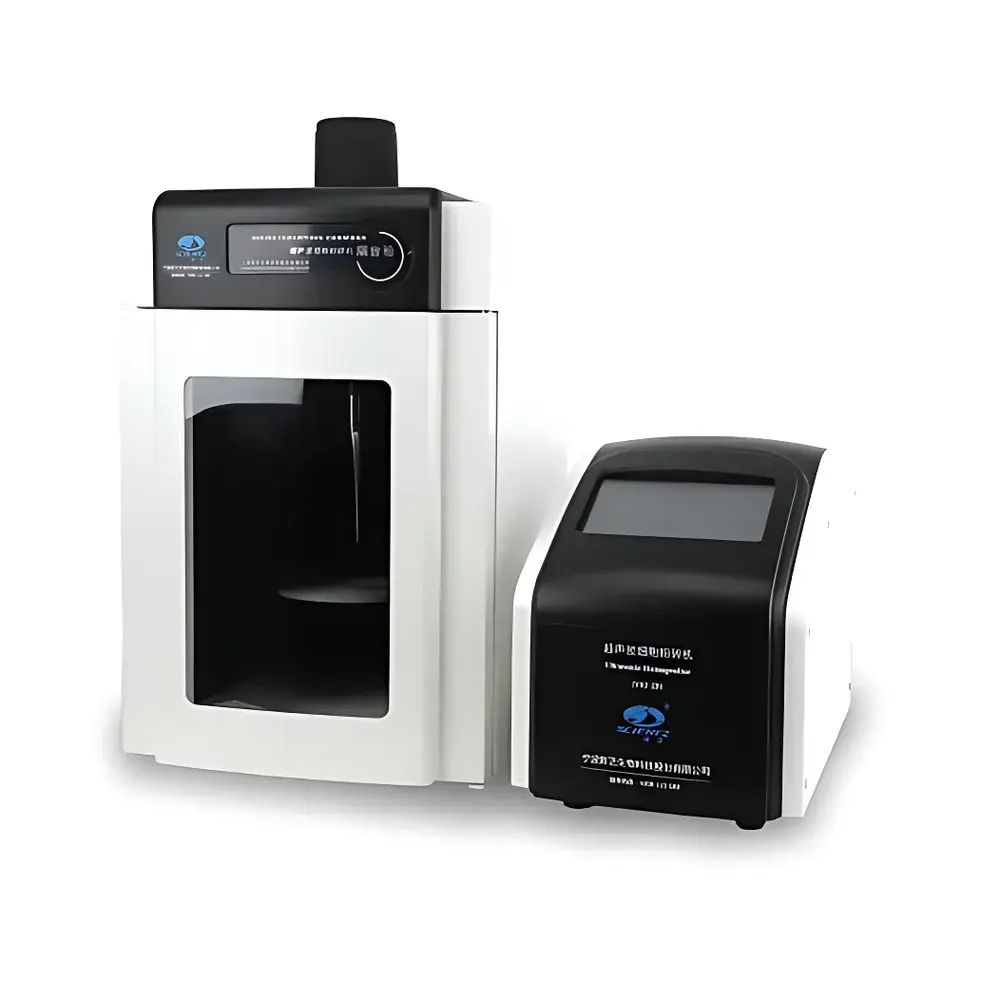
JY92-IIN Ultrasonic Cell Disruptor
| Origin | Zhejiang, China |
|---|---|
| Manufacturer Type | Distributor |
| Origin Category | Domestic (China) |
| Model | JY92-IIN |
| Price | ¥15,600 |
| Instrument Type | Ultrasonic Disruptor |
| Sample Compatibility | Soft biological samples |
| Output Particle Size | 0.01–0.5 mm |
| Maximum Feed Particle Size | <15 mm |
| Sieve Cut-Off | 40 mesh |
| Batch Processing Volume | 0.5–500 mL |
| Frequency Range | 20–25 kHz |
| Display | Backlit LCD |
| Power Output | 650 W (adjustable from 1% to 99%) |
| Standard Probe Diameter | 6 mm |
| Optional Probe Diameters | 2, 3, 10, 12, 15 mm |
| Duty Cycle | 1–99% |
| Time Resolution | 0.1 s (ultrasonication time, interval time, total time) |
| Input Voltage | 220 V / 110 V, 50 Hz / 60 Hz |
| Main Unit Dimensions (W×D×H) | 400 × 280 × 220 mm |
| Net Weight (Unit Only) | 12.1 kg |
| Unit + Transducer Weight | 14 kg |
| Packaging Dimensions | 534 × 295 × 435 mm |
Overview
The JY92-IIN Ultrasonic Cell Disruptor is a benchtop ultrasonic processor engineered for controlled mechanical lysis of biological cells and tissues via acoustic cavitation. Operating within a stable frequency range of 20–25 kHz, the instrument generates high-intensity ultrasonic waves transmitted through a titanium alloy probe into liquid suspensions. These waves induce transient microcavitation—formation, growth, and violent collapse of microscopic vapor bubbles—producing localized shear forces, microstreaming, and extreme transient temperatures (>5,000 K) and pressures (>1,000 atm). This physical mechanism enables efficient disruption of membranes and organelles without significant thermal denaturation when operated under pulsed mode. Designed for reproducible, scalable sample preparation, the JY92-IIN serves as a core tool in upstream bioprocessing workflows where consistent cell breakage is required prior to protein extraction, nucleic acid isolation, or subcellular fractionation.
Key Features
- Microprocessor-controlled operation with backlit LCD interface for real-time monitoring of power output, elapsed time, and duty cycle
- Continuous 1–99% ultrasonic power adjustment in 1% increments for precise energy delivery optimization across sample types
- Pulse mode functionality with independently programmable sonication duration, pause interval, and total cycle count—each adjustable to 0.1-second resolution
- Interchangeable titanium alloy probes (standard 6 mm; optional 2, 3, 10, 12, and 15 mm diameters) to match volume, viscosity, and target particle size requirements
- Robust thermal management design with overheat protection; no integrated temperature sensor or alarm, requiring external monitoring for thermosensitive applications
- Compliance-ready architecture: supports manual logbook documentation of operating parameters (power %, time, probe ID, sample ID), facilitating GLP-aligned recordkeeping
Sample Compatibility & Compliance
The JY92-IIN is validated for soft, aqueous-based biological matrices including cultured mammalian and insect cells, bacterial pellets (e.g., E. coli, Bacillus spp.), yeast, plant leaf homogenates, and tissue minces. It is not recommended for fibrous, mineralized, or highly viscous non-aqueous suspensions. While the instrument itself carries no CE, UL, or FDA registration, its operational parameters align with common preparatory steps described in ISO 11348 (toxicity testing), USP <1043> (cell lysis validation), and ASTM E2714 (ultrasonic equipment performance verification). Users performing regulated work (e.g., clinical assay development or GMP-compliant biologics R&D) must validate probe sterilization (autoclavable up to 121°C/20 min), establish probe-to-sample contact consistency, and define acceptance criteria for lysate clarity, protein yield, and DNA shearing profile per batch.
Software & Data Management
The JY92-IIN operates via embedded firmware without proprietary PC software or network connectivity. All parameter settings—including power level (%), pulse-on/pulse-off timing, total runtime, and probe selection—are stored locally in non-volatile memory and recalled at power-up. The absence of digital data export or audit trail functionality means users must manually document operational logs in laboratory notebooks or LIMS-compatible spreadsheets. For laboratories subject to 21 CFR Part 11 compliance, supplementary controls—such as witnessed parameter entry, dual-signature verification of run sheets, and periodic calibration checks against reference standards (e.g., calorimetric power measurement per ASTM E2637)—are required to ensure data integrity and traceability.
Applications
- Pre-analytical lysis of microbial and eukaryotic cells prior to Western blotting, ELISA, or mass spectrometry sample prep
- Extraction of intracellular enzymes, recombinant proteins, and plasmid DNA from E. coli and yeast cultures
- Preparation of antigenic lysates for immunology studies and vaccine development
- Nanomaterial dispersion and deagglomeration in aqueous colloids (e.g., graphene oxide, liposomes, polymeric nanoparticles)
- Accelerated solvent extraction of phytochemicals from plant tissues under mild conditions
- Inactivation and fragmentation of viruses and bacteriophages for structural or serological analysis
FAQ
Is the JY92-IIN suitable for RNA isolation workflows?
Yes—when operated in short-pulse mode (e.g., 2 s on / 5 s off) at ≤40% amplitude and maintained at 4°C using an ice-water bath, it minimizes RNase activation and RNA degradation. However, DNase/RNase inhibitors and cold-probe pre-chilling are strongly advised.
Can the instrument be used with organic solvents?
No. Titanium probes are incompatible with chlorinated hydrocarbons (e.g., chloroform), strong acids (e.g., >10% HCl), or oxidizing agents (e.g., HNO₃). Only aqueous buffers, alcohols (≤70% ethanol), and low-concentration detergent solutions are permitted.
What maintenance is required for long-term reliability?
Probe tip inspection after every 10 hours of cumulative use; replacement if pitting or erosion exceeds 0.2 mm depth. Regular cleaning with 70% ethanol and ultrasonic bath degreasing every 50 hours. Annual verification of power output accuracy using calorimetric calibration per ASTM E2637 is recommended.
Does the unit include validation documentation?
No. Factory calibration certificates and IQ/OQ protocols are not supplied. Users must perform installation qualification (e.g., dimensional verification, electrical safety check) and operational qualification (e.g., amplitude linearity test, time accuracy verification) internally or via third-party service providers.



