
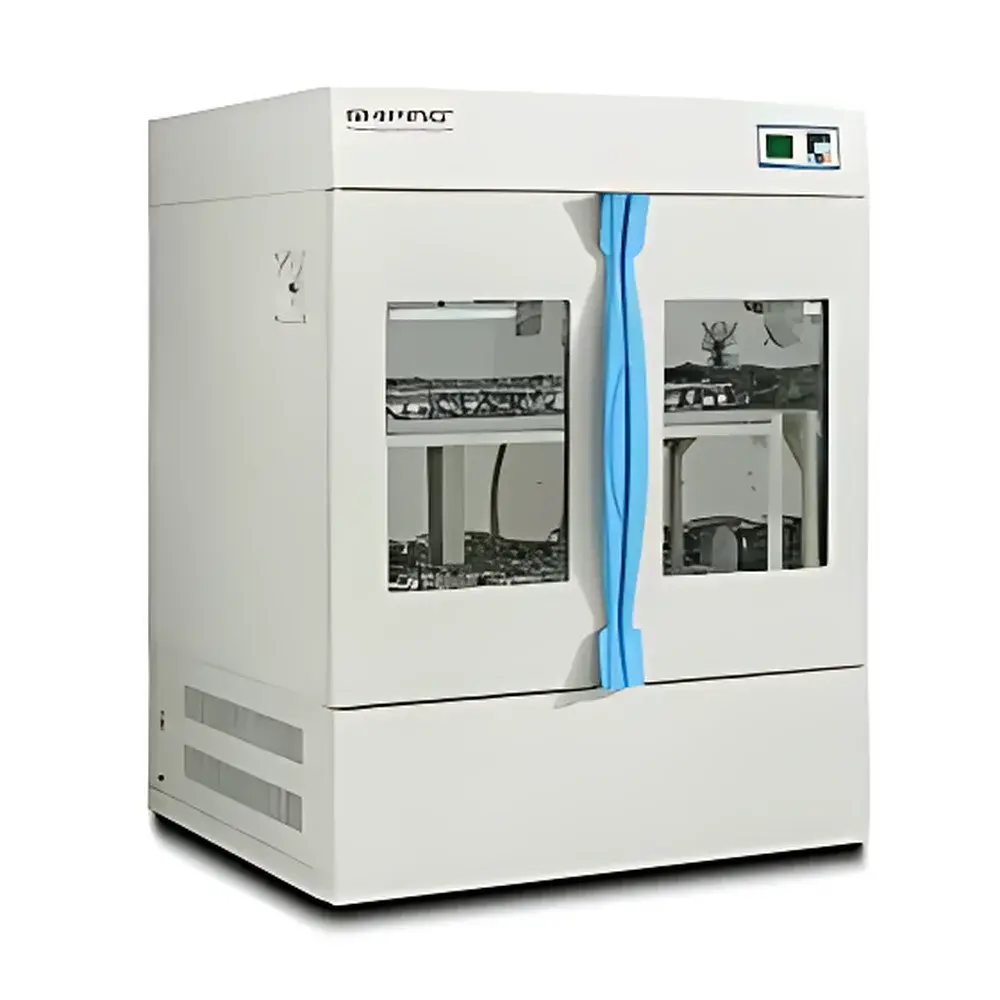
HePu SPH-2112B Dual-Door, Dual-Shelf Benchtop Incubator Shaker with Full-Temperature Control
| [Brand | HePu (Jihepu) |
|---|---|
| Origin | Shandong, China |
| Model | SPH-2112B |
| Timer Range | 0–500 min |
| Oscillation Frequency | 50–280 rpm |
| Amplitude | 35 mm |
| Temperature Range | Ambient +5°C to 60°C |
| Shelf Quantity | 2 |
| Power Supply | AC 200–240 V, 50–60 Hz |
| Heating Power | 800 W |
| Cooling System | CFC-Free R134a |
| Net Weight | 356 kg |
| External Dimensions (W×D×H) | 1200 × 850 × 1600 mm |
| Internal Chamber Dimensions (W×D×H) | 1100 × 700 × 830 mm |
| Chamber Material | Electropolished Imported Stainless Steel |
| Display | Dual-Line Backlit LCD |
| Control Algorithm | PID Microprocessor-Based Environmental Scanning Controller |
| Compliance | Designed for GLP-compliant environments |
Overview
The HePu SPH-2112B is a vertically oriented, dual-door, dual-shelf incubator shaker engineered for high-throughput cell culture, microbial fermentation, and biochemical assay development in regulated life science laboratories. It integrates precise temperature control with uniform orbital agitation across two independently accessible shelves—enabling parallel processing of large-volume cultures without cross-contamination or thermal interference. Its core operational principle combines PID-regulated heating and CFC-free R134a refrigeration with single-axis balanced drive mechanics, delivering stable rotational oscillation (50–280 rpm) and tight thermal uniformity (±1°C) within an ambient +5°C to 60°C range. Designed for continuous operation in GMP-aligned bioproduction and QC labs, the SPH-2112B meets foundational requirements for reproducible aerobic cultivation, suspension-based protein expression, and seed train expansion—particularly where scalability, energy efficiency, and long-term stability are critical.
Key Features
- Two-tiered stainless steel chamber with dual independent access doors—maximizing workflow flexibility while minimizing thermal loss during sample loading/unloading.
- Single-axis balanced drive system (Chinese patent-protected design) ensures low-noise, low-vibration operation with consistent torque delivery across the full speed range.
- Dual-line backlit LCD display showing real-time setpoints and actual values for temperature, speed, amplitude, and remaining timer duration.
- PID microprocessor controller with environmental scanning capability enables adaptive thermal regulation and automatic compensation for ambient fluctuations.
- CFC-free R134a refrigeration system integrated with 800 W heating capacity provides rapid temperature stabilization and precise cooling below ambient—critical for thermosensitive expression systems.
- Intelligent safety architecture includes over-temperature cutoff, motor overheat protection, power-failure recovery, and soft-start acceleration to safeguard fragile cultures and glassware.
- Electropolished imported stainless steel interior chamber resists corrosion and facilitates validated cleaning protocols per FDA 21 CFR Part 11 and EU GMP Annex 15 requirements.
Sample Compatibility & Compliance
The SPH-2112B accommodates standard culture vessels including 1000 mL flasks (36 per shelf), 500 mL Erlenmeyer flasks (74 total), or 250 mL bottles (102 total), arranged on two 970 × 560 mm reinforced stainless steel shelves. Its chamber geometry (1100 × 700 × 830 mm internal volume) supports stacked vessel configurations without airflow obstruction. The unit operates within ISO 14644-1 Class 8 cleanroom-compatible environments (5–25°C ambient, 20–90% RH). All electronic controls support configurable audit trails, user-level access restrictions, and parameter lockout functions—aligning with GLP documentation standards and supporting validation per ASTM E2500 and USP Analytical Instrument Qualification frameworks.
Software & Data Management
While the SPH-2112B operates via embedded firmware rather than external PC software, its PID controller logs runtime parameters—including temperature deviation history, speed variance, and alarm events—to non-volatile memory. Data export is supported through optional RS-485/Modbus RTU interface (available as factory-configured add-on), enabling integration into centralized LIMS or SCADA platforms. All logged entries include timestamps, operator IDs (when configured), and event severity classification—ensuring traceability for regulatory submissions. Firmware supports firmware update via secure USB port with cryptographic signature verification, satisfying integrity requirements under 21 CFR Part 11 Subpart B.
Applications
- High-density bacterial and yeast fermentation for recombinant protein production and vaccine antigen synthesis.
- Stable mammalian cell line expansion under controlled dissolved oxygen simulation (via optimized air exchange rates).
- Enzyme kinetics studies requiring simultaneous multi-temperature, multi-speed experimental conditions.
- Antibiotic susceptibility testing using broth microdilution formats with automated agitation cycles.
- Environmental microbiology applications such as activated sludge acclimation and biodegradation assays under defined thermal regimes.
- Biopharmaceutical process development workflows compliant with ICH Q5D and Q5A guidance documents.
FAQ
Does the SPH-2112B support remote monitoring or Ethernet connectivity?
No native Ethernet or Wi-Fi module is included; however, optional RS-485/Modbus RTU communication hardware can be installed for integration with building management systems or industrial PLC networks.
What is the maximum flask size supported on each shelf?
Each shelf accommodates up to thirty-six 1000 mL Erlenmeyer flasks placed in staggered configuration, verified for mechanical stability at 280 rpm.
Is the unit suitable for use in a cold room environment?
Yes—the device is rated for ambient operation between 5°C and 25°C; it maintains specified temperature accuracy down to +5°C above ambient, making it compatible with controlled cold-room installations.
Can the oscillation amplitude be adjusted?
Amplitude is fixed at 35 mm (Φ35) to ensure mechanical resonance avoidance and long-term bearing integrity; this value complies with ISO 20449:2017 specifications for orbital shakers used in clinical microbiology.
How is calibration performed and documented?
Factory calibration includes NIST-traceable temperature and speed verification; users may perform field verification using external PT100 probes and optical tachometers—the controller supports user-initiated calibration offset entry with password-protected access.





