
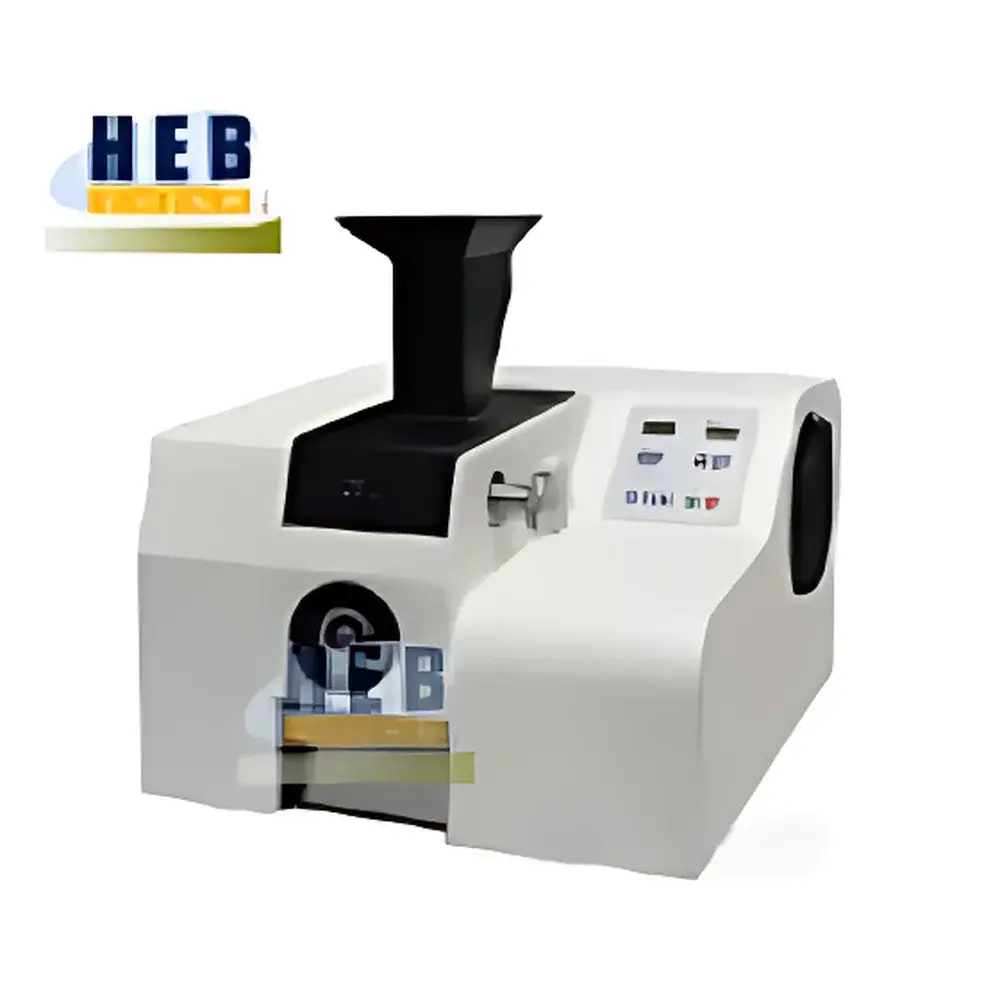
JH-E20 Jaw Crusher
| Brand | Jihepu (Jinan Hepu) |
|---|---|
| Origin | Shandong, China |
| Model | JH-E20 |
| Instrument Type | Laboratory Jaw Crusher |
| Sample Applicability | Brittle, hard, medium-hard, and hard-tough materials |
| Feed Size | ≤45 mm |
| Discharge Size Range | 0–12 mm (adjustable) |
| Final Output Particle Size | ≤0.5 mm |
| Minimum Output Granularity | 0.01 mm |
| Batch Processing Volume | 50 mL |
| Drive Motor Power | 1.1 kW |
| Speed Range | 100–1000 rpm (variable) |
| Voltage/Frequency | 220 V / 50 Hz |
| Grinding Chamber Material Options | Manganese steel, stainless steel, zirconia, tungsten carbide, industrial-grade polymer |
| Net Weight | 65 kg |
| Hopper | Flip-up design for easy cleaning |
| Jaw Plate Rotation | Bidirectional (forward/reverse) |
| Zero-point Calibration System | JH proprietary mechanical calibration for jaw gap compensation |
| Safety Features | Splash guard, enclosed crushing chamber, interlocked hopper lid |
Overview
The JH-E20 Jaw Crusher is a precision-engineered laboratory-scale crushing instrument designed for controlled, reproducible primary size reduction of solid heterogeneous samples. Operating on the principle of compressive fracture—where material is subjected to high mechanical stress between two opposing, converging jaw plates—the JH-E20 delivers consistent coarse-to-intermediate particle size reduction without significant heat generation or contamination. Its core architecture follows the classic Blake-type jaw mechanism, optimized for stability under cyclic loading and calibrated for repeatable gap control. This makes it especially suitable for sample preparation workflows requiring defined top-size limits prior to downstream analysis (e.g., XRF, XRD, ICP-MS, or sieve analysis), where particle homogeneity and minimal fines generation are critical. Unlike high-energy mills, the JH-E20 avoids over-grinding or amorphization of crystalline phases, preserving structural integrity for mineralogical or geochemical characterization.
Key Features
- Mechanically adjustable jaw gap (0–12 mm range) with integrated JH zero-point calibration system to compensate for jaw wear and maintain dimensional repeatability across extended operational cycles
- Bidirectional jaw plate rotation capability enables uniform wear distribution and extends consumable service life
- Flip-up feed hopper and fully accessible crushing chamber facilitate rapid residue removal and cross-sample decontamination—essential for trace-element or multi-matrix labs
- Modular jaw plate assembly supports interchangeable liners made from manganese steel (for general-purpose crushing), stainless steel (for low-metal contamination), zirconia (for ultra-low abrasion in ceramic or pharmaceutical prep), tungsten carbide (for extreme hardness applications), and chemically inert polymers (for reactive or moisture-sensitive samples)
- Enclosed splash guard and interlocked hopper lid comply with ISO 13857 safety principles for stationary machinery, minimizing operator exposure to particulate ejection during operation
- Variable-speed DC motor (100–1000 rpm) allows fine-tuning of throughput and energy input—critical when processing friable versus ductile materials
Sample Compatibility & Compliance
The JH-E20 accepts feed particles up to 45 mm in maximum dimension and consistently reduces them to a discharge size ≤0.5 mm, with resolution down to 0.01 mm achievable via precise gap setting. It is validated for use with geological matrices (granite, basalt, silicates, slag), construction materials (cement clinker, refractory ceramics, fired clay), environmental solids (soil cores, fly ash, municipal solid waste fractions), and dried biological specimens (calcified shells, desiccated marine tissue). All structural components conform to GB/T 19001–2016 (equivalent to ISO 9001:2015) quality management requirements. Jaw plate materials meet ASTM F899 standards for corrosion resistance where applicable. The unit’s electrical design complies with IEC 61000-6-2 (immunity) and IEC 61000-6-4 (emissions), and its mechanical safety architecture aligns with EN 60204-1 for electrical equipment of machines.
Software & Data Management
The JH-E20 operates as a stand-alone electromechanical system with no embedded microprocessor or digital interface. All operational parameters—including speed setpoint, run duration, and jaw gap position—are manually configured and mechanically locked. For laboratories operating under GLP or GMP frameworks, this analog architecture eliminates software validation burdens associated with electronic recordkeeping. Jaw gap settings are documented using calibrated vernier scales mounted directly on the frame; users maintain manual logbooks compliant with FDA 21 CFR Part 11 Annex 11 expectations for non-electronic systems. Optional external digital tachometers and gap measurement gauges can be integrated for audit-ready parameter verification.
Applications
- Geological survey labs: Preparation of rock chips and drill core fragments for petrographic thin-sectioning or bulk elemental analysis
- Cement and refractories QA/QC: Reduction of clinker nodules and kiln feed samples to <500 µm for loss-on-ignition (LOI) and Blaine fineness testing
- Environmental monitoring: Homogenization of heterogeneous soil composites prior to heavy metal extraction per EPA Method 3050B
- Ceramic R&D: Pre-crushing of sintered bodies and green compacts for phase-purity assessment via X-ray diffraction
- Marine biogeochemistry: Controlled fragmentation of calcareous biominerals (e.g., oyster shell, coral skeletons) without inducing carbonate decomposition
- Recycling process development: Size reduction of electronic waste fractions (PCBs, solder joints) for leaching optimization studies
FAQ
What is the recommended maintenance interval for jaw plate replacement?
Jaw plates should be inspected after every 200 operational hours or following processing of abrasive matrices (e.g., quartz-rich rocks); replacement frequency depends on material hardness and cumulative throughput.
Can the JH-E20 be used for wet grinding?
No—it is strictly a dry-crushing instrument. Moisture ingress compromises mechanical integrity and induces premature wear; samples must be oven-dried to ≤1% moisture content prior to feeding.
Is third-party calibration certification available?
Yes—certified gap verification and rotational speed calibration services are offered by authorized Jihepu service centers, traceable to CNAS-accredited reference standards.
Does the unit support continuous feed operation?
It is designed for batch processing only; feed volume is limited to 50 mL per cycle to ensure uniform stress distribution and prevent jaw jamming.
How is compliance with occupational dust exposure limits ensured?
The JH-E20 must be operated inside a certified fume hood or connected to a local exhaust ventilation (LEV) system meeting EN 61998-1 airflow specifications; optional dust collection adapters are available for integration with HEPA-filtered vacuum systems.



