
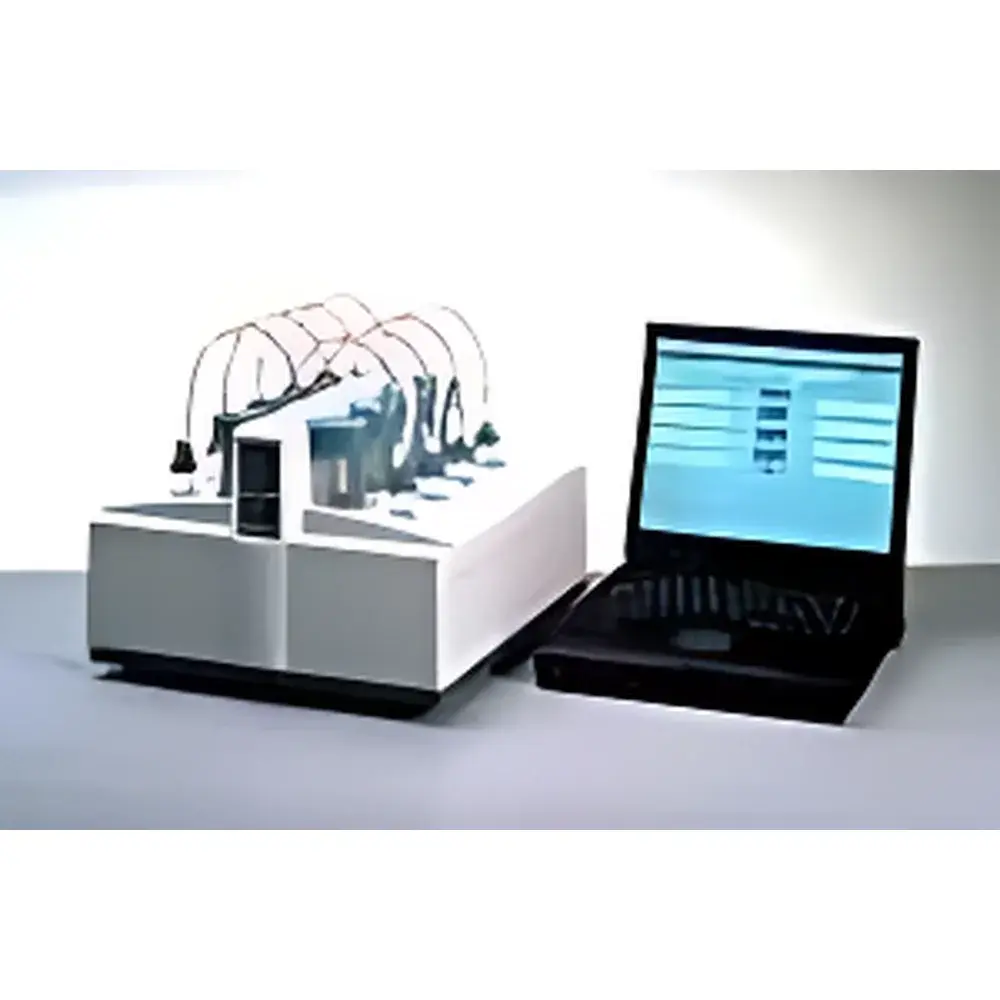
Metrohm 743 Rancimat Oil Oxidation Stability Analyzer
| Brand | Metrohm |
|---|---|
| Origin | Switzerland |
| Model | 743 |
| Temperature Control Range | 50–220 °C (1 °C step) |
| Temperature Repeatability | < 0.2 °C |
| Max. Temperature Deviation | < 0.3 °C |
| Temperature Stability | < 0.1 °C |
| Inter-position Temperature Uniformity | < 0.3 °C |
| Heating Time (20 → 120 °C) | ~45 min |
| Heating Time (20 → 220 °C) | ~60 min |
| Air Flow Rate | 7–25 L/h (integrated diaphragm pump) |
| Conductivity Measurement Range | 0–500 µS/cm |
| Temperature Offset Adjustment | −9.9 to +9.9 °C (0.1 °C step) |
| Sample Capacity | 2–10 g or mL per reaction vessel |
| Dual-temperature Parallel Operation | 2 independent temperature zones, 8 sample positions (4 per zone) |
Overview
The Metrohm 743 Rancimat Oil Oxidation Stability Analyzer is a fully automated, benchtop instrument engineered for precise determination of the oxidative stability of fats, oils, and lipid-containing materials via the Rancimat method (EN 14112, ISO 6886, AOCS Cd 12b-92, ASTM D7545). It operates on the principle of accelerated oxidation under controlled thermal stress and continuous air flow, monitoring volatile oxidation products—primarily formic acid—by measuring the electrical conductivity of a trapping solution. The time at which a sharp increase in conductivity occurs defines the induction period (IP), a quantitative indicator of oxidative resistance. Designed for compliance-driven laboratories, the 743 delivers traceable, reproducible results essential for quality control, shelf-life prediction, and antioxidant efficacy evaluation in food, feed, biofuel, and cosmetic applications.
Key Features
- Dual independent temperature zones enable simultaneous testing at two distinct setpoints (e.g., 100 °C and 110 °C), with four sample positions per zone—totaling eight parallel determinations.
- Each sample position features an individual start/stop function, allowing flexible scheduling and staggered initiation without cross-contamination.
- Interchangeable, chemically resistant reaction vessels ensure complete isolation between samples; no carryover or memory effect between runs.
- Integrated diaphragm air pump delivers stable, pulse-free airflow (7–25 L/h) with digital regulation—critical for consistent oxidation kinetics and IP reproducibility.
- High-precision PID temperature control achieves < 0.1 °C stability and < 0.3 °C uniformity across all eight positions, validated by built-in reference sensors.
- Real-time conductivity monitoring (0–500 µS/cm, 0.1 µS/cm resolution) with automatic derivative calculation to objectively identify the induction period onset.
- GLP-compliant internal calibration module enables on-demand verification of temperature and conductivity performance—fully documented for audit readiness.
Sample Compatibility & Compliance
The 743 accommodates a broad spectrum of lipid matrices: refined and crude vegetable oils (soybean, sunflower, rapeseed, palm, peanut), animal fats (butterfat, lard, fish oil), emulsified products (margarine, mayonnaise), and complex food systems (nuts, baked goods, cured meats, cereals). For heterogeneous or low-fat samples, standardized lipid extraction (e.g., AOCS Am 2-93) precedes analysis. Instrument operation conforms to internationally recognized standards including EN 14112 (biodiesel), ISO 6886 (edible oils), AOCS Cd 12b-92 (fats and oils), and ASTM D7545 (oxidative stability of FAME). All measurement data—including raw conductivity curves, derivative plots, IP values, and system logs—are timestamped and user-attributed, supporting 21 CFR Part 11 compliance when paired with Metrohm’s MagIC Net™ software configured for electronic signatures and audit trails.
Software & Data Management
Controlled via MagIC Net™ software (v3.3 or later), the 743 supports method-driven workflows, automated report generation (PDF/CSV), and hierarchical database management. Induction periods are calculated automatically using second-derivative threshold detection, but users retain full manual override capability for curve inspection and endpoint redefinition. Multi-temperature IP datasets can be subjected to Arrhenius modeling within the software: linear regression of ln(IP) vs. 1/T yields activation energy (Ea) and enables extrapolation to storage-relevant temperatures (e.g., 25 °C or 40 °C), facilitating predictive shelf-life assessment. The relational database permits filtering by sample ID, batch, operator, date range, or analytical parameter; export functions support integration with LIMS and ERP platforms. All instrument events—including temperature ramp profiles, air flow deviations, and calibration actions—are permanently logged with immutable timestamps.
Applications
- Quality assurance of edible oils and frying fats during refining, blending, and packaging.
- Evaluation of natural and synthetic antioxidants (e.g., tocopherols, TBHQ, BHA/BHT) and synergistic blends.
- Oxidative stability screening of biodiesel (FAME) per EN 14214 requirements.
- Stability assessment of lipid-based cosmetics, nutraceuticals, and infant formula ingredients.
- Research into pro-oxidant effects of metals (e.g., copper-catalyzed oxidation of light fuel oils).
- Validation of storage conditions and packaging barrier efficacy for lipid-rich foods.
- Supporting regulatory submissions requiring documented oxidative stability data (EFSA, FDA, Health Canada).
FAQ
What standards does the Metrohm 743 comply with?
The instrument implements the Rancimat method as specified in EN 14112, ISO 6886, AOCS Cd 12b-92, and ASTM D7545. Its hardware and software architecture support GLP and GMP environments, including full audit trail and electronic signature capabilities when configured per 21 CFR Part 11.
Can the 743 operate more than eight samples simultaneously?
Yes—up to four 743 units can be networked and controlled by a single PC, enabling concurrent analysis of 32 samples across eight independent temperature settings.
Is sample preparation standardized?
While the instrument accepts 2–10 g or mL of neat oil, solid or emulsified samples require prior lipid extraction per AOCS or ISO protocols to ensure representative and interference-free measurement.
How is temperature accuracy verified?
The integrated GLP verification kit includes traceable PT100 reference probes and automated comparison routines that log deviation data against NIST-traceable standards—fully compliant with ISO/IEC 17025 calibration requirements.
Does the system support remote monitoring?
MagIC Net™ offers secure remote access via VPN or dedicated intranet, allowing real-time observation of active runs, alarm notifications, and post-run data retrieval without physical presence in the lab.





