
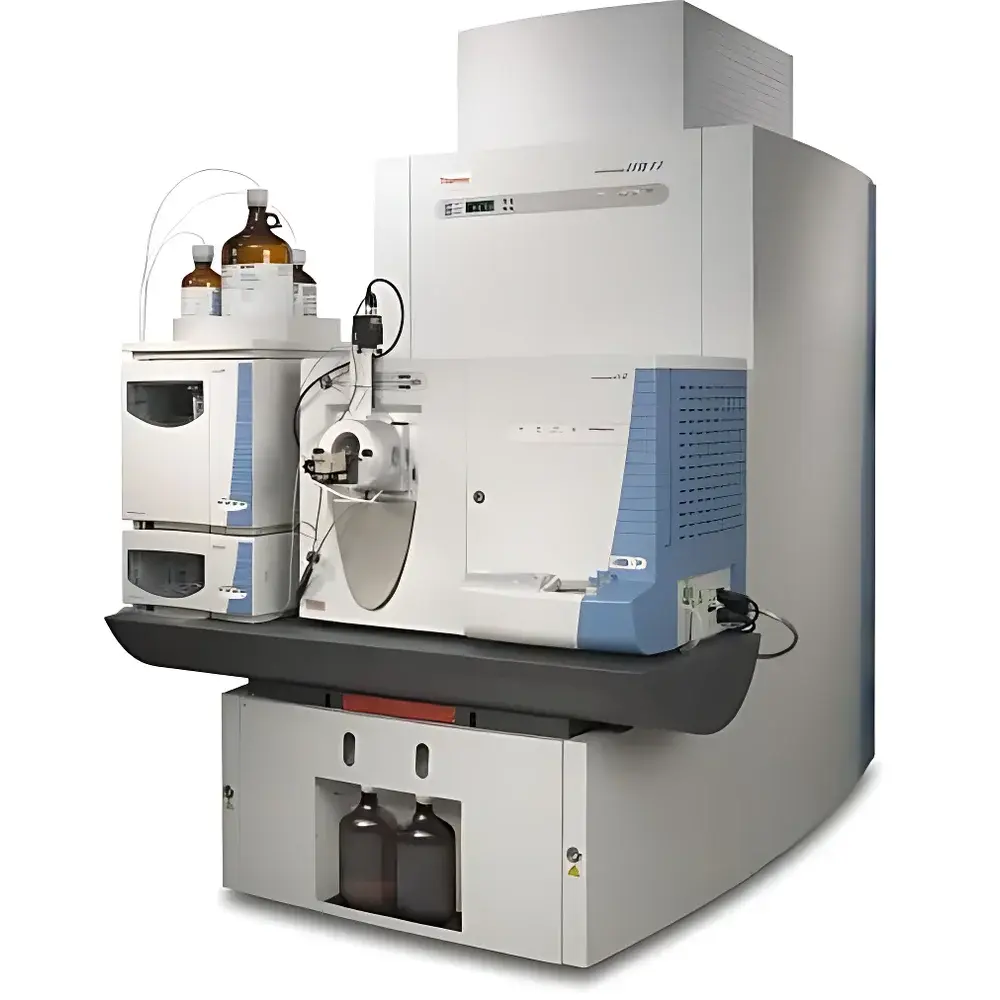
Thermo Scientific LTQ-FT Ultra Linear Ion Trap Fourier Transform Ion Cyclotron Resonance Mass Spectrometer
| Origin | Germany |
|---|---|
| Manufacturer Type | Authorized Distributor |
| Origin Category | Imported |
| Model | LTQ-FT Ultra |
| Price Range | USD 140,000 – 280,000 |
| Instrument Type | Hybrid Tandem Mass Spectrometer (LTQ + FTICR) |
Overview
The Thermo Scientific LTQ-FT Ultra is a hybrid tandem mass spectrometer integrating a linear ion trap (LTQ) with a high-field Fourier transform ion cyclotron resonance (FTICR) mass analyzer. Engineered for precision in top-down and bottom-up proteomics, this platform leverages the complementary strengths of two distinct mass analysis technologies: rapid, sensitive ion trapping and accumulation in the LTQ stage, followed by ultra-high-resolution, accurate-mass measurement in the FTICR cell. Its operational principle relies on magnetic field–dependent cyclotron motion of trapped ions within a superconducting magnet (typically 7–9 T), where image current detection and Fourier transformation yield mass spectra with resolving powers exceeding 100,000 (at m/z 400) and mass accuracy better than 1 ppb under optimized conditions. Designed for seamless coupling with nano-LC and capillary LC systems, the LTQ-FT Ultra delivers real-time, online hyphenated analysis without compromising duty cycle or spectral fidelity—making it a foundational instrument for rigorous structural biology, post-translational modification (PTM) mapping, and complex mixture characterization in petroleum, natural products, and synthetic polymers.
Key Features
- Hybrid architecture combining a high-capacity linear ion trap with an enhanced UltraCell FTICR analyzer
- Resolving power >100,000 (FWHM at m/z 400) and mass accuracy <1 ppb with internal calibration
- Multi-stage MSn capability (up to MS5) enabled by sequential isolation, activation (CID, ECD, IRMPD), and transfer between LTQ and FTICR compartments
- Electron capture dissociation (ECD) and infrared multiphoton dissociation (IRMPD) sources co-integrated for complementary fragmentation—critical for labile PTM retention and de novo sequencing
- UltraCell design mitigates space-charge effects via enlarged trapping volume and optimized electrode geometry, enabling higher ion capacity without increased magnetic field strength
- Column-compatible sensitivity down to the sub-attomole (sub-100 zmol) level for peptide analysis using nano-electrospray ionization
Sample Compatibility & Compliance
The LTQ-FT Ultra supports diverse sample introduction methods including nanoelectrospray (nESI), microelectrospray, MALDI (via external source interface), and direct infusion. It is routinely deployed for intact protein analysis (up to ~50 kDa), peptide digests, glycopeptides, phosphopeptides, lipids, and petrochemical fractions. From a regulatory standpoint, the system complies with data integrity requirements outlined in FDA 21 CFR Part 11 when operated with Thermo Scientific Chromeleon CDS or Compound Discoverer software configured with audit trail, electronic signatures, and role-based access control. Method validation workflows align with ICH Q2(R2) and ISO/IEC 17025 guidelines for analytical instrument qualification (AIQ), including performance verification per ASTM E2316 (mass accuracy), E2599 (resolution), and USP (system suitability).
Software & Data Management
Control and data acquisition are managed through Thermo Scientific Xcalibur software (v4.5+), which provides synchronized operation of LTQ and FTICR modules, automated method sequencing, and real-time spectral preview. Quantitative and qualitative analysis is extended via integration with Proteome Discoverer (for database searching, PTM localization, and spectral library matching) and Compound Discoverer (for untargeted metabolite identification). All raw data files (.raw) are stored in vendor-neutral, timestamped formats compliant with mzML 1.1 standards. Audit trails—including parameter changes, calibration events, and user logins—are retained for ≥36 months and exportable for GLP/GMP audit readiness. Optional secure network deployment supports centralized instrument monitoring and remote diagnostics via Thermo Fisher Connect platform.
Applications
- Top-down proteomics: Intact protein mass measurement, sequence coverage, and characterization of heterogeneous modifications (e.g., ubiquitination, acetylation)
- Bottom-up PTM analysis: Localization of phosphorylation, glycosylation, and oxidation sites with confidence scores derived from ECD/IRMPD fragment ion annotation
- De novo peptide sequencing: High-fidelity fragment ion ladders generated via ECD enable reconstruction of unknown sequences without database dependency
- Complex mixture analysis: Separation and identification of isobaric and near-isobaric species in crude oil fractions, polymer additives, or environmental extracts
- Native MS: Preservation of non-covalent complexes under gentle desolvation conditions, supported by low-energy activation and cryo-cooled FTICR detection
FAQ
What distinguishes LTQ-FT Ultra from standalone FTICR or quadrupole-based instruments?
The LTQ-FT Ultra uniquely combines rapid precursor selection and fragmentation in the linear ion trap with ultra-high-resolution mass measurement in the FTICR cell—enabling MSn experiments that are impractical on conventional FTICR systems due to long transient acquisition times.
Is ECD compatible with all sample types?
ECD requires multiply protonated cations and is most effective for peptides and small proteins (<30 kDa); its efficiency diminishes for highly hydrophobic or low-charge-state analytes, where IRMPD serves as a robust alternative.
How is mass calibration maintained across long acquisition runs?
Internal calibration uses co-infused lock mass compounds (e.g., Ultramark 1621), while external calibration is performed daily using standard tuning mixtures; Xcalibur’s dynamic recalibration algorithm corrects for drift during multi-hour LC-MS runs.
Can the system be validated for regulated environments (e.g., pharmaceutical QC)?
Yes—when paired with validated software configurations, documented IQ/OQ/PQ protocols, and traceable reference standards, the LTQ-FT Ultra meets ALCOA+ principles and supports submissions to EMA and FDA under ICH M10 guidance.
What maintenance intervals are recommended for the superconducting magnet and vacuum system?
The magnet requires helium refills every 12–18 months depending on cryocooler performance; turbomolecular pumps and ion optics undergo preventive maintenance every 6 months, with FTICR cell cleaning advised annually or after high-salt matrix exposure.



