
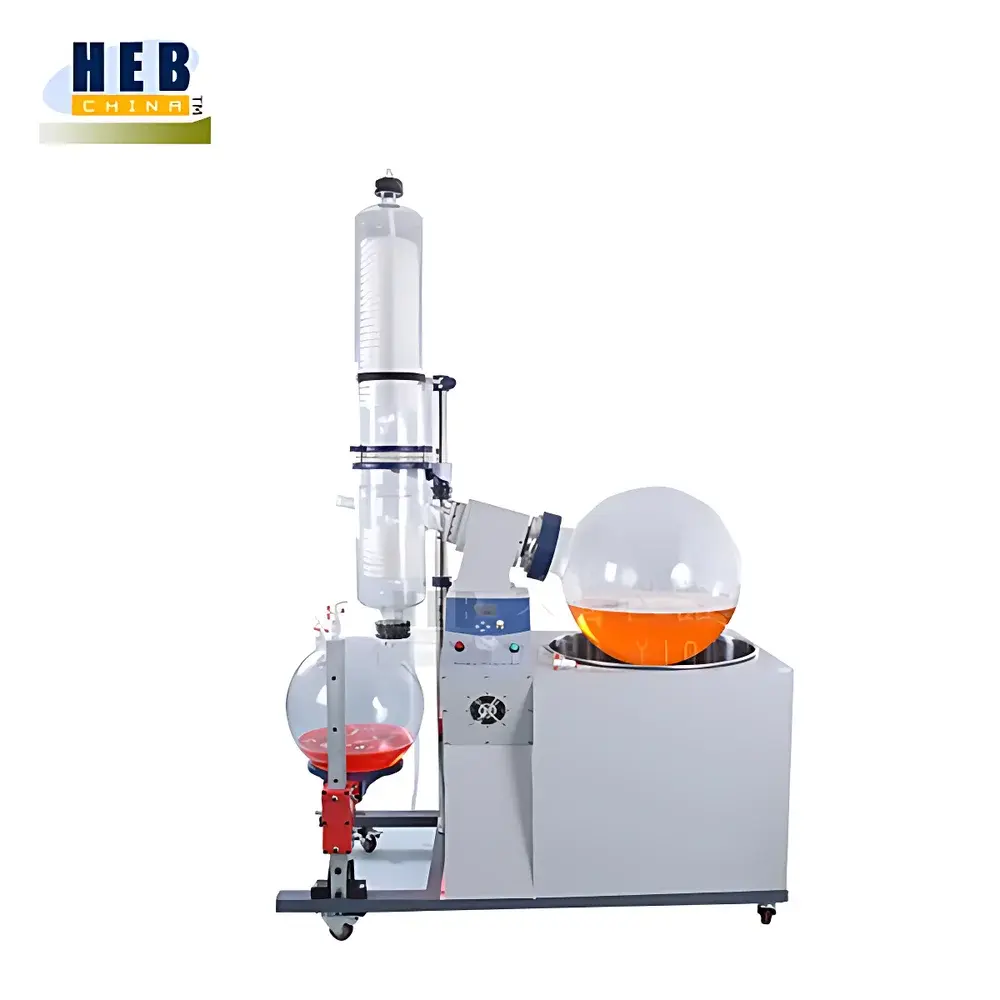
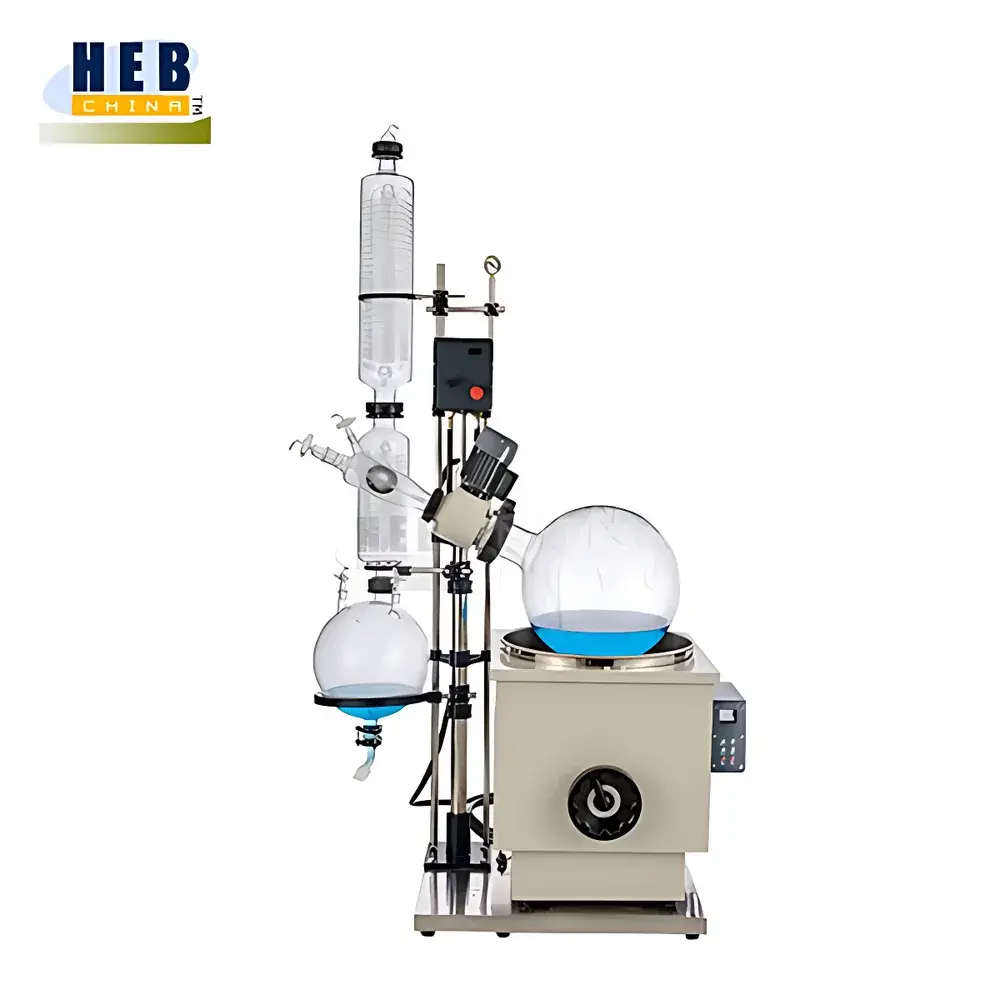
HePu RE-100L Rotary Evaporator
| [Brand | HePu |
|---|---|
| Model | RE-100L |
| Capacity | 100 L |
| Ultimate Vacuum | 0.098 MPa |
| Rotation Speed | 0–110 rpm |
| Bath Temperature Range | 0–400 °C |
| Temperature Control Accuracy | ±1 °C |
| Condenser Cooling Area | 0.11 m² |
| Rotating Flask Material | GG-17 borosilicate glass |
| Bath Vessel Material | 304 stainless steel |
| Power Supply | 380 V / 50 Hz (bath), 220 V / 50 Hz (rotation)] |
Overview
The HePu RE-100L Rotary Evaporator is an industrial-scale, vacuum-assisted solvent removal system engineered for high-throughput concentration, purification, and recovery of heat-sensitive compounds under controlled reduced-pressure conditions. Operating on the principle of thin-film evaporation—where a rotating flask generates a uniform, dynamic liquid film across its inner surface—the instrument maximizes surface-area-to-volume ratio while minimizing thermal degradation. Integrated with a high-capacity 304 stainless steel heating bath (15 kW), precision digital temperature control (±1 °C), and a robust 100 L GG-17 borosilicate rotating flask, the RE-100L supports reproducible, scalable processing in pharmaceutical pilot plants, fine chemical synthesis labs, natural product extraction facilities, and academic process development centers. Its design complies with fundamental safety and operational expectations for Class I laboratory evaporators per IEC 61010-1, and its modular glassware configuration adheres to standard ISO 2768-1 tolerances for ground-glass joints (e.g., 50# ball-and-socket, 29# standard taper).
Key Features
- Industrial-grade rotating flask (100 L capacity, GG-17 borosilicate glass) with 180 mm diameter flange interface for mechanical stability and vacuum integrity
- High-power heating bath (15 kW, 380 V / 50 Hz) featuring 304 stainless steel inner tank (700 × 400 mm), corrosion-resistant powder-coated outer shell, and intelligent PID temperature regulation (0–400 °C, ±1 °C accuracy)
- Variable-speed drive system with frequency-converter control and LCD digital display (0–110 rpm), delivering consistent rotational torque and low-vibration operation
- Vertical triple-pass condenser assembly comprising primary (2.0 m²) and auxiliary (0.8 m²) cooling surfaces—fabricated from high-temperature resistant borosilicate glass with optimized reflux geometry for >92% condensation efficiency at typical solvent boiling points
- Integrated vacuum monitoring via analog vacuum gauge (range: 0–0.1 MPa), compatible with external vacuum controllers or oil-free diaphragm pumps for regulated pressure ramping
- Motorized vertical lift mechanism (180 mm travel, 60 W actuator) enabling safe, repeatable flask positioning without manual intervention
- Chemically inert fluid path: PTFE stopcocks, fluororubber vacuum seals, and FEP-lined feed lines ensure compatibility with aggressive solvents including chlorinated hydrocarbons, esters, and concentrated acids
Sample Compatibility & Compliance
The RE-100L accommodates viscous solutions, suspensions, and thermolabile extracts across diverse matrices—including aqueous, ethanolic, ethyl acetate, dichloromethane, and toluene-based systems—provided vapor pressure and thermal stability thresholds remain within operational limits. All glass components conform to ASTM E438 Type I, Class A specifications for laboratory glassware. The system supports GLP-compliant workflows through traceable temperature logging (via optional RS485/Modbus interface), validated vacuum ramp profiles, and documented maintenance records. While not certified to FDA 21 CFR Part 11 out-of-the-box, the instrument’s hardware architecture permits integration with compliant data acquisition platforms for audit-ready electronic records.
Software & Data Management
The RE-100L operates as a standalone unit with embedded microcontroller-based logic for independent bath temperature setpoint management, rotation speed calibration, and real-time vacuum status indication. Optional analog outputs (0–10 V or 4–20 mA) enable connection to SCADA or LIMS environments for centralized parameter logging. For enhanced process documentation, third-party software packages (e.g., LabVIEW-compatible drivers or HePu’s optional HeDataLink module) support time-stamped export of temperature, rotation, and vacuum trends in CSV or Excel format—facilitating batch record generation per ISO 9001 and ICH Q7 requirements.
Applications
- Large-volume solvent removal in API intermediate purification (e.g., post-coupling workup in peptide synthesis)
- Concentration of botanical extracts and fermentation broths prior to chromatographic fractionation
- Recovery and recycling of high-boiling-point solvents (e.g., DMF, NMP, DMSO) in polymer synthesis laboratories
- Drying of nanomaterial dispersions and colloidal suspensions under gentle thermal conditions
- Scale-up validation studies bridging benchtop (RE-2L/5L) to pilot-scale (RE-50L/100L) evaporation protocols
- Teaching advanced separation techniques in university chemical engineering laboratories
FAQ
What is the maximum recommended working volume for the 100 L rotating flask?
The nominal capacity is 100 L; however, optimal thin-film formation and bumping prevention require loading between 40–70% of total volume (i.e., 40–70 L), depending on solution viscosity and volatility.
Can the RE-100L be operated under inert atmosphere (e.g., nitrogen or argon)?
Yes—by connecting a regulated inert gas inlet to the vacuum line via a three-way valve and adjusting the vent rate to maintain slight positive pressure during distillation.
Is the condenser cooled by circulating water or refrigerated chiller?
It is designed for external chilled water circulation (recommended supply: 5–15 °C, flow ≥12 L/min); integration with closed-loop chillers is supported via standard 1/2″ BSP fittings.
Does the system include vacuum pump and chiller?
No—these are specified as external accessories; HePu provides compatibility guidelines for selecting oil-free vacuum pumps (≥10 m³/h at 0.1 mbar) and recirculating chillers (≥3 kW cooling capacity).
What maintenance intervals are recommended for long-term reliability?
Vacuum seal inspection every 200 operating hours; condenser cleaning after each solvent class change; annual calibration of temperature sensors and rotation encoder against NIST-traceable references.



