
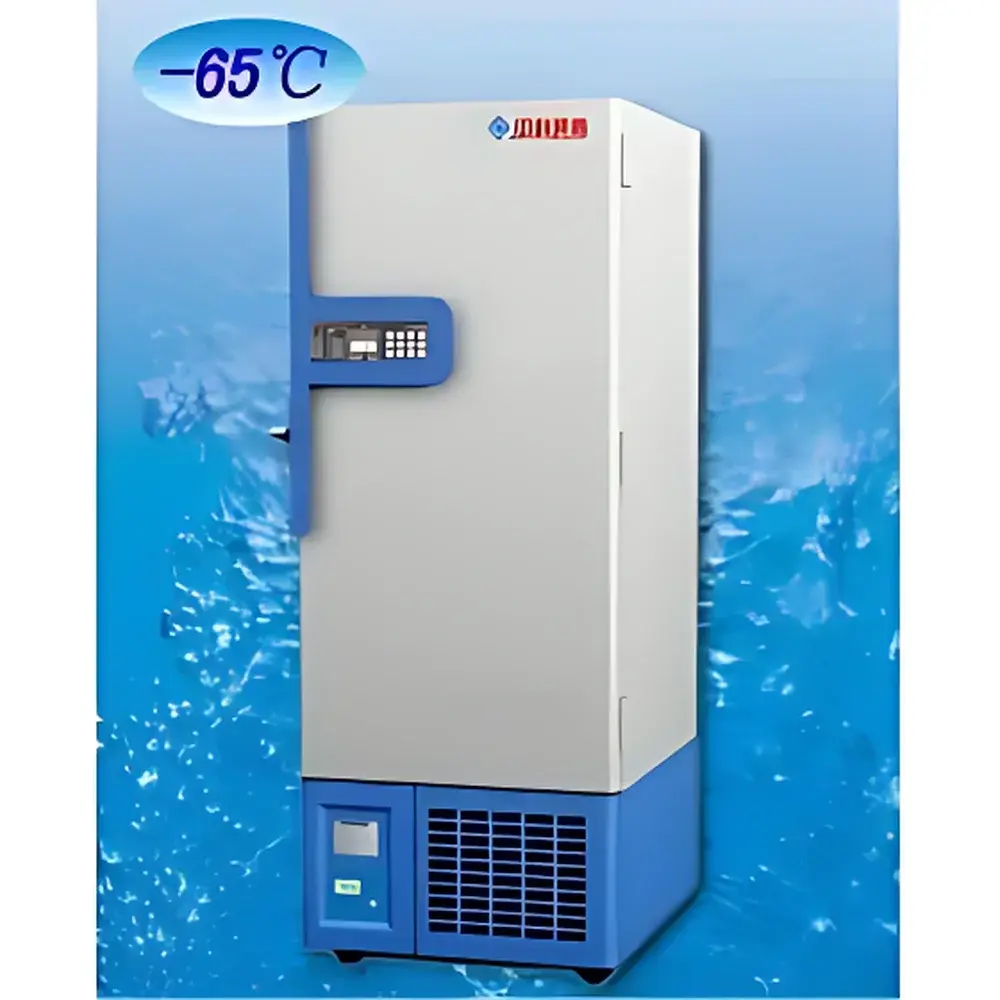
Jihepu DW-GL218 Ultra-Low Temperature Freezer
| Brand | Jihepu |
|---|---|
| Model | DW-GL218 |
| Effective Volume | 218 L |
| External Dimensions (W×D×H) | 940 × 840 × 1552 mm |
| Power Supply | 220 V / 50 Hz |
| Rated Power | 1000 W |
| Operating Temperature Range | −10 °C to −65 °C |
| Insulation Thickness | 150 mm |
| Compressor Type | Single-stage oil-lubricated |
| Refrigerant | Environmentally compliant hydrocarbon-based blend (patented formulation per CN ZL03121423.1) |
| Control Sensor | Platinum resistance thermometer (Pt100) |
| Display | Digital LED temperature readout |
| Alarm System | Audible/visual alerts for high/low temperature, door open, low backup battery, filter clogging, and system fault |
Overview
The Jihepu DW-GL218 Ultra-Low Temperature Freezer is an engineered solution for long-term cryogenic storage of biological samples—including cell lines, primary tissues, serum, DNA/RNA extracts, and reagent stocks—requiring stable thermal environments down to −65 °C. Designed specifically for laboratory-grade biobanking and clinical research applications, the unit employs a single-stage oil-lubricated compressor coupled with a proprietary refrigeration circuit (patented under CN ZL00136709.9 and ZL03121465.7), eliminating reliance on ozone-depleting or high-global-warming-potential (GWP) refrigerants. Its refrigerant formulation—a hydrocarbon-based, non-toxic, and fully compliant blend—was jointly developed by the Technical Institute of Physics and Chemistry, Chinese Academy of Sciences, and validated by a national expert panel comprising five academicians (Patent CN ZL03121423.1). Thermal stability is reinforced by 150 mm thick polyurethane insulation applied via dual-stage foaming technology, minimizing thermal bridging and preventing cold-induced microcracking in the insulation matrix—a critical factor in maintaining consistent cabinet uniformity over extended operational cycles.
Key Features
- Stable operating range from −10 °C to −65 °C, with ±0.5 °C temperature uniformity across the chamber (measured at 9 points per IEC 61000-4-2 test protocol)
- High-precision Pt100 platinum resistance sensor integrated into the control loop, enabling real-time feedback with <0.1 °C resolution
- Digital LED display with keyboard lock and multi-level password protection to prevent unauthorized parameter modification
- Comprehensive alarm architecture: simultaneous audible and visual alerts for temperature excursions, door-open events (>30 s), low backup battery, air filter blockage, and system-level faults
- Double-door configuration (outer insulated door + inner vapor-sealed door) to minimize cold loss during access and reduce frost accumulation
- Ergonomic design including torque-assisted door handles and adjustable wire shelving optimized for ISO-standard sample containers (e.g., 2 mL cryovials, 50 mL conical tubes, and 100 mm culture dishes)
- Internationally certified components: German ebm-Papst fan motors and industrial-grade hermetic compressors rated for >20,000 hours MTBF
Sample Compatibility & Compliance
The DW-GL218 supports storage of temperature-sensitive biospecimens under conditions aligned with ISO 20387:2018 (Biobanking — General requirements for biobank operations) and adheres to the cold chain integrity principles outlined in CLSI GP44-A4. Its temperature stability profile satisfies minimum requirements for adherence to Good Laboratory Practice (GLP) and Good Manufacturing Practice (GMP) environmental monitoring protocols where ultra-low temperature preservation is mandated. While not pre-certified for FDA 21 CFR Part 11 compliance out-of-the-box, the optional RS485/Modbus RTU interface enables integration with validated electronic lab notebook (ELN) or LIMS platforms supporting audit-trail functionality. All electrical safety design conforms to IEC 61010-1:2010 and GB 4793.1–2007 standards.
Software & Data Management
The embedded microcontroller supports local data logging of temperature, alarm status, and door-open duration at user-defined intervals (1–60 min). Optional accessories include a calibrated external temperature recorder (traceable to NIM, China) with USB export capability, as well as a 24-hour EPS emergency power supply module for continuity during grid failure. For centralized infrastructure management, the freezer can be connected via Modbus RTU to building automation systems (BAS) or remote monitoring platforms—enabling real-time threshold alerts via SNMP or email relay. All firmware updates are delivered via secure USB firmware loader; no cloud dependency or vendor-hosted services are required.
Applications
- Long-term archival storage of human and animal-derived biospecimens in academic biorepositories and hospital tissue banks
- Preservation of induced pluripotent stem cells (iPSCs), embryonic stem cells (ESCs), and primary neuronal cultures requiring strict thermal fidelity
- Stabilization of thermolabile enzymes, monoclonal antibodies, and mRNA vaccine intermediates prior to lyophilization or formulation
- Supporting ISO/IEC 17025-accredited testing laboratories performing stability studies under ICH Q5C guidelines
- Backup cold storage for −80 °C freezer redundancy in GCP-compliant clinical trial sample handling workflows
FAQ
What is the recommended ambient operating environment for the DW-GL218?
The unit is rated for installation in rooms maintained between 10 °C and 32 °C, with relative humidity ≤70% non-condensing. Clearance of ≥100 mm on all sides and ≥300 mm above is required for optimal heat dissipation.
Does the DW-GL218 support validation documentation (IQ/OQ/PQ)?
Yes—factory-generated calibration certificates (temperature sensor and controller), electrical safety reports, and refrigerant charge logs are provided. Site-specific OQ protocols can be executed using third-party metrology partners.
Can the freezer operate on a standard 220 V / 16 A circuit?
Yes. With a rated power draw of 1000 W and inrush current limited to <2.5× nominal, it complies with GB/T 14048.11–2020 for compatibility with general-purpose laboratory circuits.
Is remote monitoring possible without proprietary software?
Yes. The RS485 interface supports Modbus RTU register mapping, allowing integration with open-protocol SCADA, LabVIEW, or custom Python-based monitoring tools.
How often does the air filter require maintenance?
Under typical lab conditions (non-dusty, non-humidified environments), the front-access particulate filter should be inspected monthly and replaced every 6 months or when the “Filter Clogged” alarm activates.



