
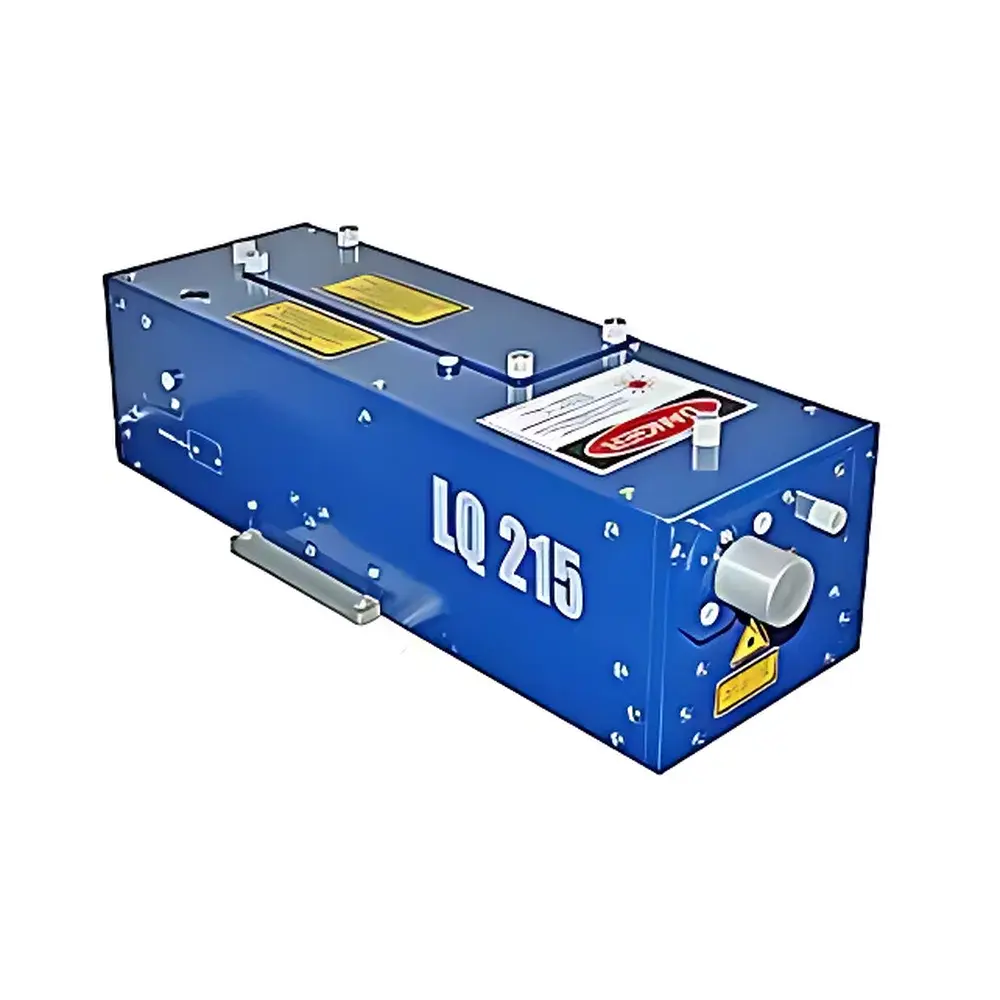
Solar+LQ215 Nd:YAG Pulsed Q-Switched Laser System
| Brand | SOLAR |
|---|---|
| Origin | Russia |
| Model | LQ215-D |
| Type | Solid-State Nanosecond Pulsed Nd:YAG Laser |
| Harmonic Output | 1064 nm, 532 nm, 355 nm, 266 nm, 213 nm |
| Max Pulse Energy (1064 nm) | 130 mJ |
| Repetition Rate | Up to 50 Hz |
| Compliance | CE, RoHS, IEC 60825-1 Class 4 Laser Product |
Overview
The Solar LQ215-D is a compact, air-cooled (or optionally water-cooled), Q-switched solid-state Nd:YAG laser system engineered for high-reliability pulsed operation in demanding laboratory, industrial, and field-deployable applications. Based on a monolithic, thermally stable resonator design, the LQ215-D delivers nanosecond-duration pulses (typically < 7 ns FWHM at 1064 nm) with exceptional pulse-to-pulse stability (< ±1.5% RMS over 8 hours) and beam quality (M² < 1.3, TEM₀₀ selectable). Its core architecture leverages flashlamp-pumped neodymium-doped yttrium aluminum garnet (Nd:Y₃Al₅O₁₂) crystal technology, operating fundamentally at the fundamental wavelength of 1064 nm, with intracavity or external harmonic generation enabling output at 532 nm (second harmonic), 355 nm (third), 266 nm (fourth), and 213 nm (fifth harmonic). This multi-wavelength capability supports diverse photophysical interaction regimes—from LIBS plasma initiation and time-resolved fluorescence excitation to nonlinear optical parametric amplification pumping and precision micromachining.
Key Features
- Monolithic all-in-one design integrating laser head, power supply, and closed-loop water cooling system—no external chillers required
- Electronically interlocked safety shutter compliant with IEC 60825-1:2014 requirements for Class 4 laser systems
- Flashlamp lifetime exceeding 10⁷ shots under nominal operating conditions (1064 nm @ 50 Hz, 130 mJ)
- Harmonic generation modules factory-aligned and optimized for maximum conversion efficiency and long-term spectral stability
- Digital control interface via RS-232/USB with TTL-compatible external trigger input (rising-edge, < 10 ns jitter)
- Thermal management architecture enabling continuous operation at rated repetition rate without derating
- Front-panel LCD display with real-time monitoring of pulse energy, repetition rate, lamp current, and coolant temperature
Sample Compatibility & Compliance
The LQ215-D is compatible with standard optical tables, motorized translation stages, and vacuum-compatible beam delivery optics (e.g., fused silica lenses, dielectric mirrors, harmonic separation prisms). It meets essential international regulatory requirements including CE marking per Directive 2014/35/EU (Low Voltage Directive) and 2014/30/EU (EMC Directive), RoHS 2011/65/EU compliance for hazardous substances, and full alignment with IEC 60825-1:2014 for laser product safety classification (Class 4, accessible emission limit verification performed per Annex D). For GLP/GMP environments, optional audit-trail-enabled firmware supports FDA 21 CFR Part 11-compliant user access logs and parameter change history when integrated with validated laboratory information management systems (LIMS).
Software & Data Management
The included SolarControl software (Windows 10/11, 64-bit) provides full remote configuration, real-time diagnostics, and automated calibration routines—including automatic energy normalization across harmonics and built-in pulse energy drift compensation algorithms. Data export supports CSV, HDF5, and MATLAB .mat formats. API libraries (C/C++, Python 3.8+) enable integration into custom automation frameworks for high-throughput spectroscopy, LIBS mapping, or OPO synchronization sequences. All firmware updates are digitally signed and delivered via secure HTTPS endpoint; no internet connectivity is required during routine operation.
Applications
- Laser-Induced Breakdown Spectroscopy (LIBS) for elemental analysis of metals, soils, and geological samples (ASTM E2926-21 compliant setups)
- Pumping of tunable optical parametric oscillators (OPOs) and amplifiers (OPAs) for ultrafast mid-IR generation
- Time-resolved photoluminescence (TRPL) and pump-probe spectroscopy requiring precise temporal gating
- Thin-film ablation, micro-drilling, and surface texturing in semiconductor and photovoltaic R&D
- Calibration source for radiometric and photometric detectors across UV–NIR spectral bands
- Seed laser for master oscillator power amplifier (MOPA) architectures in high-energy laser systems
FAQ
What is the typical pulse width at 1064 nm?
Full-width at half-maximum (FWHM) is ≤ 6.5 ns under standard operating conditions (1064 nm, 50 Hz, 130 mJ), measured with a fast photodiode and 1 GHz oscilloscope.
Can the LQ215-D operate in single-shot mode with external triggering?
Yes—TTL-compatible external trigger input supports single-shot, burst-mode, or fully synchronized operation with jitter < 8 ns (RMS) relative to trigger edge.
Is harmonic generation internal or external?
All harmonic modules (SHG, THG, FHG, FHG) are housed within the main laser enclosure and factory-aligned; no user realignment is required for switching wavelengths.
What cooling method does the system use?
Standard configuration includes an integrated closed-loop water cooling unit (22–25°C setpoint, flow rate ≥ 3 L/min); air-cooled variants (LQ215-D-A) are available for low-duty-cycle applications.
Does the system support energy monitoring per pulse?
An internal calibrated pyroelectric sensor provides real-time pulse energy readout for 1064 nm and 532 nm; optional external calorimeters (e.g., Coherent PM10/PM30 series) integrate via analog voltage output (0–10 V).




