
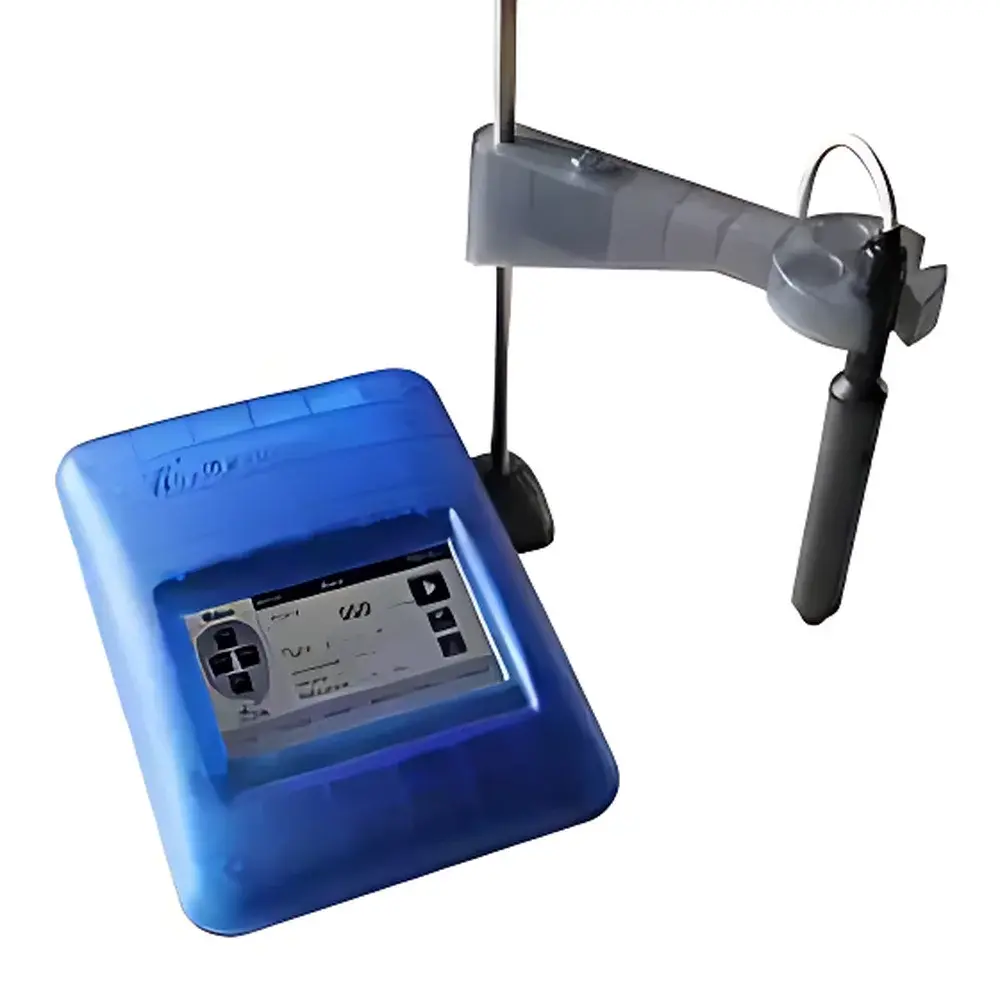
English Product Name
| Brand | Jihepu |
|---|---|
| Model | IS228-Basic |
| Type | Benchtop Conductivity Meter |
| Measurement Parameters | Conductivity, Resistivity, TDS, Salinity, Temperature |
| Conductivity Range | 0.000 µS/cm to 1000 mS/cm |
| Resistivity Range | 0.00 to 100.0 MΩ·cm |
| TDS Range | 0.00 mg/L to 1000 g/L |
| Salinity Range | 0.00–80.00 PSU |
| Temperature Range | –30.0 to 130.0 °C (MTC), –5.0 to 130.0 °C (ATC) |
| Accuracy | ±0.5% of reading (conductivity/resistivity/TDS/salinity), ±0.1 °C (temperature) |
| Resolution | 0.001 (auto-ranging across 7 conductivity decades), 0.01 PSU, 0.1 °C |
| Calibration | Single-point with built-in database of 10 standard solutions |
| Data Storage | 500 GLP-compliant records |
| Interface | RS232, USB, Mini-DIN8 electrode port (NTC 30 kΩ integrated temperature sensor) |
| Display | 5.0-inch color TFT touchscreen (800 × 480 px) |
| Power Supply | External 9 V/1 A adapter |
Overview
The Jihepu IS228-Basic Benchtop Conductivity Meter is a precision-engineered electrochemical instrument designed for reliable, multi-parameter measurement of aqueous solution properties in quality control, environmental monitoring, pharmaceutical water testing, and academic research laboratories. It operates on the principle of two- or four-electrode AC conductivity measurement—employing a constant-frequency alternating current to minimize polarization effects and electrode fouling—enabling stable, reproducible readings across an exceptionally wide dynamic range (0.000 µS/cm to 1000 mS/cm). The integrated NTC 30 kΩ temperature sensor enables simultaneous temperature measurement with ±0.1 °C accuracy, supporting both manual temperature compensation (MTC) and automatic temperature compensation (ATC) across –5.0 to 130.0 °C. The instrument supports configurable reference temperatures (20 °C or 25 °C) and selectable compensation algorithms—linear, non-linear (based on empirical water conductivity–temperature models), or disabled—ensuring compliance with method-specific requirements defined in ASTM D1125, ISO 7888, and USP . Its benchtop architecture prioritizes operational stability, ergonomic accessibility, and long-term calibration integrity in regulated environments.
Key Features
- 5.0-inch high-resolution color TFT touchscreen (800 × 480 px) with intuitive graphical interface, derived from the proven IS-series pH platform for consistent operator experience and reduced training burden.
- Auto-ranging conductivity measurement across seven decades—from ultra-pure water (0.000 µS/cm) to saturated brines (1000 mS/cm)—with resolution down to 0.001 µS/cm at lowest range.
- Simultaneous calculation and display of four derived parameters: conductivity, resistivity (0.00–100.0 MΩ·cm), TDS (0.00 mg/L–1000 g/L), and salinity (0.00–80.00 PSU), all traceable to primary standards.
- GLP-compliant data management: stores up to 500 measurement records with timestamp, operator ID, electrode ID, calibration history, and environmental conditions—fully auditable for ISO/IEC 17025 or FDA 21 CFR Part 11 readiness.
- Flexible connectivity: RS232 and USB ports support direct PC communication; compatible with Jihepu IS-LINK software for real-time data streaming, remote configuration, and automated report generation.
- Built-in calibration database with 10 preloaded standard solutions (e.g., 1408 µS/cm and 12.85 mS/cm KCl standards); single-point calibration protocol minimizes procedural complexity while maintaining metrological rigor.
Sample Compatibility & Compliance
The IS228-Basic accommodates a broad spectrum of aqueous samples—including purified water (PW), water-for-injection (WFI), process streams, wastewater effluents, seawater analogs, and electrolyte solutions—without requiring hardware modification. Its YE301 four-ring conductivity cell (included) provides optimal sensitivity and linearity for high-conductivity media while minimizing errors from cable capacitance and stray currents. The instrument meets IEC 61010-1 safety requirements for laboratory electrical equipment and conforms to electromagnetic compatibility (EMC) standards per IEC 61326-1. All measurement algorithms adhere to internationally recognized conversion factors: TDS calculated using 0.65–0.75 multiplier (user-selectable), salinity based on PSS-78 practical salinity scale, and resistivity derived directly from reciprocal conductivity. Documentation includes full traceability statements for included calibration standards and supports audit-ready GLP/GMP workflows.
Software & Data Management
IS-LINK software (Windows-compatible) transforms the IS228-Basic into a networked analytical node. It enables live graphing of conductivity vs. time, batch export of CSV/Excel datasets, customizable report templates (including lab header, SOP number, and analyst signature fields), and secure user access control. Audit trail functionality logs all configuration changes, calibration events, and data exports with immutable timestamps—critical for regulatory submissions under FDA 21 CFR Part 11 or EU Annex 11. Data files include embedded metadata: instrument serial number, firmware version, electrode type, temperature compensation mode, and uncertainty estimates derived from ±0.5% accuracy specification. USB mass storage mode allows direct file transfer without software installation.
Applications
- Pharmaceutical water systems: Monitoring conductivity of Purified Water (PW) and Water for Injection (WFI) per USP , including Stage 1–3 testing protocols.
- Environmental labs: Field-deployable benchtop verification of surface water, groundwater, and wastewater conductivity for EPA Method 120.1 and ISO 10523 compliance.
- Power generation: Boiler feedwater and condensate purity assessment per ASTM D4582 and IAPWS guidelines.
- Food & beverage QC: Salt concentration validation in brines, sauces, and dairy processing streams using PSU or %w/w salinity output.
- Academic teaching labs: Demonstrating ion mobility, Kohlrausch’s law, and temperature-dependent conductivity behavior in electrolyte solutions.
FAQ
What electrode is supplied with the IS228-Basic, and is it suitable for high-conductivity samples?
The instrument includes the YE301 four-ring conductivity cell, optimized for measurements up to 1000 mS/cm with minimal polarization error and excellent long-term stability in aggressive electrolytes.
Does the IS228-Basic support 21 CFR Part 11 compliance for electronic records?
While the hardware itself does not embed digital signatures, its GLP mode, IS-LINK audit trail, and immutable metadata export fully support implementation of Part 11 controls when deployed within a validated IT environment.
Can temperature compensation be disabled for method-specific raw data acquisition?
Yes—users may select “No Compensation” mode to record uncorrected conductivity values at measured temperature, preserving raw data integrity for post-acquisition modeling.
Is the 500-record memory retained during power loss?
Yes—data are stored in non-volatile flash memory and persist through power cycling, battery replacement, or firmware updates.
What is the recommended recalibration frequency for routine QC use?
Per ISO/IEC 17025, calibration should occur before each analytical session or at least daily when used continuously; verification with a secondary standard is advised between calibrations.




