
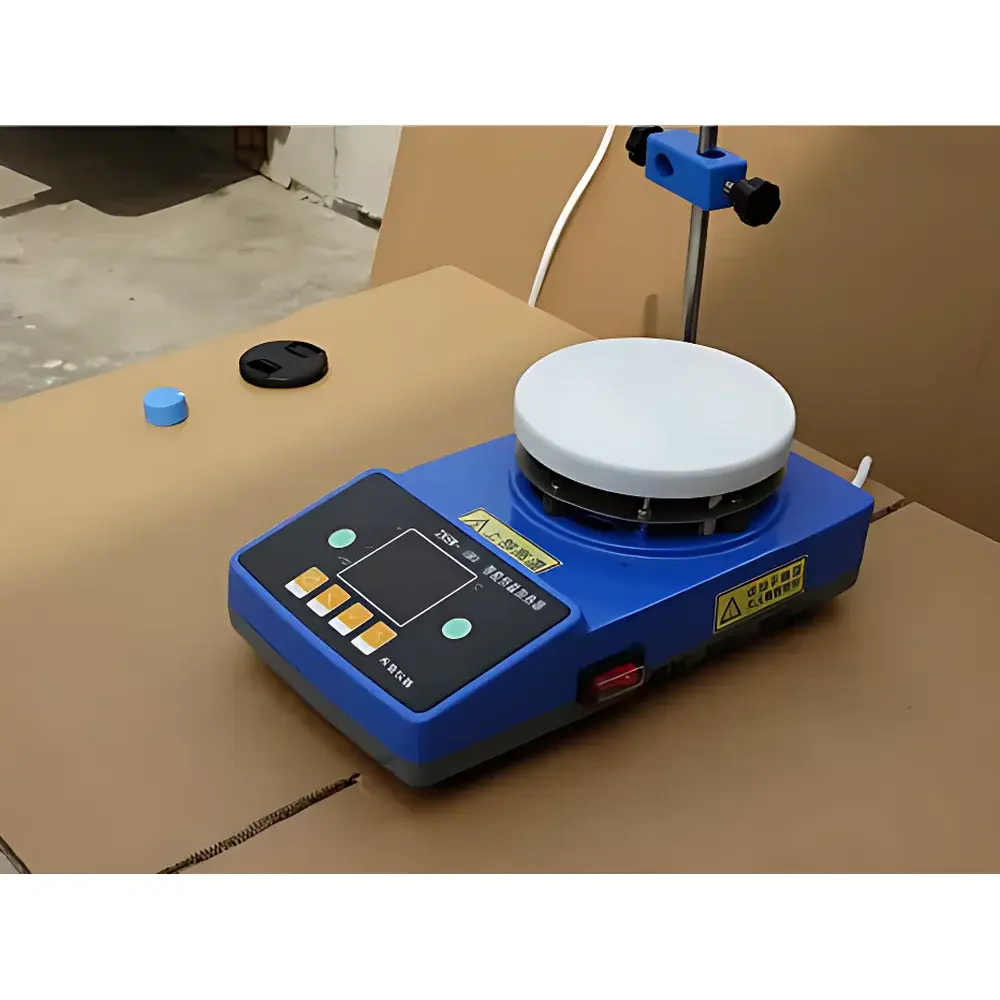
Jihepu TWJR-B Temperature-Controlled Hotplate Stirrer
| Brand | Jihepu |
|---|---|
| Origin | Shandong, China |
| Model | TWJR-B |
| Instrument Type | Magnetic Hotplate Stirrer |
| Max. Stirring Volume | 5 L |
| Heating Surface Temperature Range | Ambient to 350 °C |
| Liquid/Oil Temperature Capability | Up to 250 °C |
| Heating Power Options | 260 W / 350 W / 600 W / 750 W |
| Heating Plate Dimensions | 140×140 mm / 180×180 mm / 230×230 mm / 280×280 mm |
| Heating Surface Material | Black Crystal Ceramic Coated with Vacuum-Deposited TU2 Oxygen-Free Copper Layer |
| Control Method | Continuous Voltage Regulation via Silicon Controlled Rectifier (SCR) |
| Temperature Accuracy | ±3 °C |
| Power Supply | 220 V AC, 50 Hz |
| Enclosure Material | Flame-Retardant Reinforced PBT Thermoplastic |
| Weight | 2.2–9.5 kg (model-dependent) |
| Compliance | Designed for GLP-compliant laboratory environments |
Overview
The Jihepu TWJR-B Temperature-Controlled Hotplate Stirrer is an engineered solution for precise thermal management and gentle mechanical agitation in analytical, synthetic, and quality control laboratories. Unlike conventional hotplates, the TWJR-B integrates a high-temperature black crystal ceramic heating surface vacuum-coated with TU2 oxygen-free copper — a proprietary thermal architecture designed to deliver uniform heat distribution and rapid thermal response. Its core function relies on resistive Joule heating via Cr20Ni80 (Nichrome) heating elements, regulated through phase-angle-controlled silicon-controlled rectifiers (SCRs), enabling infinitely variable voltage adjustment from 0–220 V. This architecture supports stable surface temperatures up to 350 °C while maintaining liquid or oil bath temperatures ≤250 °C — a critical distinction for applications requiring controlled thermal input without solvent degradation or sample decomposition. The device operates exclusively as a hotplate stirrer (i.e., no built-in magnetic drive motor); users integrate it with external magnetic stir bars and compatible stirrer bases or overhead stirrers. Its design prioritizes operational safety, thermal reproducibility, and long-term stability under continuous duty cycles.
Key Features
- Black crystal ceramic heating surface with vacuum-deposited TU2 oxygen-free copper layer — corrosion-resistant, non-porous, and optimized for thermal conductivity and surface uniformity
- Four standard plate sizes (140×140 mm to 280×280 mm) supporting reaction vessels from 50 mL vials to 5 L round-bottom flasks
- Flame-retardant reinforced PBT thermoplastic housing — rated UL94 V-0, electrically insulating, and resistant to common organic solvents and acids
- Ergonomic 30° inclined control panel — positioned for optimal visibility and tactile access during both seated and standing operation
- SCR-based continuous voltage regulation — enables fine-grained thermal ramping and maintenance of setpoint temperature with ±3 °C accuracy (measured at surface)
- No internal moving parts — eliminates mechanical wear, reduces maintenance, and enhances reliability in 24/7 operation
Sample Compatibility & Compliance
The TWJR-B accommodates standard and non-standard glassware including borosilicate beakers, Erlenmeyer flasks, round-bottom flasks, and jacketed reactors (50–5000 mL). Its flat, inert ceramic surface ensures compatibility with Teflon-coated stir bars, glass-coated magnets, and PTFE-sheathed thermometers. While the unit itself does not include integrated temperature feedback, its surface temperature profile is calibrated to support external probe-based monitoring per ASTM E74 and ISO 17025 requirements. The device is constructed to meet basic electrical safety standards (IEC 61010-1) and is routinely deployed in laboratories adhering to Good Laboratory Practice (GLP) and Good Manufacturing Practice (GMP) frameworks. When paired with validated external temperature sensors and documented SOPs, it supports audit-ready workflows compliant with FDA 21 CFR Part 11 data integrity expectations.
Software & Data Management
The TWJR-B is a standalone analog-controlled instrument with no embedded microprocessor or digital interface. It features a single rotary knob for voltage adjustment and requires manual calibration verification using NIST-traceable contact thermometers (e.g., Class A glass thermometers or calibrated RTD probes). For laboratories requiring electronic data capture, integration is achieved externally via third-party temperature loggers (e.g., Omega OM-CP series) or programmable PID controllers connected to the unit’s analog output signal (if retrofitted with optional voltage-monitoring terminals). All models support manual recordkeeping aligned with ISO/IEC 17025 clause 7.5.2 (control of recorded information) and are suitable for inclusion in equipment qualification protocols (IQ/OQ/PQ).
Applications
- Solvent evaporation and concentration under controlled thermal conditions
- Preparation of polymer solutions, colloidal dispersions, and nanoparticle suspensions
- Heating and homogenization of viscous samples prior to rheological or spectroscopic analysis
- Supporting reflux, distillation, and extraction procedures in organic synthesis labs
- Thermal preconditioning of calibration standards for viscometers, densitometers, and refractometers
- Stabilization of reaction mixtures during kinetic studies where precise thermal input is required without mechanical shear
FAQ
Does the TWJR-B include a built-in magnetic stirring motor?
No. The TWJR-B is a hotplate-only unit. Magnetic stirring requires an external stir bar and a separate magnetic stirrer base or overhead stirrer system.
What is the maximum recommended operating time?
The unit is rated for continuous operation (100% duty cycle) at all power ratings, provided ambient temperature remains below 35 °C and ventilation is unobstructed.
Can the surface temperature be measured directly with a standard thermometer?
Direct contact measurement is not advised due to thermal inertia and potential damage to glass thermometers. Use a calibrated infrared pyrometer (emissivity set to 0.92–0.95) or embed a thermocouple in a dummy vessel filled with thermal oil.
Is the heating surface compatible with aggressive reagents like concentrated HNO₃ or HF?
The black crystal ceramic surface resists most common acids and bases, but hydrofluoric acid (HF) will etch silica-based ceramics and must be avoided.
How is temperature accuracy verified during routine use?
Calibration is performed quarterly using a NIST-traceable reference thermometer immersed in a standardized oil bath (e.g., silicone oil, 200 cSt) placed centrally on the heating surface, per ASTM E220 methodology.



