
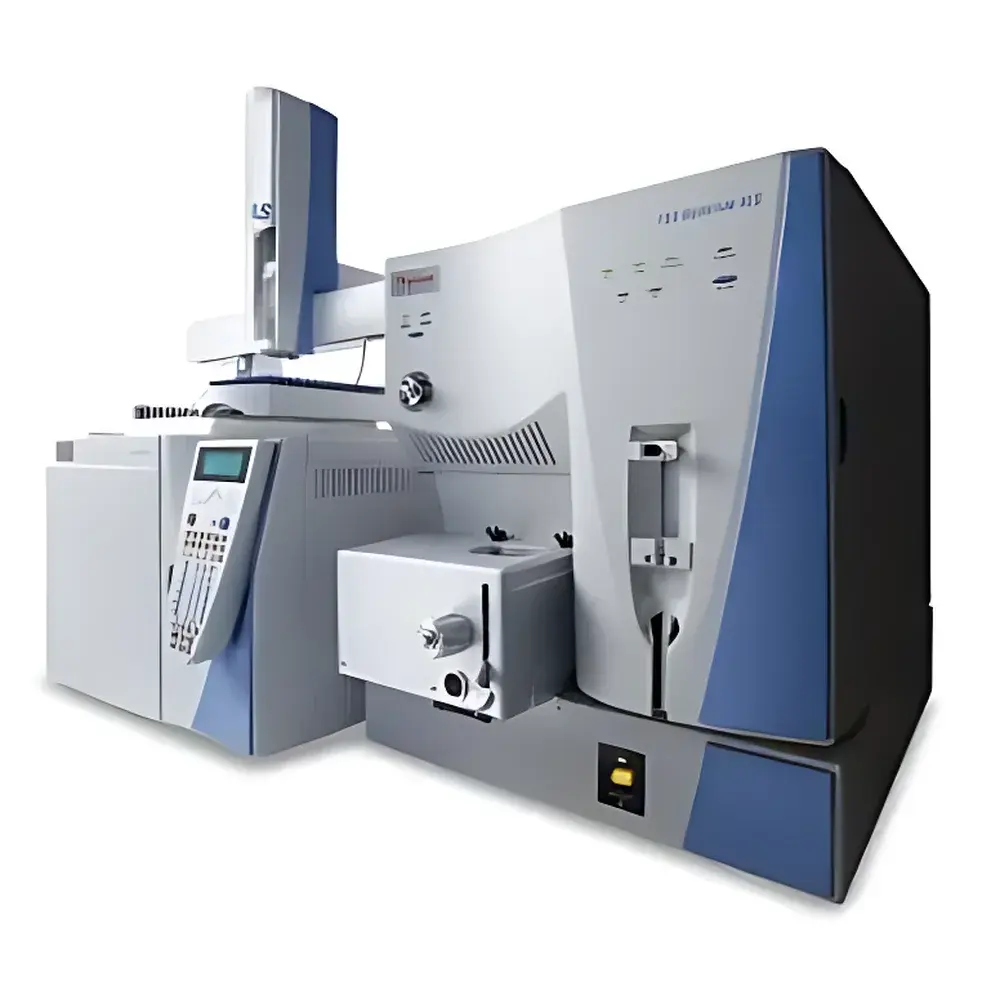
Thermo Fisher TSQ Quantum XLS Triple Quadrupole Gas Chromatography Mass Spectrometer
| Brand | Thermo Fisher |
|---|---|
| Origin | USA |
| Manufacturer Type | Original Equipment Manufacturer (OEM) |
| Origin Category | Imported |
| Model | TSQ Quantum XLS |
| Instrument Type | Triple Quadrupole Mass Spectrometer |
| Chromatography Type | Conventional Gas Chromatography (GC) |
| Regulatory Compliance | FDA 21 CFR Part 11, GLP/GMP-ready |
| Ionization Modes | Electron Ionization (EI), Chemical Ionization (CI), Positive/Negative Pulse CI (PPINICI) |
| Collision Cell Geometry | 90° bent collision cell with zero crosstalk design |
| Key Technology | DuraBrite IRIS ion source, High-Selectivity SRM (H-SRM), Structural Selectivity Detection (SSD), Quantitation-Triggered Enhanced MS/MS (QED) |
Overview
The Thermo Fisher TSQ Quantum XLS is a high-performance triple quadrupole gas chromatography mass spectrometer (GC-MS/MS) engineered for ultra-trace quantitative and confirmatory analysis in regulated and research-intensive laboratories. Built upon Thermo Fisher’s legacy of precision in tandem mass spectrometry, the system employs a robust triple quadrupole architecture operating under controlled vacuum conditions to deliver exceptional selectivity, sensitivity, and reproducibility. Its core measurement principle relies on sequential mass filtering—where Q1 isolates precursor ions, Q2 serves as a pressurized collision cell enabling controlled fragmentation via collision-induced dissociation (CID), and Q3 filters specific product ions—enabling highly selective reaction monitoring (SRM) and its enhanced variant, High-Selectivity SRM (H-SRM). This architecture minimizes chemical noise and matrix interferences, making it especially suitable for complex sample matrices encountered in food safety testing, environmental residue analysis, forensic toxicology, and pharmaceutical pharmacokinetic studies.
Key Features
- DuraBrite IRIS ion source: A high-inertness, self-cleaning electron ionization source featuring optimized geometry and surface passivation to minimize analyte adsorption and degradation—critical for thermally labile compounds such as pesticides, pharmaceuticals, and endocrine disruptors.
- Hot-swappable ion cartridge: Enables full ion source maintenance—including EI/CI/NCI mode switching—without breaking vacuum, reducing instrument downtime and improving operational continuity.
- 90° bent collision cell with zero-crosstalk design: Physically separates precursor and product ion pathways to eliminate spectral interference from unfragmented precursor ions, ensuring high-fidelity MS/MS spectra and reliable quantification.
- Quantitation-Triggered Enhanced MS/MS (QED): Simultaneously acquires quantitative SRM data and structural confirmation scans within a single GC injection—supporting regulatory compliance requirements for identity confirmation per ICH M7, USP <1225>, and EU Commission Decision 2002/657/EC.
- Structural Selectivity Detection (SSD): Integrates retention time, precursor/product ion ratio, and fragment intensity thresholds to strengthen compound identification confidence beyond standard SRM criteria.
- PPINICI capability: Pulse-driven positive/negative chemical ionization allows rapid polarity switching during a single run—ideal for screening applications requiring broad-spectrum detection of acidic, basic, and neutral analytes.
- Integrated back-flush GC interface (optional): Reduces column contamination and carryover by diverting non-volatile matrix components away from the analytical column and MS interface, extending column lifetime and sustaining sensitivity over high-throughput sequences.
Sample Compatibility & Compliance
The TSQ Quantum XLS is validated for use with widely adopted sample preparation workflows including QuEChERS (EN 15662), DIN EN 12393-1, ASE/PLE, and liquid-liquid extraction (LLE). It supports method alignment with national standards across China (GB series), Japan (JIS, ML), and the European Union (SANTE/2023/2022). The system complies with Good Laboratory Practice (GLP) and current Good Manufacturing Practice (cGMP) documentation requirements through full audit trail functionality, electronic signature support, and secure user access controls—all enabled by native integration with Thermo Scientific Chromeleon CDS software under FDA 21 CFR Part 11 compliance.
Software & Data Management
Controlled via Thermo Scientific Chromeleon Chromatography Data System (CDS) v7.3 or later, the TSQ Quantum XLS delivers seamless method development, acquisition, processing, and reporting. The software includes automated calibration verification, peak integration validation, and batch-level QC flagging based on predefined acceptance criteria. All raw data files are stored in open-format .RAW containers compatible with third-party processing tools. Audit trails log every user action—including method edits, sequence modifications, and result reprocessing—with timestamp, operator ID, and reason-for-change fields. Data integrity is further ensured through write-once-read-many (WORM) archive options and role-based permission hierarchies.
Applications
- Food safety: Multi-residue pesticide screening at sub-pg/g levels in fruits, vegetables, cereals, and infant formula using QuEChERS-extracted samples.
- Environmental analysis: Quantification of persistent organic pollutants (POPs), brominated flame retardants (PBDEs, HBCDs), and dioxin-like compounds in soil, sediment, and wastewater extracts.
- Forensic toxicology: Confirmation and quantification of drugs of abuse, novel psychoactive substances (NPS), and metabolites in blood, urine, and hair matrices.
- Pharmaceutical development: Bioanalytical support for ADME/PK studies—measuring low-abundance drug candidates and metabolites in plasma and tissue homogenates.
- Regulatory compliance: Routine monitoring aligned with EPA Method 8270, ISO 17025-accredited labs, and EFSA/EPA reference methods for trace organic contaminants.
FAQ
Does the TSQ Quantum XLS support both EI and CI ionization without venting the mass spectrometer?
Yes—the hot-swappable ion cartridge enables full ion source exchange or mode switching (EI/PCI/NCI) under continuous vacuum operation, typically completed in under 90 seconds.
What is the role of the 90° bent collision cell in minimizing false positives?
Its orthogonal geometry physically decouples precursor ion transmission from product ion detection paths, eliminating direct transmission of unfragmented ions into Q3 and thereby suppressing background signal and cross-talk artifacts.
Can the system perform quantitative and qualitative analysis in a single injection?
Yes—via Quantitation-Triggered Enhanced MS/MS (QED), where an SRM transition exceeding a defined threshold automatically triggers a concurrent product ion scan for structural confirmation.
Is the TSQ Quantum XLS compatible with legacy GC methods developed for single-quadrupole systems?
Yes—method translation is supported through Thermo’s Method Translation Tool, which provides automated parameter conversion for retention time, temperature ramp, and ion optics settings.
How does DuraBrite IRIS improve long-term sensitivity stability?
The source incorporates ultra-low-bleed materials and pre-filtering quadrupole optics that reduce matrix deposition on critical components, extending mean time between maintenance cycles by up to 3× compared to conventional EI sources.




