
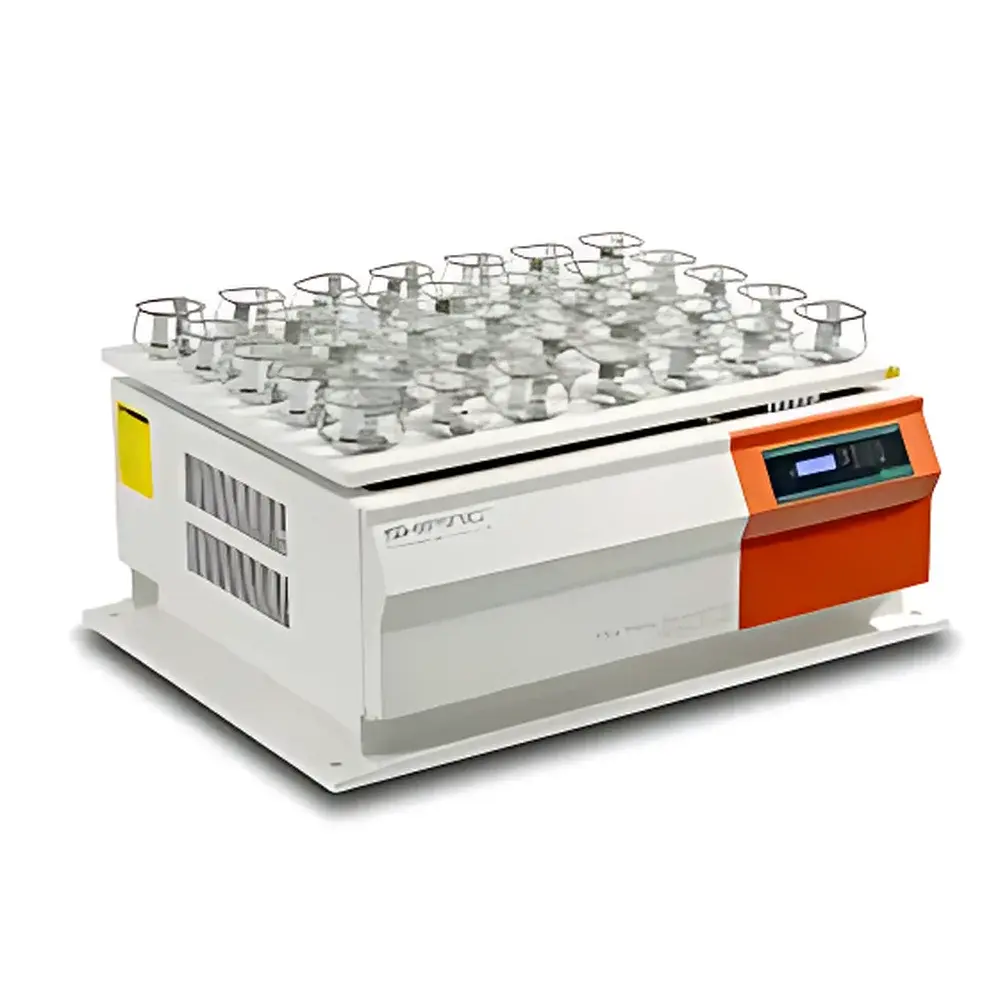
Jihepu SPH-311D High-Precision Orbital Shaker for Small-Volume Culture Vessels
| Brand | Jihepu |
|---|---|
| Origin | Shandong, China |
| Model | SPH-311D |
| Timer Range | 0–500 h (continuous operation) |
| Oscillation Speed | 50–300 rpm |
| Orbit Diameter | Φ50 mm |
| Temperature Control | Not integrated (designed for use in external controlled environments) |
| Shelf Quantity | 1 platform |
| Power Supply | AC 200–240 V, 50–60 Hz |
| Rated Power | 70 W |
| Net Weight | 60 kg |
| Platform Dimensions | 680 × 500 mm |
| Frequency Accuracy | ±1 rpm |
| Drive Mechanism | Patented single-axis dynamic balance drive |
Overview
The Jihepu SPH-311D High-Precision Orbital Shaker is an engineered solution for aerobic microbial cultivation—particularly in antibiotic production, recombinant protein expression, and strain screening workflows. Unlike generic shakers, the SPH-311D employs a precisely calibrated orbital motion (Φ50 mm diameter) optimized to maximize oxygen transfer efficiency (kLa) in small-volume culture vessels (e.g., 50–500 mL Erlenmeyer flasks). Its design adheres to fundamental bioreactor fluid dynamics principles: at fixed fill volumes, increasing orbit diameter enhances liquid film formation along flask walls, thereby expanding gas–liquid interfacial area more effectively than speed increases alone. This enables reproducible dissolved oxygen (DO) profiles critical for aerobic fermentation kinetics—without requiring excessive rotational speeds (>300 rpm) that risk splashing, evaporation-induced medium concentration, or shear-sensitive cell damage. The unit operates without integrated heating/cooling; it is expressly intended for installation within externally regulated incubators or temperature-controlled rooms—ensuring compliance with ISO 13485 environmental control requirements for GMP-aligned bioprocess development.
Key Features
- Patented single-axis dynamic balance drive system—minimizes mechanical vibration, extends bearing life, and ensures silent, long-term operational stability.
- Eight-segment programmable controller: each segment independently sets speed (50–300 rpm) and duration (up to 500 h), supporting multi-phase growth protocols (e.g., lag-phase adaptation → exponential growth → stationary-phase induction).
- PID-based microprocessor control with ±1 rpm speed accuracy—maintains consistent orbital kinetics across load variations and ambient temperature fluctuations.
- Soft-start circuitry prevents abrupt acceleration, eliminating reagent splashing and preserving sample integrity during flask loading/unloading.
- Dual-layer safety architecture: independent over-speed audible/visual alarm + isolated leakage current and over-current protection—fully compliant with IEC 61010-1 safety standards.
- Motor thermal cutoff and temperature runaway protection—automatically interrupts power if internal motor temperature exceeds safe thresholds.
- High-torque, maintenance-free brushless DC motor rated for continuous duty cycles under full load.
- Epoxy-coated cold-rolled steel chassis with structural reinforcement (angle iron, channel steel, cast iron base)—optimized for rigidity and resonance suppression in clustered lab installations.
Sample Compatibility & Compliance
The SPH-311D accommodates standard microbiological glassware including 50 mL, 100 mL, 250 mL, and 500 mL Erlenmeyer flasks (clamps included for 250 mL and 500 mL sizes; optional adapters available for 50–1000 mL vessels). Its orbital geometry has been validated per ASTM D4097 (Standard Test Method for Oxygen Transfer Rate in Laboratory-Scale Shaken Cultures) for kLa enhancement in low-fill-ratio configurations (e.g., 50 mL medium in 500 mL flask). As a Class I electrical device intended for use in climate-controlled laboratory spaces, it meets CE marking requirements and supports GLP/GMP documentation through configurable audit trails in optional data-logging modules (sold separately). It does not incorporate temperature regulation; users must validate environmental chamber performance per ISO 14644-1 (cleanroom classification) or USP when deployed in regulated biomanufacturing support labs.
Software & Data Management
The built-in LCD interface supports real-time monitoring of elapsed time, setpoint speed, and active program segment. All user-defined parameters—including eight-segment schedules, last-used speed, and timer status—are retained in non-volatile memory during power loss (power-fail recovery function). For traceability in regulated environments, optional RS-485/Modbus RTU connectivity enables integration with LIMS or SCADA systems. When paired with certified third-party data loggers, the shaker supports 21 CFR Part 11-compliant electronic records—including operator ID, timestamped parameter changes, and alarm event logs—with digital signature capability. Firmware updates are performed via secure USB interface with version-controlled checksum verification.
Applications
- Aerobic microbial culture for antibiotic biosynthesis (e.g., penicillin, cephalosporin strains)
- High-throughput strain selection and media optimization studies
- Recombinant protein expression in E. coli and yeast hosts
- Cell line expansion for mammalian suspension cultures (pre-bioreactor scale-up)
- Enzyme production and metabolic pathway characterization
- Environmental microbiology assays requiring standardized aeration
FAQ
Is the SPH-311D suitable for use inside a CO2 incubator?
No—it lacks sealed electronics and temperature-compensated components required for humidified, CO2-enriched environments. Use only in dry, temperature-stabilized rooms or dedicated shaker incubators with external environmental control.
Does it support serial communication for remote monitoring?
Yes—via optional RS-485 Modbus RTU interface (hardware kit and configuration software sold separately).
What is the maximum flask fill volume recommended for optimal oxygen transfer?
For 500 mL flasks, 50–100 mL working volume delivers peak kLa at 220–250 rpm; exceeding 150 mL reduces surface-to-volume ratio and diminishes aeration efficiency.
Can it operate unattended for extended periods?
Yes—the 500-hour timer, power-fail recovery, and thermal overload protection enable fully autonomous overnight and weekend runs.
Are calibration certificates available for regulatory submissions?
Factory calibration reports (speed accuracy, timer drift, mechanical stability) are provided with each unit; NIST-traceable recalibration services are available upon request.




