
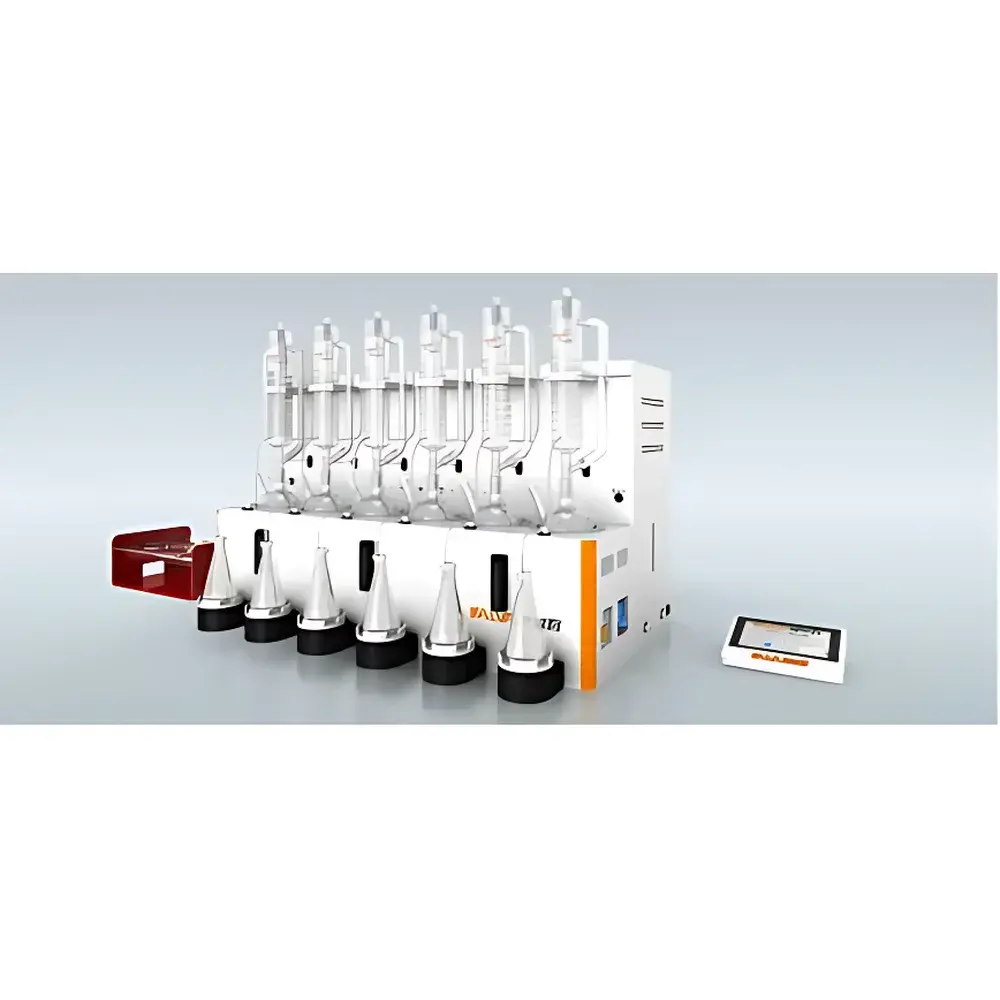
HePu Smart D6 Fully Automated Intelligent Distillation System
| Brand | HePu (Jihepu) |
|---|---|
| Origin | Shandong, China |
| Manufacturer Type | Authorized Distributor |
| Equipment Type | Quartz Glass Distillation Apparatus |
| Model | Smart D6 |
| Price | USD 6,900 (FOB Qingdao) |
| Distillation Units | 6-channel independent control |
| Temperature Range | Ambient to 320 °C (per channel) |
| Time Control | 0–999 min (per channel) |
| Power | 3000 W total (400 W per heating zone, adjustable) |
| Heating Uniformity | Infrared ceramic heating modules |
| Endpoint Detection | Gravimetric, ±0.01 g accuracy |
| Distillate Volume Range | 1–600 g (user-defined per channel) |
| Cooling | Integrated compressor-based closed-loop chiller |
| Condenser Cleaning | Automated in-line rinse function |
| Display | 7-inch capacitive touchscreen (16-bit true color) |
| Control Interface | Local GUI + Ethernet/Wi-Fi enabled PC/remote monitoring (optional cloud server module) |
Overview
The HePu Smart D6 Fully Automated Intelligent Distillation System is an ASTM-compliant, laboratory-grade distillation platform engineered for high-throughput, trace-level analysis of volatile analytes in environmental, wastewater, and regulatory testing laboratories. Designed in accordance with ISO 6439 (cyanide), ISO 6378 (phenols), ISO 5667-16 (ammonia nitrogen), and EPA Method 410.1 (COD pre-distillation), the system implements a gravimetric endpoint detection principle—measuring real-time mass change of the receiving vessel during distillation—to eliminate subjective visual judgment and photometric interference common in optical endpoint systems. Its six independently controlled distillation channels operate under programmable thermal profiles, enabling parallel processing of heterogeneous sample matrices while maintaining strict adherence to method-defined temperature ramping, hold times, and distillate volume thresholds. The system’s fully sealed cooling circuit—integrated with a high-efficiency compressor chiller—ensures consistent condensation performance across ambient temperatures from 10 °C to 35 °C without reliance on municipal water supply, thereby meeting ISO/IEC 17025 requirements for environmental control stability during accredited testing.
Key Features
- Six-channel modular architecture with per-unit independent temperature (ambient–320 °C), time (0–999 min), and distillate mass (1–600 g) programming—enabling simultaneous multi-analyte workflows (e.g., phenol + cyanide + NH₃-N in one run).
- Infrared ceramic heating elements with mold-formed geometry ensure uniform thermal distribution, minimizing localized superheating and eliminating bumping or explosive boiling—critical for reproducible recovery of volatile organics and low-boiling inorganics.
- Gravimetric endpoint detection calibrated to ±0.01 g resolution, coupled with proprietary vibration-dampened load-cell isolation and dynamic noise-filtering algorithms, delivers >99.8% endpoint repeatability across 10,000+ cycles (validated per ISO 5725-2).
- Fully automated anti-suckback mechanism activates upon power-down or temperature decay, preventing reflux of condensed distillate into the digestion flask—a design feature essential for preserving analytical integrity in ammonia and cyanide determinations per USP and CLSI EP21-A.
- On-board compressor chiller maintains condenser inlet water at 4–8 °C continuously; closed-loop operation eliminates scaling, reduces lab water consumption by >95%, and supports uninterrupted 24-hour unattended operation.
- Integrated tare function, one-touch start, and Smart GUI with context-aware prompts reduce operator training time to <15 minutes—fully compliant with GLP documentation requirements for user access control and audit trail generation.
Sample Compatibility & Compliance
The Smart D6 accommodates standard 500 mL dual-neck round-bottom flasks, 10–100 mL volumetric receivers (including Nessler tubes and Class A borosilicate glassware), and custom container geometries via programmable height calibration. It is validated for use with aqueous matrices containing suspended solids ≤500 mg/L, chloride ≤10,000 mg/L, and sulfide ≤20 mg/L—covering EPA 300.0, ISO 11923 (COD distillation step), and China’s HJ 503-2009, HJ 484-2009, and HJ 537-2009 regulatory methods. All wetted surfaces contact only high-purity quartz glass, PTFE, and 316L stainless steel—ensuring zero metal leaching during high-acid (H₂SO₄, H₃PO₄) or high-alkali (NaOH) distillations. Full compliance with IEC 61010-1 (safety), IEC 61326-1 (EMC), and FDA 21 CFR Part 11 (when paired with optional HePu LabLink™ software suite) is documented in the certified Type Examination Report (TER-SD6-2024-0892).
Software & Data Management
Control firmware runs on a hardened ARM Cortex-A9 real-time OS with deterministic task scheduling, ensuring sub-second response latency for endpoint capture and thermal actuation. Local operation occurs via the 7-inch resistive-capacitive hybrid touchscreen running HePu DistilOS v3.2—supporting method templates, electronic signature capture, and automatic PDF report generation (including raw mass/time logs, thermal curves, and QC flagging). For networked environments, the system integrates with HePu LabLink™ Server (Windows/Linux), enabling centralized method deployment, remote status monitoring via web dashboard, and secure RESTful API access for LIMS integration (ASTM E1578-compliant). All data—including instrument logs, user actions, and calibration records—is stored with SHA-256 hashing and timestamped audit trails meeting ALCOA+ principles for 21 CFR Part 11 compliance.
Applications
The Smart D6 is routinely deployed in municipal water quality labs (ISO 5667 series), third-party environmental testing facilities (CNAS-accredited per ISO/IEC 17025:2017), and pharmaceutical QC labs performing residual solvent testing (ICH Q2(R2)). Primary applications include: distillation pretreatment for spectrophotometric determination of volatile phenols (4-aminoantipyrine method); acid distillation of cyanide complexes prior to pyridine-barbituric acid detection; alkaline distillation of ammonium salts for indophenol blue analysis; and sulfuric acid-mediated distillation in COD digestion protocols where chloride interference must be removed. Its ability to execute staggered start times, variable ramp rates, and post-distillation hold phases makes it suitable for method development studies requiring kinetic profiling of volatilization efficiency.
FAQ
Does the Smart D6 support method validation per ISO/IEC 17025?
Yes—full validation documentation (IQ/OQ/PQ protocols, uncertainty budgets, and repeatability studies) is provided with each unit and updated annually per CNAS requirements.
Can the system be integrated into an existing LIMS without custom coding?
Yes—LabLink™ includes pre-built connectors for Thermo Fisher SampleManager, LabVantage, and STARLIMS via ASTM E1578-compliant XML schema export.
What maintenance intervals are recommended for the compressor chiller?
Compressor oil and filter replacement every 12 months or 3,000 operating hours; condenser coil cleaning quarterly using the built-in rinse cycle.
Is quartz glassware included, and does it meet ASTM E438 Type I Class A specifications?
Yes—the supplied 500 mL dual-neck flasks and condensers are certified to ASTM E438 Type I, Class A, with individual calibration certificates traceable to NIM (China National Institute of Metrology).
How is data integrity ensured during power interruption?
The system features non-volatile flash memory with auto-save every 2 seconds; all active distillation sessions resume from last valid endpoint upon reboot without data loss.



