
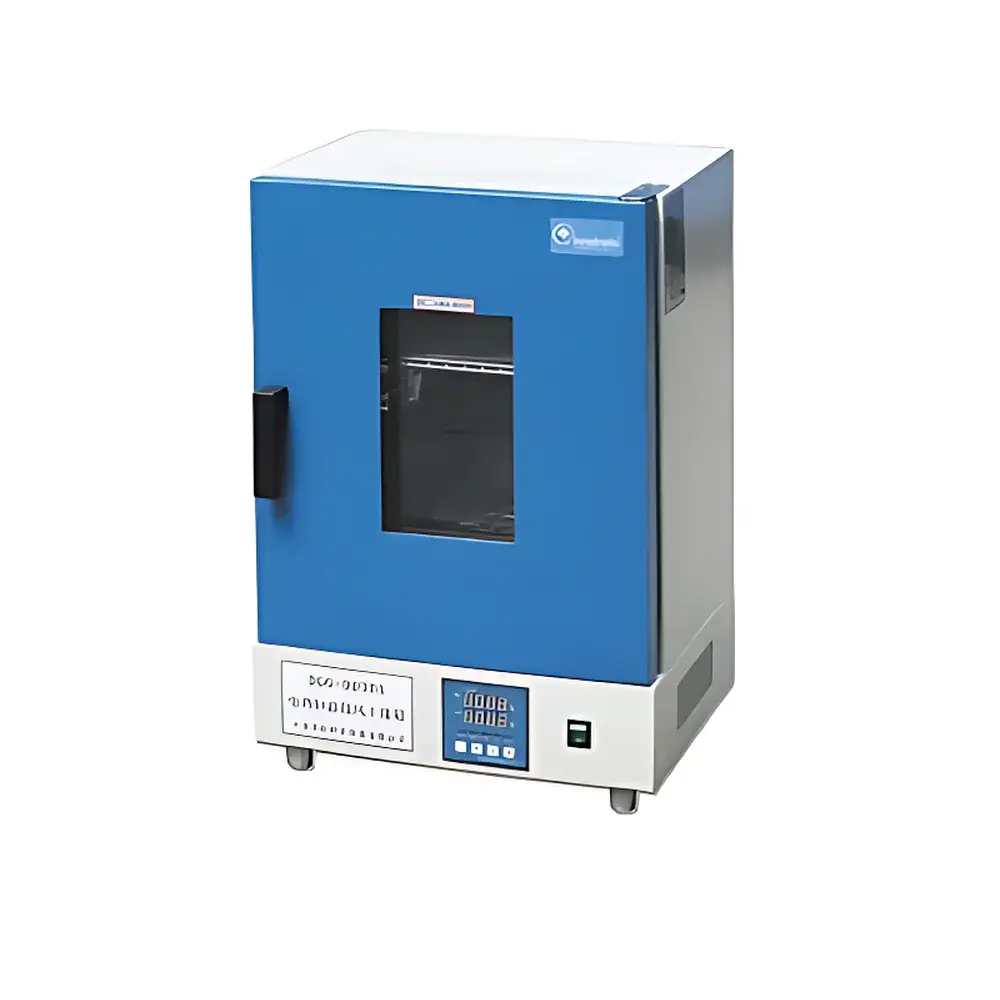
English Product Name
| Brand | Jihepu |
|---|---|
| Origin | Shandong, China |
| Model | DGG-9076A |
| Temperature Range | RT+10 °C to 300 °C |
| Temperature Uniformity | ±1 °C |
| Interior Dimensions (W×D×H) | 400 mm × 400 mm × 450 mm |
| Exterior Dimensions (W×D×H) | 550 mm × 600 mm × 800 mm |
| Interior Material | Mirror-finish stainless steel or galvanized steel |
| Heating Method | Forced convection via axial fan |
| Power Supply | 220 V, 50 Hz |
| Rated Power | 2100 W |
| Timer Range | 1–9999 minutes |
| Temperature Resolution | 0.1 °C |
| Operating Ambient | 5–40 °C, ≤80% RH |
Overview
The Jihepu DGG-9076A is a vertical forced-air constant-temperature drying oven engineered for precision thermal processing in laboratory and industrial quality control environments. It operates on the principle of uniform convective heat transfer, utilizing a high-efficiency axial fan to circulate heated air vertically through the chamber—ensuring rapid thermal equilibration and minimal spatial temperature gradients. Designed for applications requiring stable, repeatable thermal exposure—including moisture removal, polymer curing, pharmaceutical stability testing, sample pre-conditioning, and microbiological media drying—the DGG-9076A meets foundational requirements for ISO/IEC 17025-compliant laboratories performing non-destructive thermal treatment protocols. Its RT+10 °C to 300 °C operating range supports both low-temperature desiccation and high-temperature bake-out procedures, while the ±1 °C temperature fluctuation specification reflects its suitability for routine analytical workflows where reproducibility—not ultra-high metrological accuracy—is the operational priority.
Key Features
- Digital microprocessor-based temperature controller with 0.1 °C resolution and programmable timer (1–9999 minutes), supporting single-setpoint operation or optional multi-segment ramp-soak profiles when equipped with the D-series intelligent LCD controller.
- Vertically oriented chamber architecture optimized for gravitational airflow distribution, minimizing stratification and enhancing thermal homogeneity across the full working volume (400 × 400 × 450 mm).
- Interior constructed from mirror-finish stainless steel (standard) or electrogalvanized steel (alternative), offering corrosion resistance, ease of decontamination, and compatibility with mild solvents and aqueous cleaning agents.
- Robust external casing fabricated from cold-rolled steel with powder-coated finish, providing mechanical durability and thermal insulation integrity under continuous operation.
- Independent over-temperature protection circuit—field-installable as an option—that interrupts power to the heating elements if user-defined safety limits are exceeded, satisfying basic electrical safety requirements per IEC 61010-1.
- Two standard adjustable stainless-steel wire shelves included; load capacity rated for static uniform distribution up to 20 kg per shelf.
Sample Compatibility & Compliance
The DGG-9076A accommodates a broad range of solid and semi-solid samples—including glassware, metal parts, ceramic substrates, polymer pellets, filter papers, biological tissue sections, and pharmaceutical excipients—provided they remain thermally stable within the specified temperature envelope. It is not intended for volatile organic solvents, pyrophoric materials, or oxygen-sensitive compounds unless operated under inert gas purge (requires optional inlet/outlet ports). While not certified to UL or CE for standalone safety compliance in North America or the EU, the unit conforms to general-purpose laboratory equipment design principles aligned with ASTM E145-22 (Standard Specification for Gravity-Convection and Forced-Ventilation Ovens) and supports GLP documentation practices when integrated into validated workflows. Its construction and control architecture permit integration into GMP-aligned environments when paired with appropriate calibration records, preventive maintenance logs, and change-control documentation.
Software & Data Management
The base configuration features a stand-alone digital controller with LED display and tactile keypad input. Optional RS485 serial interface (Modbus RTU protocol) enables bidirectional communication with external SCADA or LIMS platforms for remote parameter setting, real-time temperature logging, and alarm event capture. An optional Windows-compatible communication software package provides time-stamped data export in CSV format, configurable sampling intervals, and basic trend visualization. For regulated environments, the optional printer module generates hard-copy audit trails of setpoints, actual chamber temperatures, and timer status—supporting 21 CFR Part 11 traceability when deployed with electronic signature-enabled host systems. All firmware revisions undergo functional verification per internal QA procedures prior to release.
Applications
- Moisture content determination per AOAC 950.46 and USP <731> loss-on-drying protocols.
- Pre-drying of gravimetric filters, crucibles, and weighing boats prior to ash content analysis (ASTM D2974).
- Curing of epoxy-coated test specimens and adhesive-bonded assemblies in materials science labs.
- Stabilization of reference standards and hygroscopic reagents prior to analytical weighing.
- Thermal conditioning of electronic components before environmental stress screening.
- Depyrogenation of glassware at ≥250 °C for sterile manufacturing support (non-validated use only).
FAQ
Is the DGG-9076A suitable for vacuum drying applications?
No. This model is a forced-air convection oven only. Vacuum capability requires dedicated vacuum oven configurations (e.g., DZ series), which feature reinforced chambers, vacuum-rated seals, and pressure monitoring systems.
Can the unit be calibrated internally using NIST-traceable references?
Yes. The controller accepts two-point calibration via front-panel menu navigation using certified RTD or thermistor probes. Full calibration reports—including as-found/as-left data—can be generated manually or via RS485-linked software.
What is the recommended recalibration interval?
Annual calibration is advised for routine QC use. In GLP/GMP settings, calibration frequency must be justified by risk assessment and historical performance data, typically ranging from 3 to 12 months.
Does the oven include validation documentation?
No factory-supplied IQ/OQ/PQ protocols are included. However, comprehensive technical specifications, wiring diagrams, and material certifications are provided to support customer-led validation activities.
Is fan speed adjustable?
Fan speed is fixed to ensure consistent airflow velocity and thermal uniformity per design validation. Variable-speed control is not implemented, as it would compromise repeatability across operational loads.



