
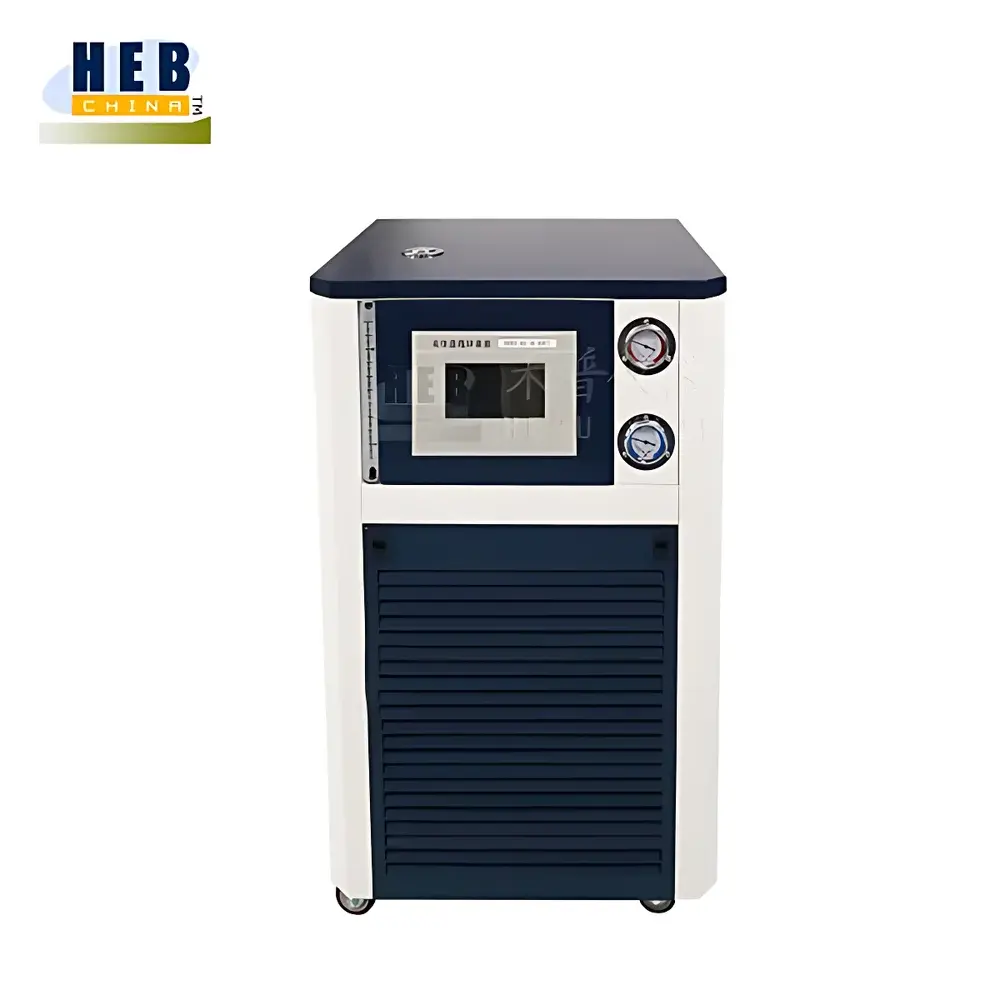
Hebei Jihepu GDSZ-10/80 High-Low Temperature Circulating Chiller
| Brand | Jihepu |
|---|---|
| Origin | Shandong, China |
| Model | GDSZ-10/80 |
| Temperature Range | −80 °C to +200 °C |
| Control Accuracy | ±0.1 °C |
| Power Supply | 3-phase 380 V / 50 Hz |
| Total Power | 7510 W |
| Heating Power | 3000 W |
| Compressor | Dual 3-PH R22 units (4410 W total, 13944 W cooling capacity) |
| Circulation Pump | 100 W, 20–40 L/min, 4–6 m head, ≤0.4 MPa pressure |
| Heat Exchanger | Plate-type, 0.53 m² surface area |
| External Port | 3/4″ NPT (6-point thread), two 2-m stainless steel braided hoses included |
| Fluid Compatibility | Premium-grade silicone oil (Class A) |
| Dimensions (W×D×H) | 590 × 630 × 1050 mm |
| Net Weight | Not specified |
| Enclosure | Powder-coated cold-rolled steel |
| Safety Protections | Phase sequence detection, phase loss, overcurrent, overtemperature, high-pressure cutoff, thermal delay, and overheat lockout |
Overview
The Hebei Jihepu GDSZ-10/80 High-Low Temperature Circulating Chiller is an engineered thermal management system designed for precise, bidirectional temperature control of external process equipment—particularly jacketed reactors, calorimeters, distillation columns, and analytical instrumentation requiring stable thermal coupling. Operating on a dual-mode thermodynamic architecture, the unit integrates mechanical refrigeration (R22-based vapor-compression cycle) with resistive electric heating to deliver continuous, stable thermal output across a wide operational envelope of −80 °C to +200 °C. Its core function relies on closed-loop circulation of thermally stable silicone oil through an external load, enabling indirect yet highly responsive heat exchange without direct contact between the chiller’s internal components and the process medium. This design ensures chemical compatibility, avoids contamination risks, and supports both exothermic and endothermic reaction control under laboratory and pilot-scale conditions.
Key Features
- Dual independent thermal modules: Two parallel 3-PH R22 compressors (total 4410 W input, 13944 W cooling capacity at nominal conditions) provide redundancy, extended service life, and improved low-temperature stability below −40 °C.
- Precision temperature regulation: PT100 platinum resistance sensor feedback coupled with PID algorithm control delivers ±0.1 °C steady-state accuracy across the full range, verified per ASTM E74 and ISO/IEC 17025 traceable calibration practices.
- Robust circulation architecture: Integrated 100 W magnetic-drive pump delivers 20–40 L/min flow at 4–6 m head, with pressure-rated stainless-steel braided hoses (2 m length, 3/4″ NPT) and sealed quick-connect fittings for leak-resistant external loop integration.
- Industrial-grade safety suite: Comprehensive protection includes phase-sequence monitoring, phase-loss detection, overcurrent tripping, high/low pressure cutouts, compressor thermal delay, and dual-stage overtemperature lockout—meeting IEC 61000-6-2 EMC and IEC 61000-6-4 emission standards.
- Human-machine interface: Backlit LCD display with membrane keypad enables local setpoint entry, real-time monitoring of fluid inlet/outlet temperatures, pump status, compressor cycling, and alarm history—no proprietary software required for basic operation.
Sample Compatibility & Compliance
The GDSZ-10/80 is validated for use with Class A methylphenyl silicone oils (e.g., Dow Corning 200 Fluid, Wacker AK 100), which maintain viscosity stability and low volatility across its full operating range. It is not compatible with water, glycol-water mixtures, or hydrocarbon-based heat transfer fluids below −30 °C due to freezing or vapor pressure limitations. The unit complies with CE marking requirements (2014/30/EU EMC Directive and 2014/35/EU LVD Directive), conforms to GB/T 21361–2017 (Chinese national standard for low-temperature chillers), and supports GLP/GMP environments via configurable event logging and manual audit trail documentation. While not inherently 21 CFR Part 11 compliant, its analog control architecture allows integration into validated systems when paired with external data acquisition hardware meeting FDA regulatory requirements.
Software & Data Management
The GDSZ-10/80 operates as a standalone instrument with no embedded Ethernet, USB, or RS-485 communication ports. All operational parameters—including setpoint, actual bath temperature, pump status, and active alarms—are accessible locally via the front-panel LCD. For automated data capture, users may connect a third-party temperature logger (e.g., Omega OM-DAQPRO-5300) to the analog 0–10 V or 4–20 mA output (optional accessory). The device stores no historical data internally; however, its deterministic control logic ensures reproducible thermal profiles across repeated runs—a prerequisite for method validation under USP , ISO 17025, and ASTM D341 viscosity testing protocols.
Applications
- Controlled-rate cooling and heating of glass-lined or stainless-steel jacketed reactors during synthesis, crystallization, and polymerization.
- Thermal conditioning of FTIR, UV-Vis, and DSC sample stages requiring sub-ambient stability and rapid ramping capability.
- Calibration support for reference thermometers, RTDs, and thermocouples across extended temperature spans.
- Environmental stress screening of electronic components and packaging materials in reliability labs.
- Stabilization of laser cavities, photodetectors, and optical benches where thermal drift compromises measurement fidelity.
FAQ
What type of heat transfer fluid is recommended for operation at −80 °C?
Premium-grade methylphenyl silicone oil with pour point ≤−90 °C and flash point ≥300 °C is mandatory. Water-based or ethylene glycol solutions are prohibited.
Can the unit operate continuously at +200 °C without derating?
Yes—continuous operation at +200 °C is supported when ambient temperature remains ≤35 °C and ventilation exceeds 300 m³/h. Derating is required above 35 °C ambient.
Is external pressure relief required for the circulation loop?
Yes—users must install an ASME-certified pressure relief valve (set ≤0.4 MPa) on the external circuit, as the unit’s internal safety valves do not protect downstream piping.
Does the chiller include dry-run protection for the circulation pump?
Yes—the pump automatically shuts down if flow interruption exceeds 15 seconds, preventing seal damage and motor overheating.
What maintenance intervals are recommended for long-term reliability?
Compressor oil should be replaced every 3,000 operating hours; plate heat exchanger inspected annually for fouling; and silicone oil tested for viscosity shift and acid number every 12 months or 2,000 hours—whichever occurs first.



