
Dionex™ ICS-PDA Diode Array Detector
| Brand | Thermo Fisher |
|---|---|
| Origin | USA |
| Manufacturer | Thermo Fisher Scientific |
| Product Type | Diode Array Detector (DAD) |
| Model | ICS-PDA |
| Wavelength Range | 190–800 nm |
| Detector Array | 1024-element photodiode array |
| Light Sources | Deuterium and tungsten lamps |
| Interface | USB + 4 analog outputs |
| Compliance | Designed for GLP/GMP environments with audit-trail-ready operation in Chromeleon™ CDS |
| Baseline Drift | Low, enabling high reproducibility in quantitative UV-Vis chromatographic analysis |
Overview
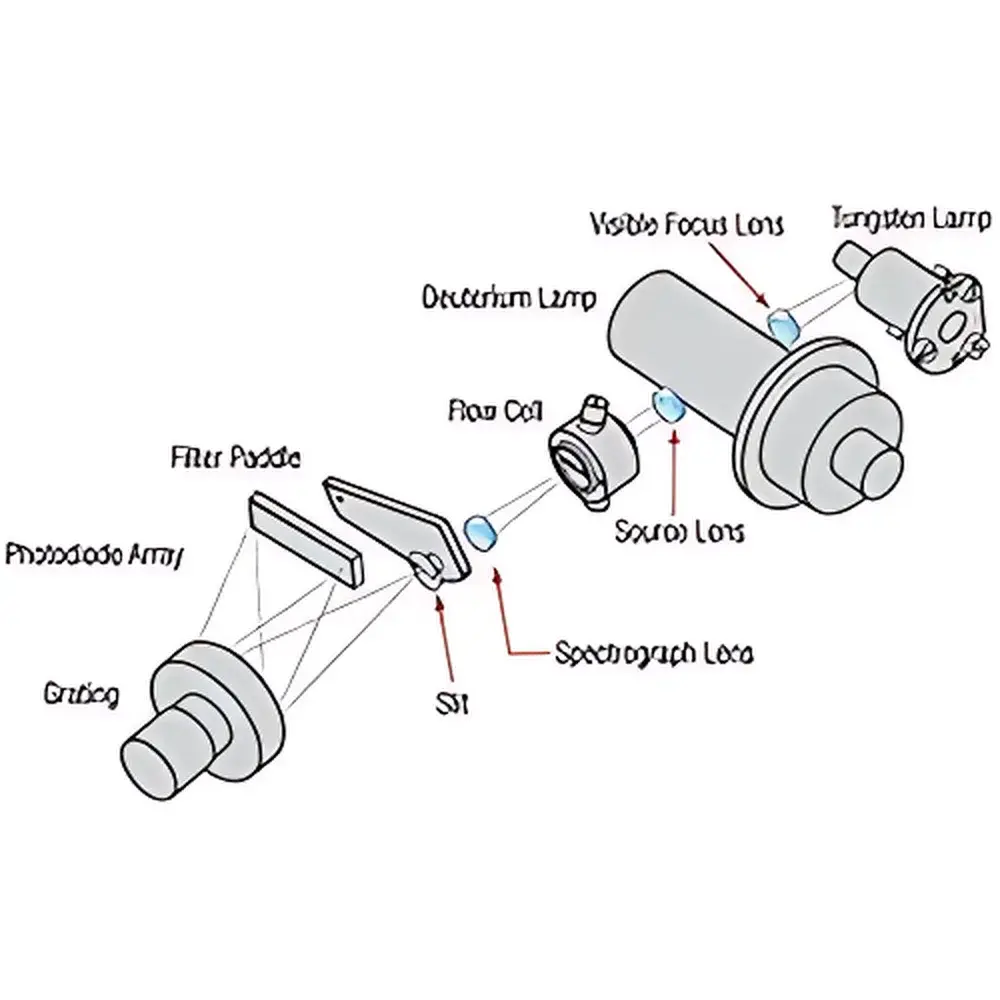
The Dionex™ ICS-PDA Diode Array Detector is a high-performance, benchtop UV-Vis absorbance detector engineered specifically for integration with Thermo Scientific™ Dionex™ ion chromatography (IC) systems. It operates on the principle of simultaneous multiwavelength spectral acquisition using a fixed 1024-element photodiode array, enabling full-spectrum collection across 190–800 nm in a single scan—without mechanical wavelength scanning or moving parts. This architecture eliminates spectral interpolation artifacts and ensures high fidelity in peak identification, purity assessment, and method development for complex ionic matrices. The detector employs dual light sources—a deuterium lamp for deep-UV performance (190–350 nm) and a tungsten-halogen lamp for visible-range stability (350–800 nm)—to deliver consistent intensity and low noise across its entire operational range. Its optical design supports high photometric accuracy and long-term baseline stability, making it suitable for regulated environments where precision, traceability, and repeatability are critical.
Key Features
- 1024-element photodiode array delivering high wavelength resolution and spectral fidelity without mechanical scanning
- Simultaneous acquisition across 190–800 nm, supporting peak purity evaluation, spectral library matching, and multiwavelength quantitation
- Dual-lamp illumination system (deuterium + tungsten) ensuring uniform signal-to-noise ratio and photometric linearity over the full range
- Front-access design for pre-aligned flow cells and lamps—minimizing alignment drift and reducing maintenance downtime
- Five status-indicating LEDs on the front panel provide real-time diagnostics for lamp status, data acquisition, communication, and error conditions
- Built-in holmium oxide filter enables automated, traceable wavelength calibration verification per ASTM E275 and ISO 6425 standards
- USB 2.0 interface for direct, plug-and-play connectivity to Chromeleon™ CDS; optional analog outputs (4 channels, ±1 V or 0–10 V) support legacy DAQ integration or auxiliary monitoring
Sample Compatibility & Compliance
The ICS-PDA is optimized for aqueous eluents commonly used in suppressed and non-suppressed ion chromatography—including carbonate/bicarbonate, methanesulfonic acid (MSA), and hydroxide-based eluents—with pressure-rated flow cells compatible up to 35 MPa (5000 psi). It meets essential requirements for analytical instrument qualification (AIQ) under ICH Q2(R2) and supports 21 CFR Part 11 compliance when operated within Chromeleon™ CDS v7.3 or later, including electronic signatures, audit trails, and user-access controls. The detector’s hardware design adheres to IEC 61010-1 safety standards and EMC Directive 2014/30/EU. Its low baseline drift (<0.5 mAU/h) and high photometric reproducibility (RSD <0.5% for repeated injections) facilitate compliance with USP , EP 2.2.46, and ISO/IEC 17025 method validation criteria.
Software & Data Management
Full operational control, real-time spectral visualization, and quantitative processing are managed through Thermo Scientific™ Dionex™ Chromeleon™ Chromatography Data System software. Chromeleon™ provides intuitive, context-aware panels for DAD-specific workflows—including spectral overlay, peak purity analysis (using angle, threshold, and correlation metrics), time-sliced spectral extraction, and library search against built-in or user-defined UV-Vis spectral databases. All raw spectral data (absorbance vs. wavelength vs. time) is stored in open-format .cdf files compliant with netCDF 4.0, enabling third-party analysis in MATLAB®, Python (via netCDF4 libraries), or R. Audit trail records capture all parameter changes, calibration events, and user actions—fully configurable for GLP, GMP, or FDA-regulated laboratories.
Applications
- Identification and confirmation of co-eluting anions/cations in environmental water analysis (e.g., nitrate/nitrite, bromate/perchlorate)
- Stability-indicating assays for pharmaceutical counterions and degradation products in QC release testing
- Qualitative and quantitative analysis of organic acids (e.g., oxalate, citrate, succinate) in food and beverage matrices
- Monitoring transition metal speciation (e.g., Cr(III)/Cr(VI), Fe(II)/Fe(III)) using post-column derivatization with UV-Vis chromophores
- Method development support via spectral deconvolution and wavelength optimization for selectivity enhancement
FAQ
Can the ICS-PDA operate independently of Chromeleon™ software?
Yes—basic LED status monitoring, lamp activation, and analog output generation are functional without software. However, spectral acquisition, data storage, and quantitative analysis require Chromeleon™ CDS.
Is wavelength calibration traceable to NIST standards?
The built-in holmium oxide filter provides a certified reference standard (NIST SRM 2034 equivalent); calibration verification reports include date, operator ID, and deviation values for regulatory documentation.
What is the maximum data acquisition rate for full-spectrum scans?
Up to 10 Hz (100 ms per full 190–800 nm spectrum), adjustable based on chromatographic peak width and signal averaging requirements.
Does the detector support variable pathlength flow cells?
No—the ICS-PDA uses a fixed 10-mm pathlength, 1.5-µL volume flow cell optimized for IC flow rates (0.2–2.0 mL/min) and low dispersion.
How is baseline stability maintained during long-duration runs?
Through thermally stabilized optics, dual-lamp power regulation, and real-time dark-current compensation algorithms embedded in the firmware.



