
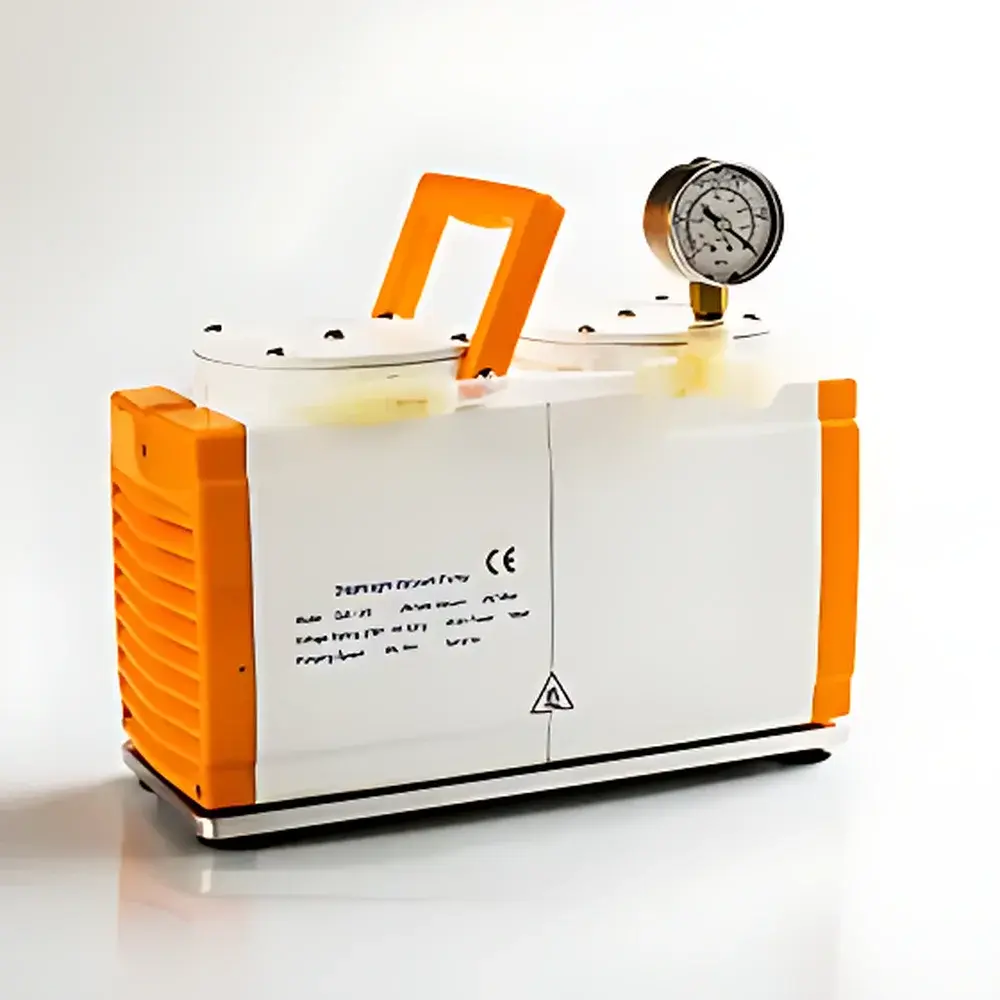
Jihepu GM-1.0A PTFE-Lined Diaphragm Vacuum Pump (Corrosion-Resistant)
| Brand | Jihepu |
|---|---|
| Origin | Shandong, China |
| Model | GM-1.0A |
| Pump Type | Oil-Free Diaphragm Vacuum Pump |
| Ultimate Vacuum | ≥0.08 MPa (200 mbar abs) |
| Pumping Speed | 60 L/min |
| Motor Power | 160 W |
| Dimensions (L×W×H) | 300 × 160 × 235 mm |
| Weight | 10 kg |
| Operating Temperature Range | 7–40 °C |
| Maximum Surface Temperature | <55 °C |
| Noise Level | <50 dB(A) |
| Inlet/Outlet Port | Φ6 mm |
| Positive Pressure Capability | ≥30 psi |
| Diaphragm & Valve Material | Imported elastomer with PTFE-coated wetted parts |
| Compliance | CE-marked design principles |
Overview
The Jihepu GM-1.0A PTFE-Lined Diaphragm Vacuum Pump is an oil-free, chemically inert vacuum generation system engineered for laboratories handling aggressive process gases in pharmaceutical synthesis, fine chemical purification, and analytical sample preparation. Unlike rotary vane or piston pumps, this unit operates on a positive-displacement diaphragm principle—where a motor-driven eccentric mechanism oscillates a flexible PTFE-coated diaphragm to alternately expand and compress the pump chamber. This architecture eliminates internal lubricants and mechanical contact between moving parts and process gas, ensuring zero hydrocarbon contamination and long-term stability under cyclic load. Its ultimate vacuum of ≥0.08 MPa (200 mbar abs) and continuous pumping speed of 60 L/min make it suitable for moderate-vacuum applications including vacuum filtration, rotary evaporation (up to 60 °C bath temperature), reduced-pressure distillation, solid-phase extraction (SPE), and centrifugal concentration workflows. The pump’s dual functionality—capable of both vacuum generation and positive pressure delivery up to 30 psi—enables versatile integration into closed-loop gas transfer or purge-and-trap systems.
Key Features
- PTFE-lined wetted path: All gas-contact surfaces—including diaphragm, valve plates, and internal chamber—are coated or constructed with polytetrafluoroethylene (PTFE), delivering exceptional resistance to concentrated mineral acids (e.g., HNO₃, H₂SO₄, aqua regia), alkalis (e.g., NaOH, KOH), halogens, oxidizers (e.g., H₂O₂, ClO₃⁻), and organic solvents (e.g., THF, DMF, chlorinated hydrocarbons).
- Oil-free and maintenance-minimized architecture: No lubrication required; diaphragm and valve assemblies are fabricated from imported high-elasticity elastomers with fatigue-tested service life exceeding 10,000 hours under standard lab duty cycles.
- Thermal stability: PTFE components retain structural integrity across −190 °C to +260 °C, enabling reliable operation in ambient conditions from 7 °C to 40 °C without performance drift; external housing surface temperature remains below 55 °C during continuous operation.
- Low-noise operation: Acoustic output <50 dB(A) at 1 m distance ensures compatibility with quiet-zone laboratories and shared instrumentation suites.
- Compact footprint and portability: Dimensions of 300 × 160 × 235 mm and mass of 10 kg allow benchtop installation without dedicated mounting; integrated rubber feet dampen vibration transmission to sensitive balances or optical tables.
Sample Compatibility & Compliance
The GM-1.0A is routinely deployed in ISO/IEC 17025-accredited testing labs for sample prep prior to ICP-MS, GC-MS, and HPLC analysis where reagent-grade vacuum integrity and absence of extractables are mandatory. Its PTFE-wetted construction meets material compatibility requirements outlined in ASTM D471 (rubber property evaluation) and USP (plastic packaging systems). While not certified to UL/CSA or ATEX standards, its 230 VAC / 50 Hz input complies with EU Low Voltage Directive (2014/35/EU) safety principles. For GxP environments, the pump supports audit-ready workflows when paired with calibrated vacuum gauges and log-enabled controllers—its stable vacuum output enables reproducible endpoint detection in gravimetric SPE or solvent removal protocols compliant with FDA 21 CFR Part 11 data integrity expectations when used within validated instrument platforms.
Software & Data Management
The GM-1.0A is a standalone analog device with no embedded firmware or digital interface. However, it integrates seamlessly with third-party vacuum monitoring systems via its standard Φ6 mm barbed inlet/outlet ports. When connected to a digital vacuum transducer (e.g., MKS Baratron or Inficon Transmitter), real-time pressure data can be logged using LabVIEW, MATLAB, or ELN-integrated SCADA platforms. Its consistent flow profile and low pulsation (<5% peak-to-peak deviation) support time-stamped vacuum ramping protocols required for method validation per ICH Q2(R2). Optional analog voltage output modules (0–10 VDC proportional to pressure) are available through authorized distributors for closed-loop feedback control in automated evaporation systems.
Applications
- Vacuum-assisted filtration of corrosive filtrates (e.g., acidic metal leachates, alkaline catalyst slurries)
- Rotary evaporation of acid-labile compounds or halogenated solvents under controlled sub-atmospheric conditions
- Reduced-pressure crystallization of pH-sensitive APIs in pharmaceutical development
- Solid-phase extraction cartridges loaded with ion-exchange resins exposed to strong eluents
- Inert gas purging of moisture-sensitive reaction vessels prior to Schlenk-line transfers
- Off-gas capture from corrosion-resistant digesters in environmental heavy-metal analysis (EPA Method 3050B)
FAQ
Is the GM-1.0A certified for use in explosion-hazardous areas?
No. It lacks ATEX, IECEx, or UL Class I Division 1 certification. Use only in general laboratory environments with adequate ventilation.
Can this pump handle solvent vapors continuously?
Yes—provided vapor concentrations remain below flashpoint thresholds and condensation is prevented upstream via cold traps. PTFE compatibility covers most common organics, but prolonged exposure to hot chlorinated solvent vapors may accelerate diaphragm aging.
What is the expected service life of the diaphragm under typical lab usage?
Based on accelerated lifecycle testing at 50% duty cycle and 25 °C ambient, mean time between replacements is ≥18 months. Replacement kits include diaphragm, inlet/outlet valves, and PTFE gaskets.
Does the pump require periodic calibration?
No intrinsic calibration is needed, as it delivers volumetric flow rather than regulated pressure. However, system-level vacuum accuracy depends on gauge calibration—recommended annually per ISO/IEC 17025 clause 6.5.
Is there a version with RS-485 or Modbus communication?
Not natively. Communication capability requires external integration via pressure sensor + PLC or OEM module add-ons available through Jihepu’s industrial channel partners.



