
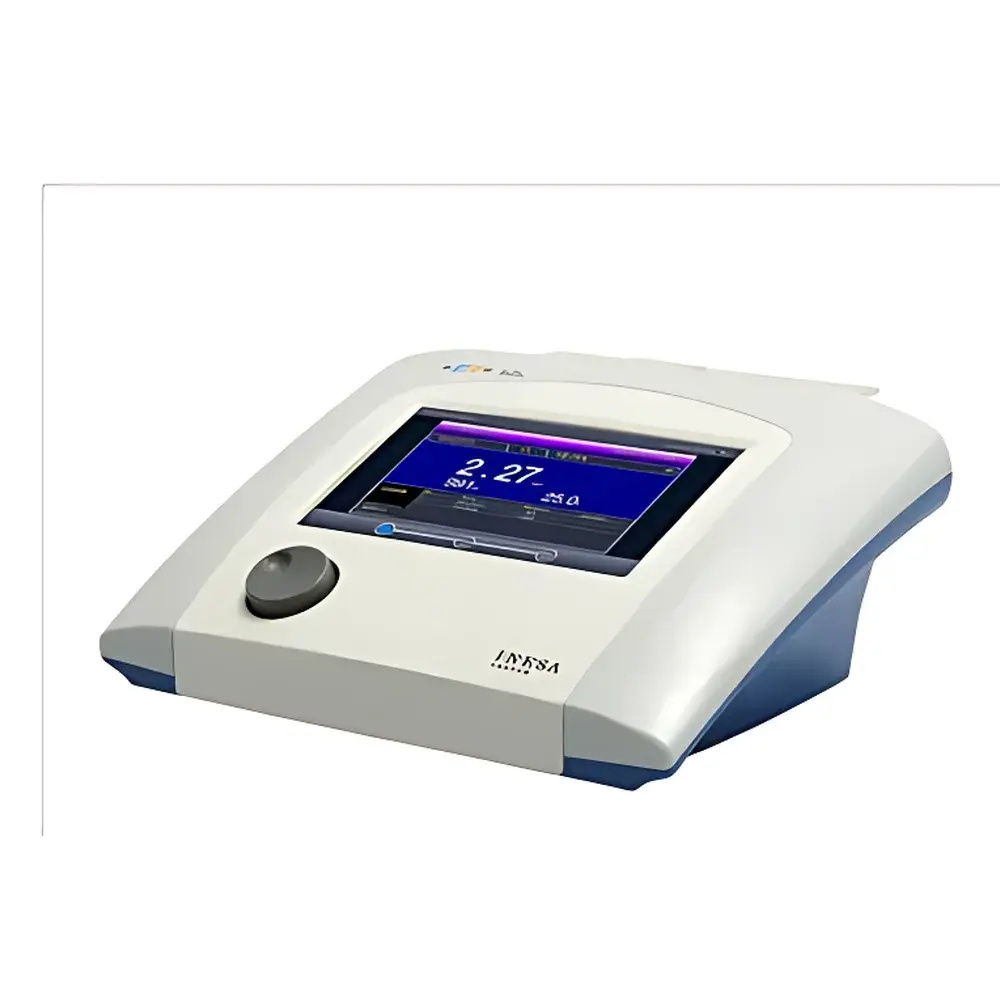
Jihepu JPSJ-606L Laboratory Dissolved Oxygen Meter
| Brand | Jihepu |
|---|---|
| Origin | Shandong, China |
| Model | JPSJ-606L |
| Instrument Type | Benchtop Laboratory DO Meter |
| Measurement Principle | Polarographic Electrochemical Probe |
| DO Range | (0.00–90.00) mg/L |
| DO Accuracy | ±0.30 mg/L |
| DO Resolution | 0.01 mg/L |
| Saturation Range | (0.0–600.0)% |
| Temperature Range | (−5.0–130.0) °C |
| Temp. Resolution | 0.1 °C |
| Atmospheric Pressure Compensation | (60.0–110.0) kPa |
| Salinity Compensation | (0.0–50.0) g/L |
| Repeatability | ≤0.1% RSD |
| Standard Electrode | DO-958-L polarographic DO probe |
| Power Supply | 24 VDC, 3 A (via 100–240 VAC adapter) |
| Dimensions | 280 × 280 × 130 mm |
| Weight | 2.5 kg |
| Data Storage | 1000 DO concentration & 1000 DO saturation records |
| Compliance | GLP-compliant data management with audit trail support |
Overview
The Jihepu JPSJ-606L is a benchtop dissolved oxygen (DO) meter engineered for precision and regulatory compliance in environmental laboratories, wastewater treatment facilities, aquaculture research, and academic water quality studies. It employs a Clark-type polarographic electrochemical sensor principle—where oxygen diffuses through a gas-permeable membrane to a cathode surface, generating a current proportional to the partial pressure of dissolved O₂. This signal is digitally converted and compensated in real time for temperature, atmospheric pressure, and salinity—enabling accurate reporting in both mg/L (mass concentration) and % saturation (relative to air-saturated water at defined conditions). Designed for rigorous daily use, the instrument meets core functional requirements of ISO 5814:2012 (water quality — determination of dissolved oxygen — electrochemical probe method) and supports traceable calibration practices aligned with GLP (Good Laboratory Practice) frameworks.
Key Features
- 7-inch full-color capacitive touchscreen with intuitive navigation-based UI, supporting both English and Chinese language interfaces
- Multi-parameter display: simultaneous real-time readouts of DO concentration (mg/L), DO saturation (%), electrode current (nA), and sample temperature (°C)
- Smart-Read mode with three configurable stability criteria (“Fast”, “Medium”, “Strict”) plus user-defined thresholds for dynamic equilibrium detection
- Timed-Read functionality: programmable single-endpoint measurement or auto-triggered interval logging (e.g., every 15 s, 1 min, or 5 min) for kinetic profiling
- Cont-Read continuous monitoring mode with scrollable waveform display to visualize transient DO changes during aeration, respiration, or biodegradation assays
- Comprehensive electrode management system: up to five DO probes registered; each stores up to 20 independent calibration records with timestamp, operator ID, and calibration solution details
- Zero-oxygen and span (air-saturated water) calibration routines with automatic temperature and barometric pressure compensation
- Integrated self-stirring capability compatible with DO-958-L probe—eliminates manual agitation errors and ensures consistent diffusion layer control
Sample Compatibility & Compliance
The JPSJ-606L accommodates aqueous samples across a broad physicochemical spectrum: freshwater, seawater (with salinity compensation up to 50.0 g/L), wastewater effluents, biological reactors, and nutrient media. Its polarographic probe design is robust against moderate turbidity and low-flow conditions but requires routine membrane replacement and electrolyte replenishment per manufacturer guidelines. The instrument conforms to GLP data integrity requirements—including electronic signatures, operator-level access control, editable/non-editable audit trails, and immutable record timestamps. All stored datasets include metadata (calibration history, probe ID, ambient pressure, temperature, salinity setting), satisfying documentation needs for internal QA audits and external regulatory reviews under ISO/IEC 17025 or EPA Method 360.5.
Software & Data Management
Data handling follows a structured, traceable architecture. Up to 1000 DO concentration values and 1000 DO saturation results are retained onboard with full GLP metadata. Statistical functions include mean, standard deviation, min/max, and relative standard deviation (RSD) calculation per dataset. Export is supported via USB mass storage (CSV format) or RS232 serial interface to LIMS or laboratory PCs. Optional direct connection to automated samplers enables unattended batch analysis. Firmware updates are performed via hot-pluggable USB drive—no PC dependency. All calibration edits, method modifications, and user account changes are logged with operator ID and timestamp, ensuring full accountability.
Applications
- Regulatory compliance testing for municipal and industrial wastewater discharge permits (e.g., EPA NPDES monitoring)
- Biochemical oxygen demand (BOD₅) incubation tracking and endpoint verification
- Aquatic ecosystem health assessment in rivers, lakes, and estuaries
- Optimization of activated sludge processes and membrane bioreactor (MBR) aeration control
- Quality control of pharmaceutical water systems (PW, WFI) per USP
- Research on microbial respiration kinetics, nitrification/denitrification rates, and hypoxia modeling
FAQ
What type of electrochemical principle does the JPSJ-606L use?
It utilizes a polarographic (Clark-type) sensor with a gold cathode and silver/silver chloride reference, operating at a fixed polarization voltage of −0.6 V vs. Ag/AgCl.
Is the instrument compliant with FDA 21 CFR Part 11?
While it provides GLP-aligned audit trails and user authentication, full Part 11 compliance requires integration with validated third-party LIMS software and additional procedural controls—not inherent to the standalone device.
Can the DO-958-L probe be used in high-salinity seawater?
Yes—when salinity compensation is enabled (0.0–50.0 g/L range) and the probe’s Teflon membrane is intact and properly hydrated.
How often should the DO electrode be calibrated?
Daily calibration is recommended for routine QC; zero and span checks must precede each analytical session when measurement uncertainty below ±0.3 mg/L is required.
Does the instrument support external printing?
Yes—via RS232-connected serial printers; formatted reports include date/time, sample ID, DO value, saturation, temperature, pressure, salinity, and calibration status.
Related Products







