
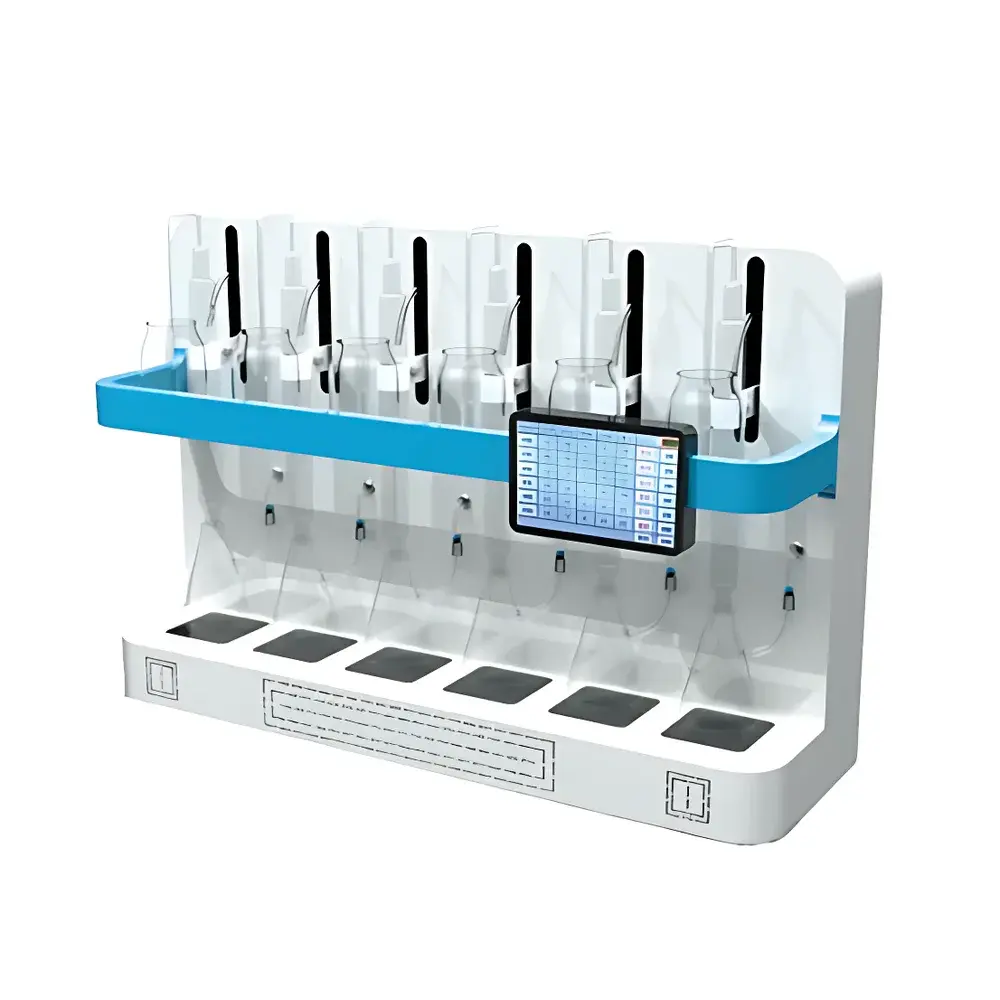
HePu HEB-107 High-Chloride Wastewater COD Digestion System
| Brand | HePu (Jihepu) |
|---|---|
| Origin | Shandong, China |
| Manufacturer Type | Authorized Distributor |
| Country of Origin | China |
| Model | HEB-107 |
| Price | USD 6,800 (FOB Qingdao) |
| Digestion Method | Rapid Digestion with Chlorine Correction |
| Heating Module | Dual Independent Far-Infrared Ceramic Heating Blocks |
| Batch Capacity | 6 Samples |
| Nitrogen Flow Control Range | 0–100 mL/min |
| Temperature Range | Ambient to 300 °C |
| Temperature Accuracy | ±0.1 °C |
| Timer Accuracy | ±1 min |
| Digestion Vessel Capacity | Up to 100 mL per position |
| Power Supply | 220 V / 50 Hz |
| Rated Power | 2400 W |
Overview
The HePu HEB-107 High-Chloride Wastewater COD Digestion System is an engineered solution for accurate chemical oxygen demand (COD) determination in chloride-rich aqueous matrices—specifically designed to comply with the Chinese national standard HJ/T 70–2001, *Determination of Chemical Oxygen Demand in High-Chloride Wastewater—Chlorine Correction Method*. Unlike conventional COD digestion systems based on HJ 828–2017 (equivalent to ISO 6060), which are unsuitable for samples containing >1000 mg/L Cl⁻ due to interference from chlorate formation and incomplete oxidation suppression, the HEB-107 implements a rigorously validated two-stage analytical workflow: (1) reflux digestion under strongly acidic conditions with Ag₂SO₄ catalyst and HgSO₄ complexation, followed by (2) quantitative off-gas capture and iodometric titration of liberated Cl₂. This dual-path approach isolates chlorine-derived oxygen demand from organic oxidation, enabling trace-level COD quantification in high-salinity industrial effluents with reproducible accuracy and minimal matrix bias.
Key Features
- Dual independent far-infrared ceramic heating blocks—certified to EU RoHS and CE electromagnetic compatibility standards—deliver uniform thermal distribution and programmable ramp/soak profiles across all six digestion positions.
- Individual per-channel nitrogen flow regulation via imported proportional flow distributor ensures precise, stable, and balanced purge gas delivery (0–100 mL/min) for consistent Cl₂ removal efficiency and inter-sample comparability.
- Microprocessor-controlled digestion timer (0–999 minutes) with automatic termination and audible alert; each position operates independently, supporting heterogeneous sample batches with variable digestion durations.
- Integrated closed-loop refrigeration cooling system—equipped with hermetic compressor and internal heat exchanger—eliminates dependency on external chilled water supply while maintaining condenser outlet temperature ≤25 °C during extended reflux cycles.
- Automated anti-suckback module prevents backflow of alkaline absorption solution into digestion vessels upon heating cessation, preserving sample integrity and operator safety.
- Robust stainless-steel chassis (900 × 455 × 630 mm) with corrosion-resistant surface treatment, optimized for laboratory benchtop deployment in QC/QA environments subject to routine chemical exposure.
Sample Compatibility & Compliance
The HEB-107 is validated for use with liquid samples containing chloride concentrations between 1000 and 20,000 mg/L—including produced water from oilfields, brine effluents from chlor-alkali plants, dyeing wastewater, coastal refinery discharges, and desalination concentrate streams. Its operational protocol directly fulfills the procedural requirements of HJ/T 70–2001, including mandatory parameters: reflux duration (120 min), sulfuric acid concentration (≥95%), mercury sulfate dosage (10:1 HgSO₄:Cl⁻ mass ratio), and post-digestion Cl₂ absorption in NaOH followed by iodometric back-titration. While not certified to ISO/IEC 17025 or FDA 21 CFR Part 11 out-of-the-box, the system supports GLP-compliant documentation when integrated with LIMS or electronic lab notebooks (ELN) via RS-232 or optional USB data export.
Software & Data Management
The HEB-107 features embedded firmware with non-volatile memory for storing up to 200 user-defined digestion programs—including temperature setpoints, ramp rates, hold times, and nitrogen flow profiles. All operational logs (start time, end time, actual temperature history per channel, flow verification status) are timestamped and exportable as CSV files via USB port. No proprietary software installation is required; exported datasets are compatible with common statistical analysis platforms (e.g., JMP, Minitab, Python pandas). For regulated environments, audit trail functionality can be implemented externally through third-party instrument integration middleware compliant with ALCOA+ principles.
Applications
This system serves laboratories engaged in regulatory compliance testing, environmental impact assessment, and process water quality control across multiple sectors: upstream oil & gas (produced water monitoring), chemical manufacturing (organochlorine synthesis effluents), textile dyeing (salt-intensive bleaching baths), power generation (cooling tower blowdown), food processing (brine wash streams), and marine outfall surveillance. It is routinely deployed in municipal environmental monitoring stations, third-party testing labs accredited to CNAS (China National Accreditation Service), and R&D centers developing chloride-tolerant wastewater treatment technologies.
FAQ
Does the HEB-107 support method validation per ISO 5667-3 or EPA Method 410.4?
The instrument itself does not perform analytical measurements but enables full execution of HJ/T 70–2001—a method technically aligned with the chlorine correction principle described in EPA Method 410.4 and ISO 5667-3 Annex D. Validation must be conducted at the laboratory level using certified reference materials (CRMs) and spike recovery experiments.
Can digestion vessels be upgraded to quartz or PTFE-lined variants?
Standard configuration includes borosilicate glass reflux tubes (100 mL capacity); custom quartz or PFA-coated options are available upon request for highly corrosive or ultra-low-background applications.
Is remote monitoring or Ethernet connectivity supported?
No native Ethernet or Wi-Fi interface is included; however, optional RS-485-to-Ethernet gateways may be integrated for centralized lab equipment monitoring systems.
What maintenance intervals are recommended for the refrigeration module?
Compressor oil and refrigerant levels require inspection every 12 months; filter-drier replacement is advised every 24 months under continuous operation (8 h/day, 5 days/week).
How is calibration traceability established for temperature and flow control?
Temperature sensors are factory-calibrated against NIST-traceable dry-block calibrators (±0.1 °C uncertainty); nitrogen flow meters are verified using bubble-flow calibrators certified to ISO 4064 Class B. Calibration certificates are supplied with each unit.







