
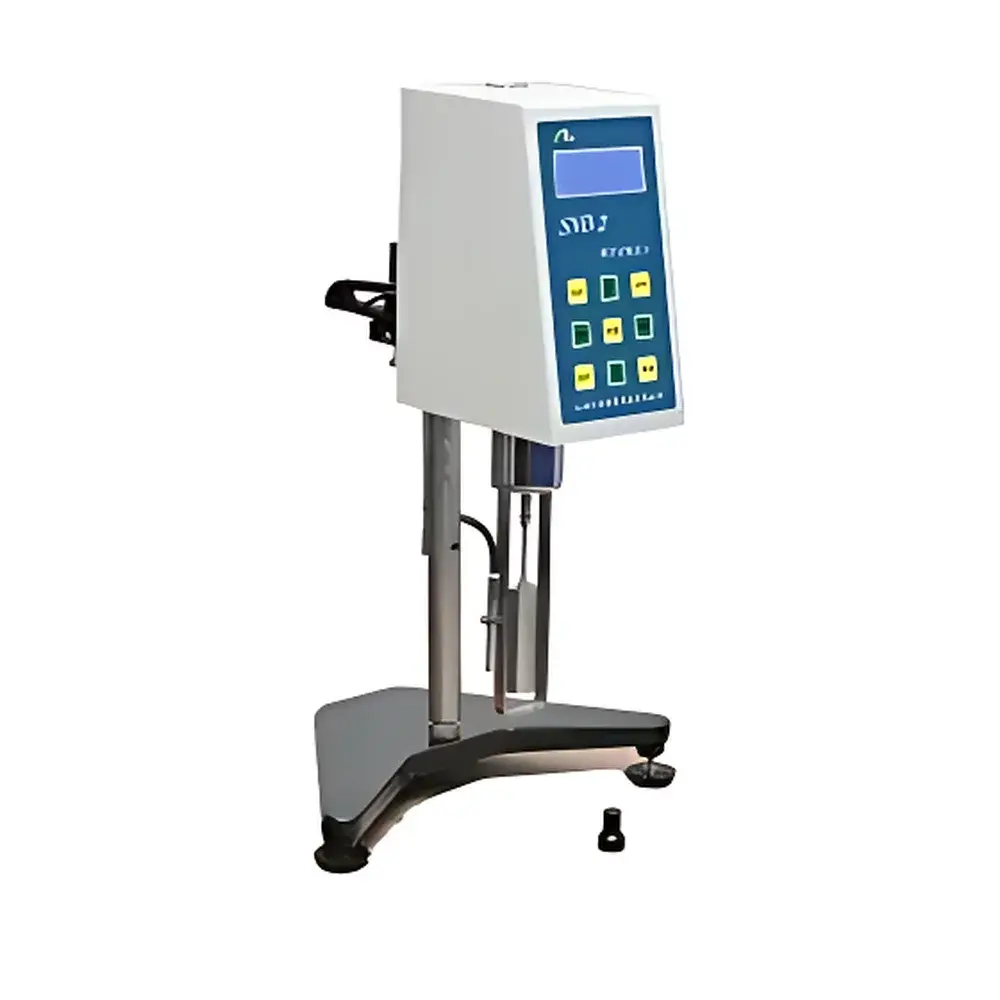
Jihepu SNB-2 Advanced Digital Rotational Viscometer
| Brand | Jihepu |
|---|---|
| Model | SNB-2 |
| Type | Rotational Viscometer |
| Viscosity Range | 10–6,000,000 mPa·s (cP) |
| Speed Range | 0.1–99.9 rpm, stepless (gearless drive) |
| Standard Spindles | four (#1, #2, #3, #4) |
| Accuracy | ±1.0% of full scale |
| Repeatability | ±0.5% of full scale |
| Temperature Measurement | integrated RTD probe, 0–100 °C, ±0.1 °C |
| Power Input | 110/220 VAC, 50/60 Hz |
| Display | backlit LCD showing viscosity, speed, torque (%), max measurable viscosity at current speed, and real-time temperature |
Overview
The Jihepu SNB-2 Advanced Digital Rotational Viscometer is a precision-engineered instrument designed for reliable, high-resolution viscosity measurement of Newtonian and non-Newtonian fluids across industrial QC laboratories, R&D facilities, and academic research settings. Based on the Couette principle—where torque exerted on a rotating spindle immersed in a fluid is directly proportional to its dynamic viscosity—the SNB-2 delivers stable, reproducible readings under controlled shear conditions. Its gearless, microstepping motor drive ensures true stepless speed control from 0.1 to 99.9 rpm, eliminating mechanical backlash and speed drift associated with traditional geared systems. This architecture enables consistent shear rate application critical for thixotropic and time-dependent fluid characterization. The instrument complies with fundamental metrological requirements aligned with ISO 2555 and ASTM D2196 for rotational viscometry, supporting traceable calibration using NIST-traceable standard oils.
Key Features
- True stepless speed control (0.1–99.9 rpm) via high-subdivision stepper motor—no gear reduction, ensuring minimal speed deviation (<±0.1 rpm) across operating range
- Real-time dual-parameter display: dynamic viscosity (mPa·s/cP), % torque, rotational speed, maximum measurable viscosity at selected speed, and sample temperature (0–100 °C, ±0.1 °C)
- Integrated PT1000 RTD temperature sensor embedded in the spindle housing for direct thermal monitoring of sample environment
- Onboard data acquisition logic enabling multi-sample acquisition per rotation—patented sampling algorithm improves statistical robustness for low-signal or transient samples
- Full-scale linearity correction performed digitally via PC interface during factory calibration, meeting repeatability specifications per ISO 17025-accredited procedures
- Alarm function with audible alert upon viscosity exceeding configured range or temperature out-of-bounds condition
- 16-bit microprocessor core with dedicated firmware for torque signal filtering, temperature compensation, and auto-zero stabilization
Sample Compatibility & Compliance
The SNB-2 accommodates a broad spectrum of liquid and semi-liquid materials—including paints, coatings, adhesives, pharmaceutical suspensions, food emulsions, polymer melts (with optional heating bath), and drilling muds. With standard spindles (#1–#4), it covers 10–6×10⁶ mPa·s; with the optional #0 ultra-low-viscosity spindle, the lower detection limit extends to 1 mPa·s. For limited-volume applications (e.g., precious biological fluids or high-value formulations), the small-sample adapter supports spindles #21, #27, #28, and #29—optimized for 0.5–20 mL volumes and calibrated to 10–1×10⁶ mPa·s. All spindle geometries conform to DIN 53019-1 dimensional tolerances. Instrument validation supports GLP/GMP documentation workflows, and optional software modules provide audit trails compliant with FDA 21 CFR Part 11 for electronic records and signatures.
Software & Data Management
The optional SNB Data Acquisition & Plotting Software enables real-time graphing of viscosity vs. time, shear rate, or temperature; export to CSV, Excel, or PDF formats; and automated report generation with instrument ID, operator, date/time stamp, and calibration certificate reference. Data logging intervals are user-configurable from 0.1 s to 60 min. The software supports batch mode operation for sequential multi-spindle testing and includes built-in statistical analysis (mean, SD, CV%, min/max). When paired with the optional monochrome thermal printer, users can generate hard-copy records with timestamp, spindle ID, speed, and measured value—ideal for paper-based QA archives. All firmware updates and calibration coefficient uploads occur via USB interface with password-protected access levels.
Applications
The SNB-2 serves as a primary tool in quality assurance for incoming raw material verification (e.g., resin viscosity acceptance), in-process monitoring of polymerization reactions, shelf-life stability assessment of cosmetic gels, and formulation optimization of ink rheology. Its timed measurement mode ensures standardized dwell periods for thixotropic recovery studies—critical for evaluating structural breakdown and rebuild kinetics in bentonite slurries or yogurt analogs. In pharmaceutical manufacturing, it supports USP compliance for viscosity testing of ophthalmic solutions and topical gels. Educational labs utilize its intuitive interface and wide dynamic range to demonstrate shear-thinning behavior, yield stress estimation (via flow curve extrapolation), and temperature-viscosity relationships governed by the Arrhenius equation.
FAQ
What is the minimum sample volume required for standard operation?
Standard spindles (#1–#4) require ≥20 mL in a 600-mL low-form Griffin beaker; with the small-sample adapter and spindles #21–#29, volume is reduced to 0.5–2 mL.
Does the SNB-2 support automatic temperature control?
No—temperature sensing is passive (RTD probe only). For isothermal testing, pair with an external thermostatic water bath (optional accessory).
Can the instrument be validated per ISO/IEC 17025 requirements?
Yes—full calibration reports, traceable to national standards via certified viscosity oils (available as optional purchase), and documented uncertainty budgets are provided upon request.
Is remote operation possible?
Yes—via RS-232 or USB-to-serial interface using the SNB software; optional infrared remote controller supports basic start/stop and speed adjustment.
How often should calibration verification be performed?
Per ISO/IEC 17025, daily verification with a certified standard oil is recommended before routine use; full recalibration every 12 months or after mechanical impact or environmental exposure beyond specification limits.



