
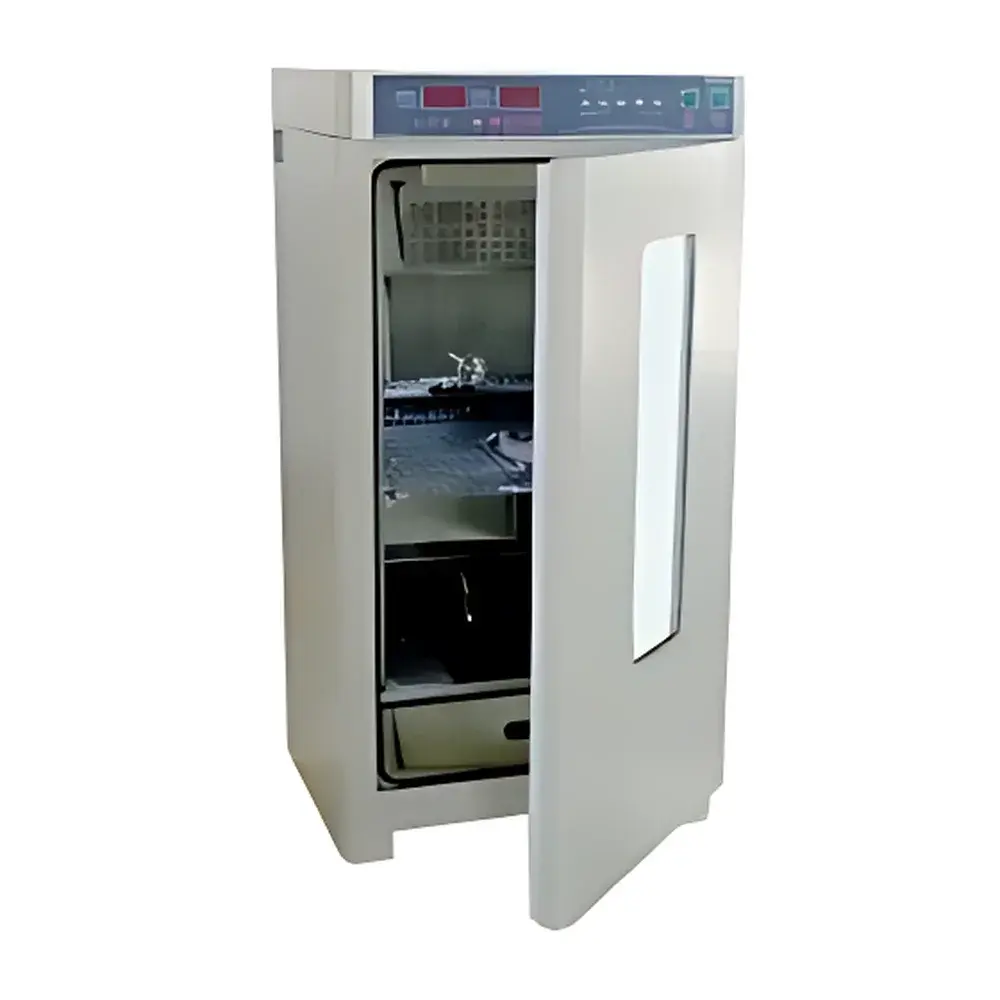
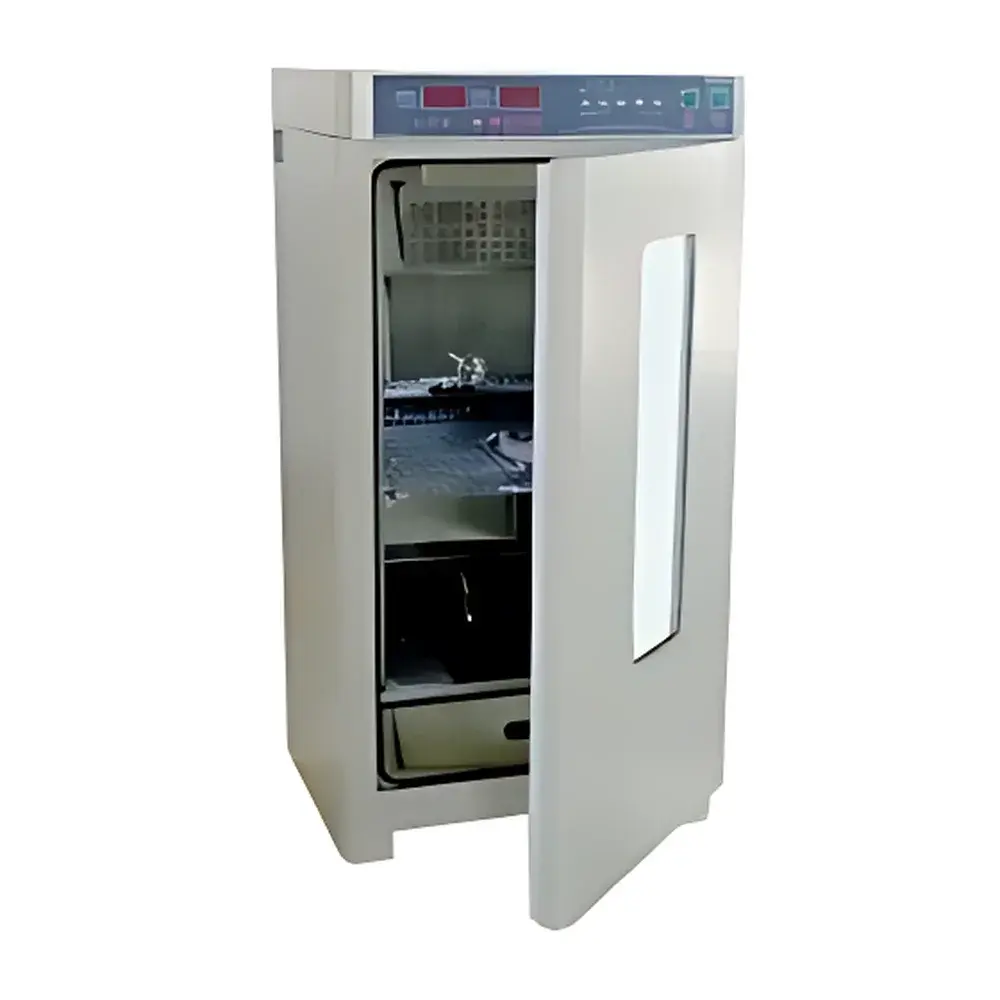
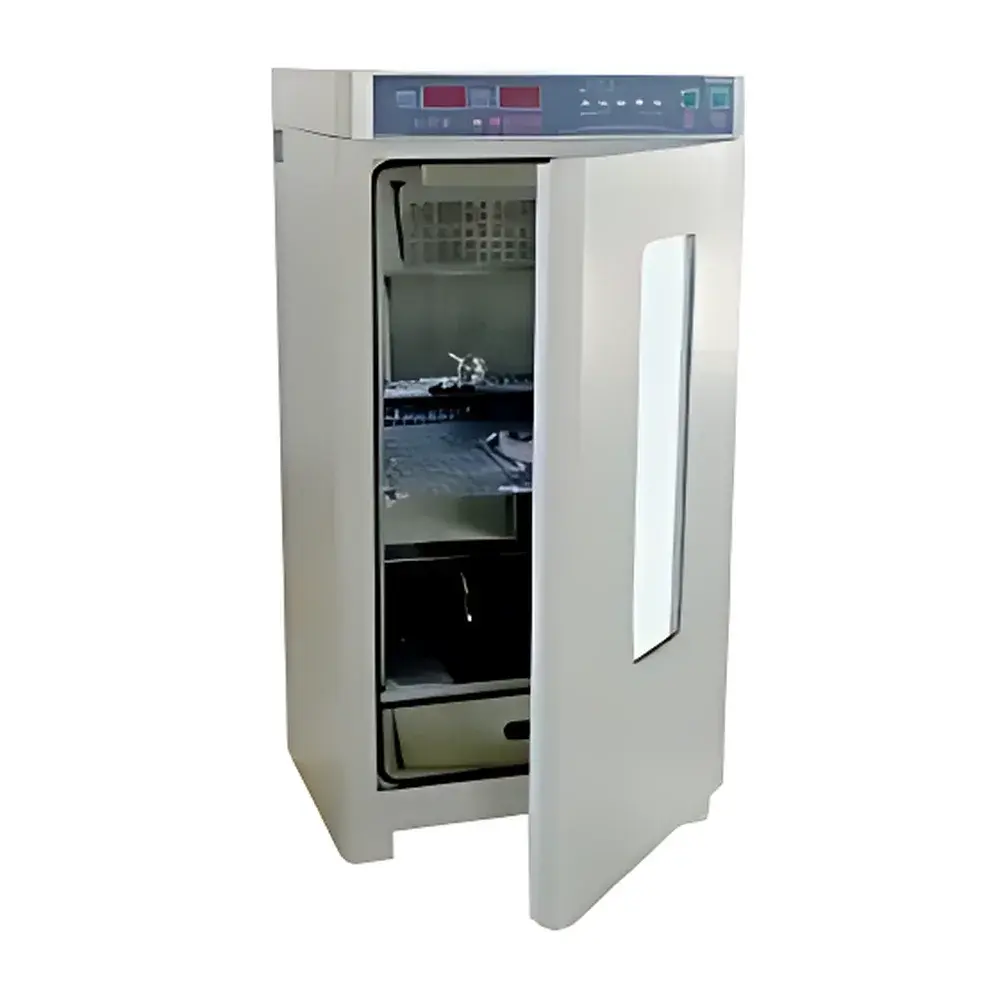
Hebei Jihepu MJX-160B-Z Mold Incubator
| Brand | Hebei Jihepu |
|---|---|
| Origin | Shandong, China |
| Model | MJX-160B-Z |
| Temperature Range | 5–50 °C |
| Temperature Uniformity | ±1.5 °C |
| Humidity Range | 20–95 % RH |
| Chamber Capacity | 160 L |
| Temperature Resolution | 0.1 °C |
| Temperature Fluctuation | ±1 °C |
| Input Power | 300 W |
| Timer Range | 0–999 h |
| Interior Dimensions (W×D×H) | 500 × 335 × 955 mm |
| Exterior Dimensions (W×D×H) | 625 × 520 × 1140 mm |
| Shelving | 3 adjustable stainless steel shelves |
| Refrigerant | R134a (CFC-free) |
Overview
The Hebei Jihepu MJX-160B-Z Mold Incubator is a purpose-engineered environmental chamber designed for controlled cultivation and preservation of filamentous fungi, yeasts, spores, and other humidity-sensitive microorganisms under stable thermal and hygrometric conditions. Unlike general-purpose incubators, this model integrates dual-mode temperature regulation—combining Peltier-assisted precision cooling with resistive heating—and features an independent humidity control system based on evaporative saturation and condensation recovery principles. Its operational envelope (5–50 °C, 20–95 % RH) meets the physiological requirements for mycological growth per ISO 7218:2018 (Microbiology of food and animal feeding stuffs) and ASTM D3273 (Standard Test Method for Resistance to Growth of Mold on the Surface of Interior Coatings in an Environmental Chamber). The unit’s R134a refrigeration circuit complies with Montreal Protocol phase-out schedules and EU F-Gas Regulation (EU) No 517/2014, ensuring regulatory alignment for global laboratory deployment.
Key Features
- Robust chamber architecture: Cold-rolled steel exterior with electrostatic epoxy coating; mirror-finish 304 stainless steel interior resistant to fungal metabolite corrosion and routine disinfectants (e.g., 70 % ethanol, 1 % sodium hypochlorite)
- High-stability microprocessor-based PID temperature controller with 0.1 °C resolution and ±1 °C fluctuation tolerance over 24-hour continuous operation
- Dual independent control loops: One for temperature (thermistor feedback), one for relative humidity (capacitive RH sensor with automatic dew-point compensation)
- UV-C germicidal lamp (254 nm) integrated into ceiling assembly for pre-cycle sterilization; safety interlock disables UV during door opening
- Triple-layer insulated vacuum-glazed observation window (tempered, low-emissivity) providing unobstructed visual monitoring without thermal leakage
- Three-tier adjustable shelving system with load capacity ≥15 kg per shelf; optimized airflow distribution via rear-mounted centrifugal circulation fan
- Power failure recovery protocol: All setpoints, timer values, and runtime logs retained in non-volatile memory; automatic resumption upon grid restoration
Sample Compatibility & Compliance
The MJX-160B-Z supports standard microbiological workflows involving Petri dishes (90–150 mm), slant tubes, liquid culture flasks (up to 2 L), and multi-well plates. Its uniformity profile (±1.5 °C across full volume) satisfies CLSI M22-A3 requirements for fungal susceptibility testing environments. Humidity control accuracy (±3 % RH at 75 % RH setpoint) enables reproducible sporulation studies aligned with USP and EP 2.6.12. The unit is CE-marked for EMC Directive 2014/30/EU and Low Voltage Directive 2014/35/EU. While not FDA 510(k)-cleared, its design adheres to GMP Annex 11 data integrity expectations through audit-trail-capable parameter logging (optional RS-232/USB interface available for external validation).
Software & Data Management
Local operation is managed via a dual-digit LED display with tactile membrane keypad supporting simultaneous setting of temperature, humidity, and timer duration. Real-time values are shown on separate channels for immediate verification. Internal event logging records up to 1,000 timestamped entries—including door openings, alarm triggers (over-temp, sensor fault, humidity deviation >5 % RH), and power interruptions—with cyclic overwrite protection. Optional firmware upgrade enables Modbus RTU communication for integration into LabVantage or Thermo Fisher SampleManager LIMS via industrial PLC gateways. All configuration changes generate immutable log entries compliant with ALCOA+ principles (Attributable, Legible, Contemporaneous, Original, Accurate, Complete, Consistent, Enduring, Available).
Applications
- ISO/IEC 17025-accredited mycology labs conducting mold identification, colony morphology assessment, and spore viability assays
- Pharmaceutical QC laboratories performing environmental monitoring (EM) per EU GMP Annex 1 and PDA Technical Report No. 13
- Agricultural research institutes studying phytopathogenic fungi (e.g., Fusarium, Aspergillus, Penicillium) under simulated field moisture regimes
- Water quality testing facilities executing BOD5 and heterotrophic plate count (HPC) protocols requiring extended incubation at 22–25 °C and ≥80 % RH
- Biotechnology R&D groups maintaining fungal starter cultures for enzyme production or biotransformation screening
FAQ
What is the maximum allowable ambient operating temperature for stable humidity control?
The unit maintains specified RH accuracy only when installed in environments ≤30 °C and ≤70 % RH ambient. Higher ambient loads require additional HVAC conditioning.
Does the incubator support GLP-compliant electronic record retention?
Yes—when equipped with optional data logger module (JHP-DL-202), it generates CSV-formatted audit trails with digital signatures compatible with 21 CFR Part 11 validation packages.
Can the UV lamp be disabled during active incubation cycles?
Yes—UV activation is manually controlled via dedicated front-panel switch and automatically de-energized when the door interlock detects opening.
Are calibration certificates traceable to NIST or equivalent NMIs included?
Factory calibration reports (temperature/humidity) are provided with each unit, referencing internal standards calibrated annually against PTB-traceable references; third-party NIST-traceable certification is available as an add-on service.
What maintenance intervals are recommended for long-term reliability?
Compressor oil and refrigerant pressure should be verified annually; humidity sensor recalibration every 6 months; UV lamp replacement every 8,000 hours or 12 months, whichever occurs first.



