
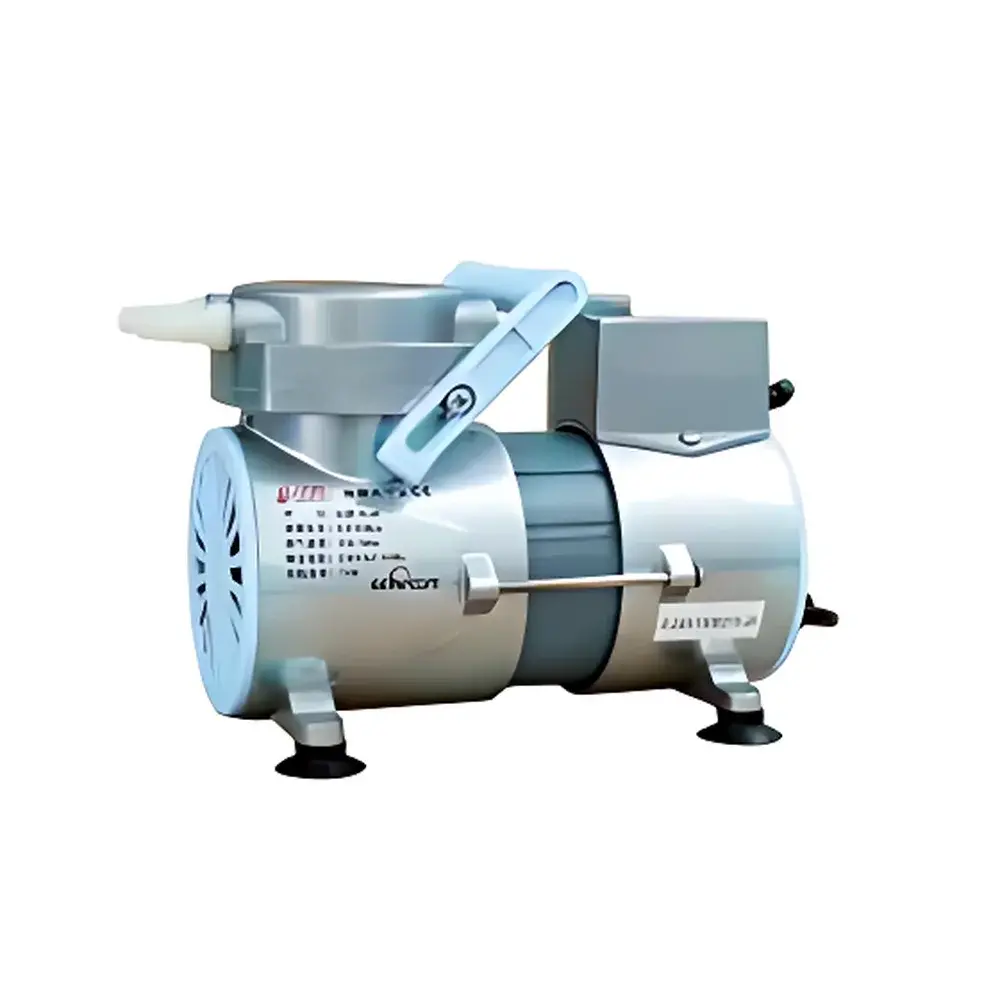
Jihepu GM-0.20 Diaphragm Vacuum Pump
| Brand | Jihepu |
|---|---|
| Origin | Shandong, China |
| Model | GM-0.20 |
| Pump Type | Oil-Free Diaphragm Vacuum Pump |
| Ultimate Vacuum | 0.075 MPa (250 mbar, ~30 psi) |
| Air Displacement Rate | 15 L/min |
| Motor Power | 75 W |
| Noise Level | <50 dB(A) |
| Inlet Port Diameter | φ6 mm |
| Dimensions (L×W×H) | 195×98×156 mm |
| Weight | 4 kg |
| Operating Temperature Range | 7–40 °C |
| Pump Head Material | Nylon |
| Housing Material | Die-Cast Aluminum |
| Maximum Continuous Operating Temperature | <55 °C |
| Compliance | CE-marked design principles (IEC 61000-6-3/6-4), suitable for GLP-compliant laboratory environments |
Overview
The Jihepu GM-0.20 Diaphragm Vacuum Pump is an oil-free, maintenance-light vacuum source engineered for precision laboratory applications requiring clean, hydrocarbon-free vacuum generation. Utilizing a corrosion-resistant nylon diaphragm and die-cast aluminum housing, it operates on positive displacement principle via reciprocating elastomeric diaphragm motion—eliminating the need for lubricating oil and preventing sample contamination. Designed specifically to support analytical instrumentation—including gas chromatography (GC), liquid chromatography (LC), solid-phase extraction (SPE), vacuum filtration, and degassing of solvents—the GM-0.20 delivers stable vacuum performance up to 0.075 MPa (250 mbar) with a nominal air displacement rate of 15 L/min at standard conditions (20 °C, 101.3 kPa). Its compact footprint (195 × 98 × 156 mm) and lightweight construction (4 kg) facilitate integration into benchtop analytical workstations, fume hoods, or mobile lab setups without compromising mechanical stability or thermal management.
Key Features
- Oil-free operation ensures zero risk of hydrocarbon backstreaming—critical for GC carrier gas purity and mass spectrometry compatibility.
- Nylon-reinforced diaphragm and valve assembly provide high chemical resistance against common organic solvents, acids, and bases encountered in pharmaceutical QC and forensic analysis.
- Die-cast aluminum housing offers superior heat dissipation and structural rigidity while maintaining low mass for ergonomic handling.
- Low-noise design (<50 dB[A] at 1 m distance) meets ISO 7779 requirements for quiet laboratory environments, minimizing acoustic interference during sensitive detection workflows.
- Thermally protected 75 W brushless motor enables continuous duty cycle operation within ambient temperatures of 7–40 °C, with internal temperature limited to <55 °C under full load.
- Standardized φ6 mm inlet port supports rapid connection to common vacuum tubing (e.g., Tygon®, Viton®) and modular vacuum manifolds used in multi-channel SPE systems.
Sample Compatibility & Compliance
The GM-0.20 is compatible with aqueous, alcoholic, chlorinated, and moderately polar organic solvent vapors typical in sample preparation workflows—provided vapor concentrations remain below saturation limits at operating temperature. It is not intended for use with strongly oxidizing agents (e.g., concentrated nitric acid vapor), halogenated hydrocarbons above 5% v/v, or particulate-laden streams without upstream filtration. From a regulatory standpoint, its oil-free architecture aligns with USP , EP 2.2.46, and ISO 8573-1 Class 0 air purity requirements for instrument-grade vacuum supply. While not certified to IEC 61010-1 as a standalone safety-certified device, its electrical design adheres to fundamental insulation and creepage distance guidelines consistent with laboratory equipment safety expectations. Documentation packages support audit readiness for GLP and ISO/IEC 17025-accredited laboratories.
Software & Data Management
As a stand-alone mechanical vacuum source, the GM-0.20 does not incorporate embedded firmware, digital interfaces (e.g., RS-232, USB, or Ethernet), or onboard data logging capabilities. Its operational status is monitored solely via tactile feedback (vibration), audible output, and external pressure gauge readings. Integration into automated systems requires external vacuum sensors (e.g., capacitance manometers) and programmable logic controllers (PLCs) or instrument control software (e.g., Chromeleon™, OpenLab CDS) configured for analog or relay-based start/stop signaling. For traceability in regulated environments, users are advised to record pump runtime, maintenance intervals (e.g., diaphragm replacement every 5,000–8,000 hours per manufacturer guidance), and calibration of connected vacuum gauges per SOP-defined schedules aligned with FDA 21 CFR Part 11 electronic record integrity principles.
Applications
- Gas chromatography sample introduction and detector evacuation (TCD, ECD, NPD).
- Vacuum-assisted liquid–liquid extraction (LLE) and solid-phase extraction (SPE) manifold operation.
- Concentration of volatile analytes via rotary evaporation pre-chilling or cold trap interfacing.
- Deaeration of HPLC mobile phase solvents and column equilibration under reduced pressure.
- Forensic toxicology sample cleanup workflows requiring inert vacuum conditions to preserve volatile biomarkers.
- Pharmaceutical dissolution testing apparatus vacuum priming and filter drying stages.
FAQ
Is the GM-0.20 compatible with aggressive solvents such as acetone or dichloromethane?
Yes—when operated within specified vapor concentration limits and with appropriate upstream condensation traps; however, prolonged exposure to high-concentration DCM vapor may accelerate diaphragm aging.
What is the recommended service interval for the diaphragm assembly?
Under typical laboratory usage (6–8 hrs/day, ambient temperature ≤30 °C), replace the diaphragm and valves every 6,000 operating hours or annually—whichever occurs first.
Can this pump be used for vacuum oven applications?
No—it is not rated for sustained operation at deep vacuum (40 °C ambient); use only for rough vacuum duties up to 250 mbar.
Does the GM-0.20 meet FDA or ISO certification requirements for GMP manufacturing environments?
It is not individually certified to ISO 13485 or FDA QSR; however, its material composition and oil-free function support compliance when validated as part of an integrated system per process-specific protocols.
Is there a CE or UL mark affixed to the unit?
The GM-0.20 conforms to EMC and LVD directive principles (EN 61000-6-3, EN 61000-6-4, EN 60335-1), but final CE marking requires end-user responsibility per EU Declaration of Conformity documentation provided with shipment.
Related Products



