
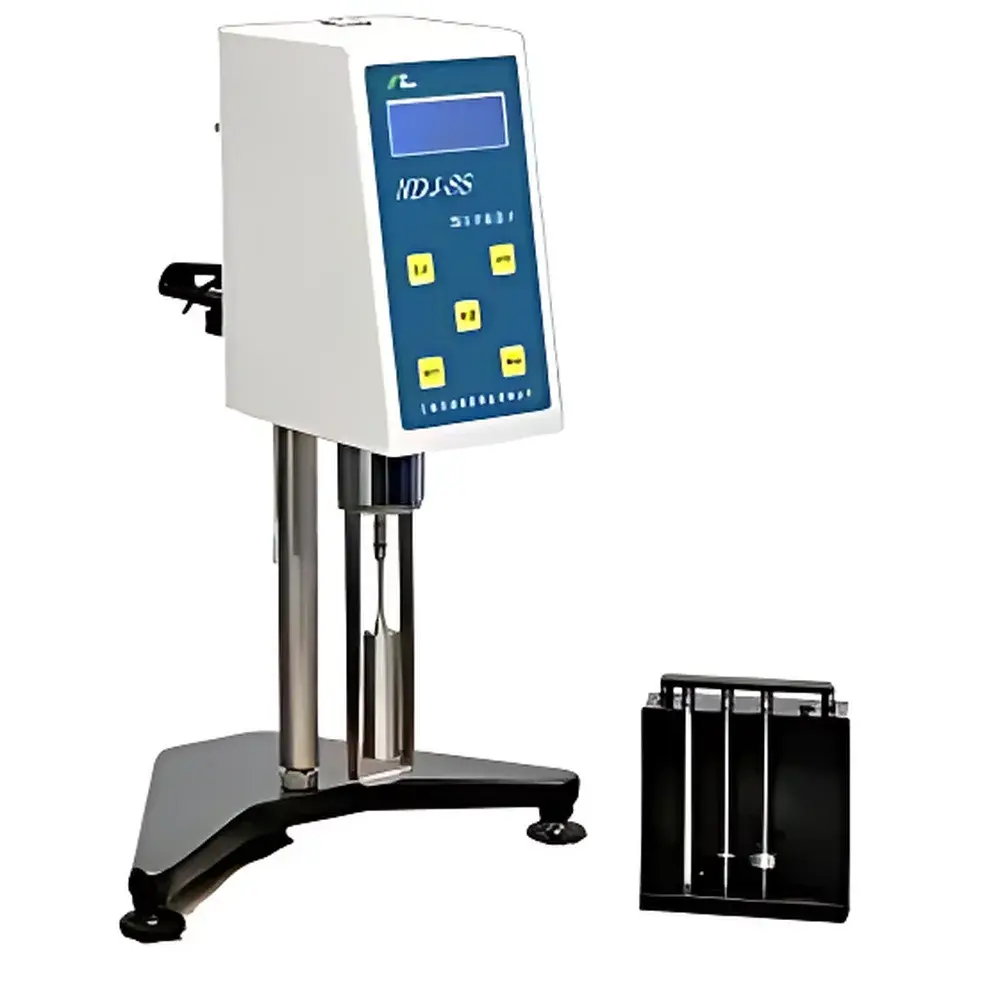
Hebei Jihepu NDJ-8S Digital Rotational Viscometer
| Brand | Jihepu |
|---|---|
| Origin | Shandong, China |
| Model | NDJ-8S |
| Instrument Type | Rotational Viscometer |
| Viscosity Range | 10–200,000 mPa·s (cP) |
| Optional Spindle | #0 for down to 1 mPa·s (cP) |
| Speed Settings | 0.3, 0.6, 1.5, 3, 6, 12, 30, 60 rpm (gearless drive) |
| Standard Spindles | Four (#1–#4) |
| Accuracy | ±1.0% of full scale |
| Repeatability | ±0.5% of full scale |
| Input Voltage | 110/220 V AC |
| Input Frequency | 50/60 Hz |
| Temperature Monitoring | Optional RTD probe |
| Data Output | RS232 interface (optional) |
| Power Supply | Switching-mode adapter with wide-input range |
Overview
The Hebei Jihepu NDJ-8S Digital Rotational Viscometer is a precision-engineered instrument designed for reliable, repeatable measurement of dynamic viscosity in Newtonian and non-Newtonian fluids using the principle of rotational viscometry. Based on Couette flow geometry, the device applies controlled torque to a rotating spindle immersed in the sample while measuring the resulting resistance—directly correlating to fluid viscosity. Engineered for laboratory, quality control, and R&D environments, the NDJ-8S delivers stable speed control across eight discrete rotational speeds (0.3–60 rpm), all achieved via direct-drive stepper motor technology—eliminating gear backlash, mechanical noise, and speed drift caused by line frequency variation. Its microprocessor-based architecture supports real-time digital display of viscosity (mPa·s or cP), % torque, current spindle/speed combination’s maximum measurable viscosity, and optional temperature readout when paired with an RTD probe. The instrument complies with fundamental metrological requirements aligned with ISO 2555 and ASTM D2196 for rotational viscosity testing.
Key Features
- Direct-drive stepper motor ensures precise, gearless rotation—no speed deviation due to AC line frequency fluctuations (50/60 Hz)
- Eight programmable shear rates (0.3, 0.6, 1.5, 3, 6, 12, 30, 60 rpm) enable systematic flow curve analysis and thixotropy assessment
- High-resolution LCD with blue backlight displays viscosity, rotational speed, % torque, and real-time upper viscosity limit per spindle/speed configuration
- Full-scale linear calibration across the entire viscosity range (10–200,000 mPa·s); accuracy ±1.0% FS, repeatability ±0.5% FS
- Patented multi-sampling algorithm per rotation—overcoming traditional single-sample-per-revolution limitations common in entry-level rotational viscometers
- Wide-input switching power supply (110/220 V AC) with high noise immunity, suitable for variable laboratory power conditions
- Acoustic overload alert activates automatically when torque exceeds spindle capacity, preventing mechanical damage and data corruption
- Optional #0 spindle extends low-end sensitivity to 1 mPa·s (cP), supporting dilute polymer solutions, solvents, and biological buffers
Sample Compatibility & Compliance
The NDJ-8S accommodates a broad spectrum of liquid and semi-liquid samples—including paints, coatings, adhesives, food emulsions, pharmaceutical suspensions, lubricants, and drilling muds. Its standardized #1–#4 spindles conform to DIN 53019-1 and ISO 3219 geometries, ensuring inter-laboratory comparability. When equipped with the optional RTD temperature probe, the system supports temperature-controlled measurements critical for ASTM D445 and ISO 3104 compliance in petroleum product testing. While not certified for GMP or 21 CFR Part 11 out-of-the-box, the RS232 interface enables integration into validated data acquisition systems where electronic records, audit trails, and user access controls can be implemented at the host software level—supporting GLP-aligned workflows in regulated QC labs.
Software & Data Management
The NDJ-8S operates as a standalone instrument with embedded firmware; no proprietary PC software is required for basic operation. However, its standard RS232 serial interface allows seamless connection to third-party data logging platforms (e.g., LabVIEW, MATLAB, or custom Python scripts) for automated capture of viscosity, torque, speed, and optional temperature timestamps. When used with the optional mini thermal printer, raw measurement outputs—including date/time stamp, spindle ID, speed, and viscosity value—are generated in real time for immediate hard-copy documentation. All internal calibration coefficients are stored in non-volatile memory and protected against power loss, maintaining traceability without periodic recalibration under normal operating conditions.
Applications
- Quality assurance of industrial coatings and inks—verifying batch-to-batch consistency prior to application
- Rheological screening of cosmetic formulations (lotions, gels, shampoos) during development and stability testing
- Monitoring viscosity changes in fermentation broths or cell culture media to infer microbial growth kinetics
- Evaluation of thixotropic recovery behavior in lithium greases and sealants using timed rotational sequences
- Verification of solvent dilution effects on resin solutions in composite manufacturing processes
- Teaching laboratories—demonstrating Newtonian vs. pseudoplastic behavior using sucrose/water and xanthan gum solutions
FAQ
What spindle configurations are included with the NDJ-8S?
The instrument ships with four standard spindles (#1–#4) compliant with ISO 3219 geometry. The optional #0 spindle is available separately for ultra-low-viscosity applications.
Is temperature control integrated into the base unit?
No—the NDJ-8S does not include built-in thermostatic control. However, it supports external temperature monitoring via an optional RTD probe and can be used with a separate circulating water bath (e.g., JC-200 series) for isothermal testing.
Can the NDJ-8S meet regulatory requirements for pharmaceutical QC?
As supplied, it lacks 21 CFR Part 11-compliant electronic signature and audit trail functionality. However, when interfaced with validated third-party software and procedural controls, it may support GxP data integrity requirements within a documented quality system.
How is calibration verified and maintained?
Calibration is performed using NIST-traceable standard oils across the full viscosity range. Users may conduct routine verification using certified reference fluids; factory recalibration is recommended annually or after mechanical impact.
Does the instrument support continuous data streaming?
Yes—via RS232 at configurable baud rates (default 9600 bps), enabling real-time streaming of viscosity, torque, speed, and temperature (if probe installed) to external acquisition systems.



