
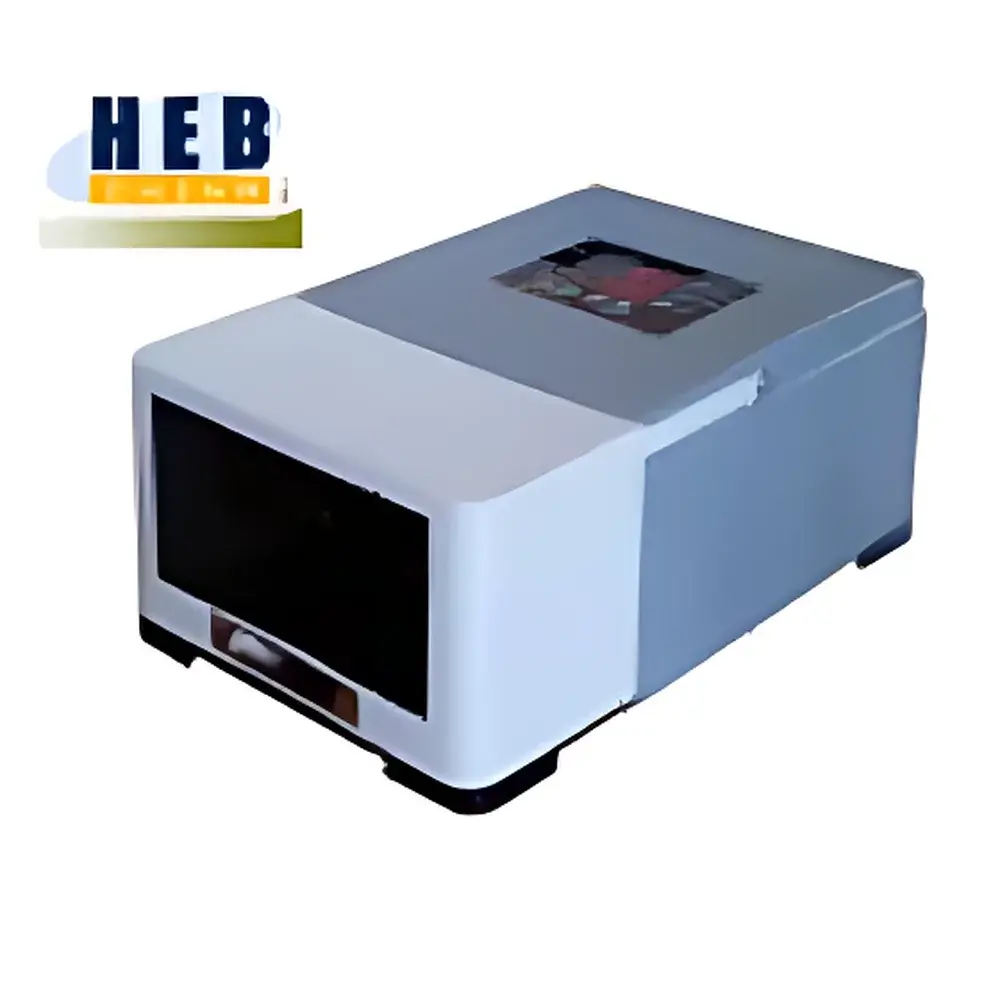
JH-B10 KBr Grinding Mill
| Brand | Jihepu (Jinan Hepu) |
|---|---|
| Origin | Shandong, China |
| Model | JH-B10 |
| Instrument Type | Cryogenic Planetary Ball Mill |
| Sample Type | Soft to Medium-Hard Materials (e.g., KBr, pharmaceutical excipients, polymers, biological tissues) |
| Feed Size | ≤8 mm |
| Final Particle Size | ≤5 µm |
| Batch Capacity | 25–50 mL per jar (dual-jar configuration) |
| Grinding Vessel Options | 25 mL & 50 mL旋盖-type jars ×2 |
| Grinding Media Materials | Agate, Stainless Steel, Zirconia, Tungsten Carbide, Ceramic, PTFE |
| Time Setting Range | 1 s – 99 min 59 s (digital display) |
| Drive Motor | Brushless DC Motor, 550 W |
| Vibration Frequency | 10–2000 cycles/min |
| Typical Grinding Duration | ~2 min (for KBr powder homogenization) |
| Dimensions (W×H×D) | 300×180×420 mm |
Overview
The JH-B10 KBr Grinding Mill is a high-precision, dual-vial planetary ball mill engineered specifically for the preparation of homogeneous potassium bromide (KBr) powders used in Fourier-transform infrared (FTIR) spectroscopy sample preparation—particularly for pressed pellet formation. It operates on the principle of high-energy impact and shear forces generated by the eccentric motion of grinding jars relative to the sun wheel, enabling rapid size reduction while preserving chemical integrity and minimizing contamination. Unlike conventional mortar-and-pestle or roller mills, the JH-B10 integrates programmable frequency control, automatic centering clamping, and multi-format vessel compatibility—making it suitable not only for KBr but also for soft organic compounds, pharmaceutical APIs, polymer blends, and lyophilized biological samples requiring micron-scale dispersion prior to spectral or thermal analysis.
Key Features
- Dual independent grinding stations with auto-centering clamping mechanism ensuring consistent mechanical coupling and vibration damping across variable load conditions.
- Digital time control interface (1 second to 99 minutes 59 seconds) with real-time display and memory retention for repeatable method recall.
- Adjustable vibration frequency (10–2000 cycles/min) optimized for balancing throughput and particle morphology—critical for IR-transparent KBr pellet uniformity.
- Modular vessel support accommodating multiple formats simultaneously: two 25/50 mL旋盖-type jars, plus dual-position microplate holders for 1 mL (48-well), 2 mL (24-well), 5 mL (12-well), and 10 mL (6-well) configurations—enabling parallel processing of diverse sample types.
- Brushless DC motor (550 W) delivering stable torque output over extended operation cycles, with low electromagnetic interference and minimal maintenance requirements.
- Grinding media selection includes agate (for ultra-low metal contamination), zirconia (high density, inert), stainless steel (durability), tungsten carbide (extreme hardness), ceramic, and PTFE (non-reactive, low-density applications).
Sample Compatibility & Compliance
The JH-B10 is validated for soft-to-medium hardness materials with Mohs hardness ≤4, including KBr, NaCl, sucrose, lactose, cellulose derivatives, freeze-dried proteins, and plant extracts. Its sealed旋盖-type jars prevent cross-contamination and moisture ingress during grinding—essential for hygroscopic salts like KBr. The instrument complies with general laboratory safety standards (IEC 61000-6-2/6-4 for EMC, GB/T 13306-2011 for equipment nameplates) and supports GLP-aligned workflows through traceable parameter logging (when paired with optional PC interface). While not certified to ISO/IEC 17025 or ASTM E1952, its reproducible particle size distribution (<5 µm D90) meets typical pre-analytical requirements for FTIR, XRD, and DSC sample preparation per USP and Ph. Eur. 2.9.31 guidelines.
Software & Data Management
The JH-B10 operates via embedded firmware without proprietary software dependency. All operational parameters—including duration, frequency, and start/stop timestamps—are stored in non-volatile memory and accessible via front-panel display. Optional RS-232 or USB-to-serial interface enables integration with LIMS or custom LabVIEW/Python scripts for automated batch logging. Audit trail functionality (user ID, timestamp, parameter set) can be implemented externally for FDA 21 CFR Part 11 compliance when deployed in regulated QC environments. No cloud connectivity or remote access features are included—ensuring data sovereignty and network isolation per institutional IT policies.
Applications
- Routine KBr pellet fabrication for transmission-mode FTIR spectroscopy, ensuring optical homogeneity and minimal scattering artifacts.
- Homogenization of pharmaceutical blend samples prior to content uniformity testing (USP ) or dissolution profiling.
- Preparation of fine powders for X-ray diffraction (XRD) phase identification where crystallite size broadening must be minimized.
- Cell lysis and matrix disruption in metabolomics workflows involving plant or microbial biomass.
- Dispersion of conductive fillers (e.g., carbon black, graphene oxide) into polymer matrices for rheological or electrical characterization.
FAQ
Is the JH-B10 suitable for cryogenic grinding?
No—the system lacks integrated cooling or liquid nitrogen porting. For temperature-sensitive samples, pre-chilling of jars and media is recommended, but sustained sub-0°C operation is not supported.
Can I use this mill for wet grinding?
Yes, provided vessels are rated for solvent compatibility (e.g., PTFE-lined jars) and grinding media are chemically inert toward the chosen medium; however, standard operation is optimized for dry grinding.
What maintenance intervals are recommended for the brushless motor?
No scheduled maintenance is required; the motor is sealed and rated for >20,000 hours of continuous operation under nominal load conditions.
Does the instrument include calibration documentation?
Factory calibration certificates for time and frequency accuracy are available upon request (NIST-traceable reference instruments used during verification).
How is jar imbalance compensated during high-frequency operation?
The auto-centering clamping system dynamically adjusts radial tolerance within ±0.1 mm, reducing harmonic resonance and bearing stress at frequencies above 1500 cycles/min.



