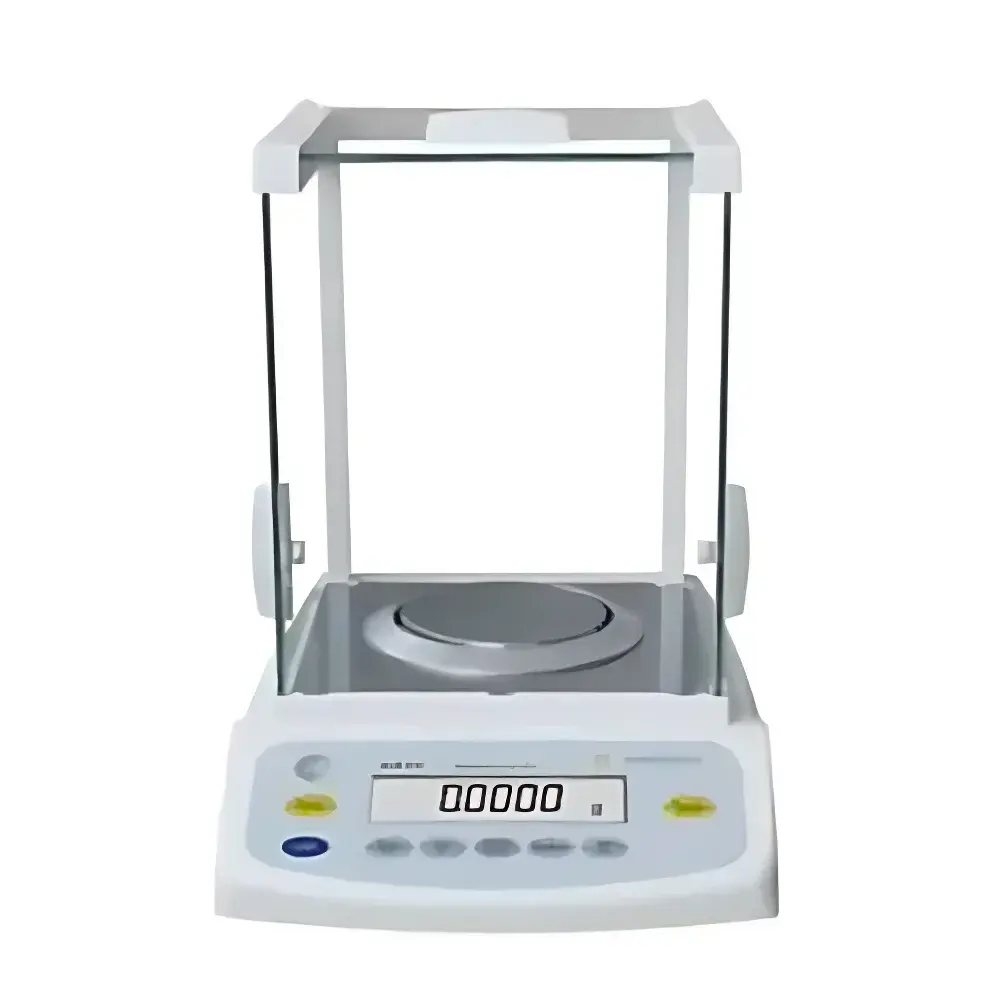
Sartorius BSA124S-CW Analytical Balance
| Origin | Germany |
|---|---|
| Manufacturer Type | Authorized Distributor |
| Origin Category | Imported |
| Model | BSA124S-CW |
| Instrument Type | Analytical Balance |
| Maximum Capacity | 120 g |
| Readability | 0.1 mg |
| Repeatability | 0.1 mg |
| Calibration | Internal motor-driven calibration weight |
| Display | Backlit LCD with 15 mm high characters |
| Level Indicator | Integrated front-mounted bubble level |
| Draft Shield | Five-sided glass windscreen with anti-static coating |
| Shock Protection | Four-stage damping system |
| Connectivity | RS-232C bidirectional interface |
| Applications | Percentage weighing, animal weighing, counting, density determination, net weight summation, unit conversion, arithmetic (×/÷) |
| Compliance | GLP-compliant data output, ISO/IEC 17025 traceable operation |
Overview
The Sartorius BSA124S-CW is a high-precision analytical balance engineered for routine laboratory weighing tasks requiring reproducible results at the 0.1 mg readability level. Designed and manufactured in Germany, it employs a monolithic electromagnetic force compensation sensor — a hallmark of Sartorius metrology — ensuring long-term stability, minimal drift, and immunity to mechanical hysteresis. Its operating principle relies on real-time electromagnetic feedback to maintain equilibrium between the load and the restoring force, delivering true mass measurement traceable to SI units. The BSA124S-CW is optimized for environments where ambient fluctuations (e.g., air currents, temperature gradients, or floor vibrations) are common but cannot compromise data integrity. Built-in dynamic temperature compensation and four-stage mechanical damping actively counteract thermal expansion effects and low-frequency disturbances, enabling consistent performance without requiring climate-controlled rooms.
Key Features
- Monolithic electromagnetic force compensation sensor for exceptional linearity and zero-point stability
- Internal motor-driven calibration system with certified reference weights — single-button activation ensures traceable, repeatable calibration per ISO 9001 and GLP requirements
- Five-sided draft shield constructed from anti-static coated glass, minimizing electrostatic interference and maximizing visibility during sample handling
- Front-mounted bubble level with integrated visual indicator — enables rapid verification of leveling prior to each weighing session
- Backlit LCD display featuring 15 mm character height and high contrast ratio — legible under variable lighting conditions including low-illumination labs or UV hoods
- 40 MHz microprocessor (MC1 architecture) enabling sub-second stabilization time and responsive menu navigation
- RS-232C bidirectional interface as standard — supports direct connection to Sartorius YDP03-0CE printers or host PCs for audit-ready data export
- Dual tare keys (left/right positioned) accommodate ergonomic preferences across diverse user populations
- Downward hook assembly for below-balance weighing of large-volume or suspended samples (e.g., density kits, magnetic susceptibility fixtures)
- Automatic fault diagnostics with on-screen error codes — simplifies troubleshooting and reduces instrument downtime
Sample Compatibility & Compliance
The BSA124S-CW accommodates standard 90 mm diameter weighing pans and is compatible with all Sartorius-certified accessories, including density determination kits, universal sample holders, and static-dissipative weighing boats. Its five-sided glass enclosure permits unobstructed access while maintaining ISO 17025–compliant environmental isolation. All internal calibration events generate timestamped, operator-annotated records compliant with FDA 21 CFR Part 11 when paired with validated software (e.g., Sartorius LabX Lite). The balance meets European Union Measuring Instruments Directive (MID) Annex MI-001 for non-automatic weighing instruments and conforms to OIML R 76–1 Class I accuracy requirements. Routine verification protocols align with USP , ASTM E898–22, and ISO/IEC 17025 clause 6.4.10 for measurement uncertainty estimation.
Software & Data Management
Data capture and reporting follow GLP/GMP-aligned workflows. Through the RS-232C port, raw weight values, timestamps, operator IDs (when enabled), calibration logs, and environmental metadata (e.g., internal temperature readings) can be transmitted in ASCII format to external systems. When interfaced with optional YDP03-0CE thermal printers, outputs include full header information (date/time, model, serial number, calibration status) and comply with ALCOA+ principles (Attributable, Legible, Contemporaneous, Original, Accurate). For networked laboratories, the balance integrates seamlessly into Sartorius LabX software platforms, enabling centralized user management, electronic signatures, and automated report generation with digital audit trails.
Applications
This balance serves critical roles across pharmaceutical QC labs (e.g., active pharmaceutical ingredient (API) assay preparation, reference standard dilution), academic research (gravimetric analysis, catalyst loading, polymer synthesis stoichiometry), environmental testing (filter weighing for particulate matter analysis), and materials science (coating thickness validation via mass gain). Its animal weighing mode supports live-sample monitoring with adaptive filtering; percentage weighing facilitates formulation batch scaling; density determination mode computes material density directly using Archimedes’ principle with built-in buoyancy correction. The counting function leverages statistical sampling algorithms compliant with ISO 14411 for high-throughput component verification.
FAQ
Does the BSA124S-CW support external calibration with user-provided weights?
No — the CW variant is equipped exclusively with an internal motorized calibration mechanism and does not provide manual external calibration capability.
Is the RS-232C interface compatible with modern USB-equipped computers?
Yes — Sartorius offers certified RS-232-to-USB adapter cables (e.g., OM-USB-232) that preserve full bidirectional communication and data integrity.
Can the balance store calibration history internally?
It does not retain historical calibration records in non-volatile memory; however, all calibration events generate immediate printable or serial-exportable logs.
What is the maximum recommended sample height inside the draft shield?
For optimal airflow management and stability, samples should not exceed 120 mm in height above the pan surface.
Does the BSA124S-CW meet requirements for ISO/IEC 17025 accredited testing laboratories?
Yes — when operated within specified environmental limits (20 ± 5°C, ≤ 60% RH, vibration class M2 per ISO 27889), and with documented calibration and verification procedures, it satisfies metrological requirements for accredited mass measurement.