
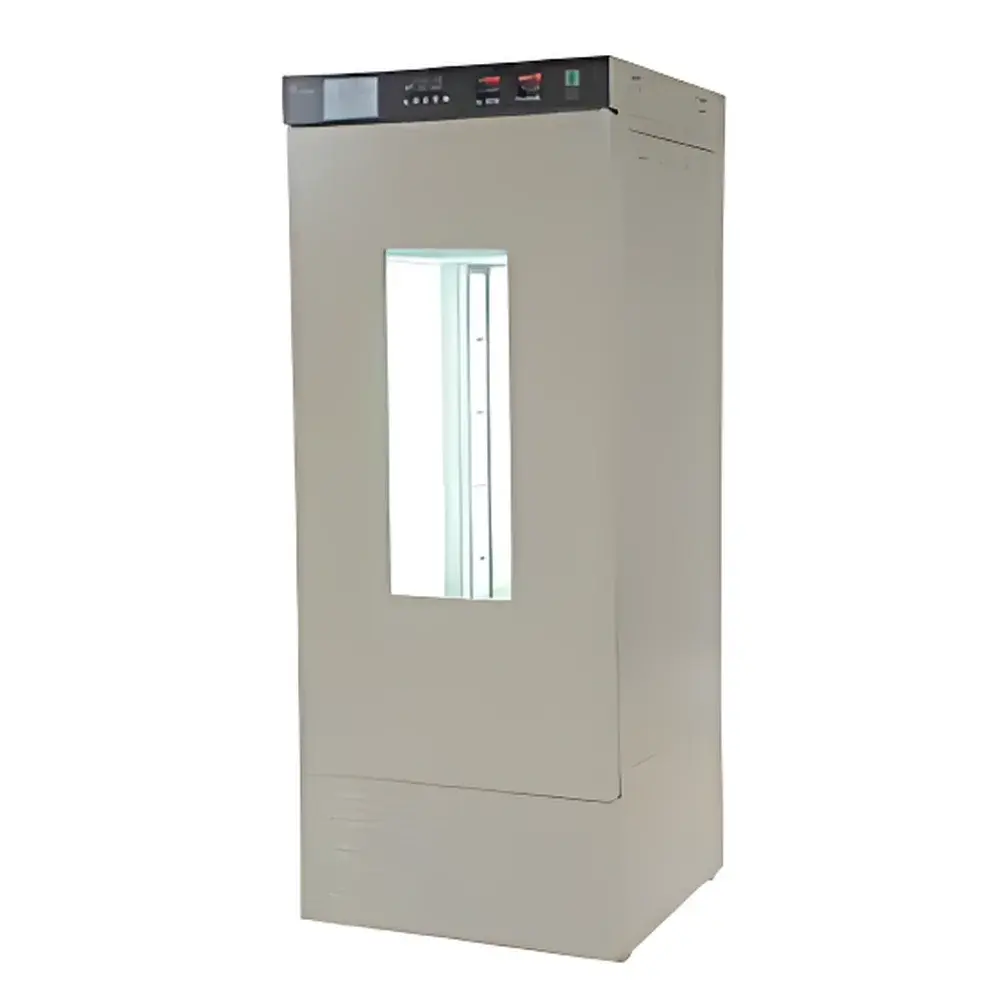
Jihepu SPX-300B-G Plant Growth Chamber
| Brand | Jihepu |
|---|---|
| Origin | Shandong, China |
| Model | SPX-300B-G |
| Temperature Range (dark) | 5–50°C |
| Temperature Range (light) | 10–50°C |
| Temperature Resolution | 0.1°C |
| Temperature Uniformity | ±2°C |
| Temperature Fluctuation | ±1.5°C |
| Illumination Intensity | 0–15,000 lx (6-level adjustable) |
| Input Power | 1200 W |
| Timer Range | 0–999 h |
| Interior Dimensions (W×D×H) | 495 × 635 × 955 mm |
| Exterior Dimensions (W×D×H) | 690 × 665 × 1650 mm |
| Shelving | 4 adjustable stainless steel shelves |
| Construction | Cold-rolled steel exterior with electrostatic powder coating |
Overview
The Jihepu SPX-300B-G Plant Growth Chamber is a precision-engineered environmental control system designed for reproducible, long-term plant physiology studies, seed germination assays, photobiological research, and controlled cultivation of model organisms. It operates on the principle of active thermoelectric and resistive heating combined with forced-air convection and multi-level LED or fluorescent illumination to simulate diurnal light–temperature cycles. Unlike basic incubators, this chamber integrates independent regulation of temperature and photosynthetically active radiation (PAR)-equivalent light intensity across six discrete levels (0–15,000 lx), enabling users to replicate specific ecological niches—from low-light understory conditions to full-sun exposure—while maintaining thermal stability within ±1.5°C fluctuation and ±2°C spatial uniformity across the 300 L working volume.
Key Features
- Microprocessor-based dual-display controller with touch-sensitive keypad for intuitive setting of temperature setpoints, illumination levels, and time-based program sequences
- High-stability temperature control architecture featuring PID algorithm tuning, automatic recovery from power interruption, and non-volatile memory retention of all operational parameters
- Four independently adjustable, load-rated stainless steel shelves with reinforced edge support—optimized for even airflow distribution and unobstructed light penetration
- Robust mechanical construction: cold-rolled steel outer cabinet with corrosion-resistant electrostatic powder coating; seamless mirror-finish 304 stainless steel interior chamber resistant to cleaning agents and humidity-induced oxidation
- Dual-mode timer functionality—supports both countdown operation (0–999 hours) and real-time scheduling with automatic start/stop logic for unattended overnight or multi-day experiments
- Integrated safety mechanisms including over-temperature cut-off, door-open alarm, and current-limiting circuitry compliant with IEC 61000-4 electromagnetic compatibility standards
Sample Compatibility & Compliance
The SPX-300B-G accommodates a broad range of biological samples requiring defined photoperiodic and thermal environments—including Arabidopsis thaliana seedlings, rice callus cultures, fungal spore plates, Drosophila melanogaster vials, and bacterial agar slants. Its design conforms to fundamental requirements outlined in ISO 17025 for laboratory equipment qualification, and supports GLP-compliant experimental workflows when paired with documented calibration procedures. While not certified to UL/CSA safety standards out-of-the-box, its electrical architecture meets GB 4793.1–2007 (Chinese national standard equivalent to IEC 61010-1) for laboratory equipment. Users conducting regulated studies under FDA 21 CFR Part 11 or EU Annex 11 should implement supplementary audit-trail logging via external data acquisition systems.
Software & Data Management
This chamber operates as a standalone instrument without embedded network connectivity or proprietary software. All parameter configuration and monitoring occur locally via the front-panel dual-digit display and tactile interface. For traceable data recording, users are advised to integrate an external USB or RS-485 data logger compatible with Modbus RTU protocol (available upon request from authorized distributors). The unit’s non-volatile memory preserves user-defined profiles—including up to 8 programmable temperature/light cycles—across power cycles, supporting continuity in longitudinal experiments. Calibration certificates for temperature sensors (PT100 class B) and illuminance meters (calibrated against NIST-traceable lux standards) may be provided separately per ISO/IEC 17025-accredited service.
Applications
- Standardized seed germination testing per ISTA and AOSA protocols under controlled photoperiods and thermal gradients
- Phenotypic screening of transgenic plant lines under stress-mimicking conditions (e.g., elevated temperature + reduced light)
- Cultivation of phototrophic microorganisms such as Chlamydomonas reinhardtii and Synechocystis sp. PCC 6803
- Developmental biology studies involving circadian rhythm entrainment in zebrafish embryos or Drosophila pupae
- Stability testing of biologics and microbial reference standards under ICH Q5C-relevant storage conditions
- Teaching laboratory modules in plant physiology, ecology, and environmental microbiology where reproducible environmental replication is critical
FAQ
What is the maximum ambient temperature at which the SPX-300B-G can maintain 10°C under full illumination?
The chamber is rated for operation in ambient environments up to 30°C. At 30°C ambient and 15,000 lx illumination, minimum achievable internal temperature is approximately 12°C due to radiant heat load from lighting elements.
Can the illumination spectrum be customized beyond intensity adjustment?
No—the factory-installed lamp assembly provides broad-spectrum white light optimized for general plant growth (400–700 nm). Spectral modification requires third-party retrofitting with tunable LED arrays, which voids warranty and may compromise thermal management.
Is validation documentation (IQ/OQ/PQ) included with purchase?
No. Installation Qualification (IQ) and Operational Qualification (OQ) templates are available upon request, but Performance Qualification must be conducted by the end user using NIST-traceable thermometers and lux meters per their internal SOPs.
How frequently should temperature and illuminance sensors be recalibrated?
Annual recalibration is recommended for temperature sensors; illuminance sensors require verification every six months due to photometric drift in lamp output over time.
Are replacement shelves or custom-sized trays available?
Yes—four standard shelves are included; additional 304 stainless steel shelves (same dimensions) and perforated mesh trays for enhanced airflow are available as optional accessories through authorized Jihepu distributors.




