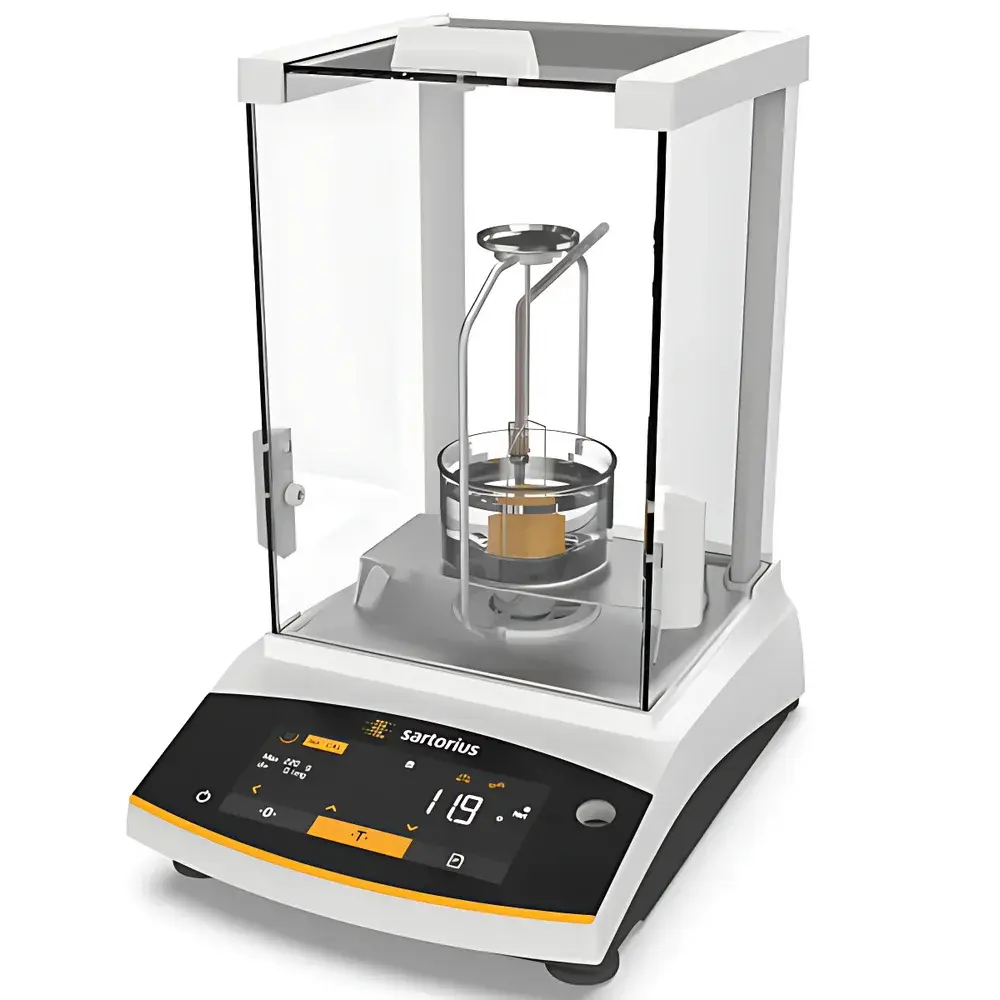
Sartorius BCE124-1CCN Analytical Balance
| Origin | Germany |
|---|---|
| Manufacturer Type | Authorized Distributor |
| Origin Category | Imported |
| Model | BCE124-1CCN |
| Instrument Type | Analytical Balance |
| Maximum Capacity | 120 g |
| Readability | 0.1 mg |
| Repeatability (typ. at full load) | ±0.1 mg |
| Linearity (typ.) | ±0.06 mg |
| Sensitivity Drift | ±1.5 ppm/K (10–30 °C) |
| Stabilization Time (typ.) | ≤1.5 s |
| Weighing Pan Dimensions | 90 mm × 240 mm |
| Chamber Height (pan edge to draft shield bottom edge) | 90 mm |
| External Dimensions (W×D×H) | 219 × 317 × 345 mm |
| Calibration | Internal (isoCAL®) |
| Interface | USB-C, RS-232 (9-pin), optional printer/second display auto-detection |
| Display | LED touchscreen |
| Applications | 12 built-in methods including weighing, percentage, counting, formulation, animal weighing, net/gross, etc. |
Overview
The Sartorius BCE124-1CCN is a high-precision analytical balance engineered for routine and regulated laboratory environments where reproducibility, traceability, and operational efficiency are critical. Designed and manufactured under stringent German quality standards, it employs Sartorius’ proprietary monolithic electromagnetic force compensation sensor technology — delivering exceptional stability, minimal drift, and rapid stabilization (<1.5 s typical). Its 120 g maximum capacity and 0.1 mg readability meet the requirements of ISO/IEC 17025-compliant testing labs, pharmacopeial assays (USP , EP 2.1.3), and GLP/GMP-controlled workflows. The balance operates on the principle of electromagnetic force restoration: when mass is placed on the pan, the system dynamically adjusts current through a coil to restore equilibrium, with displacement measured via an optical sensor — ensuring linearity, hysteresis-free performance, and long-term calibration integrity.
Key Features
- isoCAL® internal calibration and adjustment system — fully automated, temperature-compensated, and triggered manually or on schedule; eliminates manual intervention while maintaining compliance with ISO 9001 and FDA 21 CFR Part 11 audit-trail requirements.
- Robust mechanical architecture: weighing pan and housing components constructed from chemically resistant PBT polymer, stainless steel, and tempered glass — enabling resistance to common solvents, acids, and bases, and minimizing cross-contamination risk in multi-user labs.
- Rectangular 90 × 240 mm weighing pan with integrated overload protection — accommodates standard labware (e.g., volumetric flasks, beakers, crucibles) and supports dynamic applications such as animal weighing and formulation.
- Electrostatic-dissipative draft shield with anti-static coated glass — reduces electrostatic interference during low-mass measurements (<10 mg), a known source of instability in high-sensitivity analytical work.
- LED touchscreen interface with intuitive icon-driven navigation — supports multilingual operation (English, German, French, Spanish, Chinese, Japanese) and provides real-time feedback on leveling status, calibration state, and environmental alerts.
- Auto-detection of Sartorius peripherals — including thermal printers, secondary displays, and barcode scanners — enabling plug-and-play integration without driver installation.
- PC Direct mode via USB-C — transmits weight data directly into Microsoft Excel®, Word®, or LIMS fields using standard HID protocol; no third-party software required.
Sample Compatibility & Compliance
The BCE124-1CCN is validated for use with solid, granular, and powdered samples across pharmaceutical QC, academic research, and materials science laboratories. Its open chamber design and 90 mm vertical clearance accommodate tall or irregularly shaped vessels. All wetted surfaces are non-porous and wipe-clean per ISO 14644-1 Class 5 cleanroom maintenance protocols. The instrument conforms to EN 45501 (OIML R76), CE marking directives, and electromagnetic compatibility (EMC) standards IEC 61326-1. For regulated environments, it supports 21 CFR Part 11-compliant user access control (password-protected configuration), electronic signature capability (via optional software), and full audit trail logging of all critical events — including calibration, zeroing, parameter changes, and error states.
Software & Data Management
Data output is supported through three native interfaces: USB-C (HID class), RS-232 (9-pin D-sub), and optional Ethernet (via Sartorius Cubis® II gateway). The balance stores up to 1,000 measurement records locally with timestamps, operator IDs (assignable via password groups), and context tags. When connected to Sartorius LabX® software (sold separately), it enables full GxP compliance — including role-based permissions, electronic signatures, raw data archiving, and automatic report generation aligned with ALCOA+ principles. All internal firmware updates are digitally signed and verified, ensuring integrity throughout the device lifecycle.
Applications
- Pharmaceutical: Active pharmaceutical ingredient (API) dispensing, reference standard weighing, dissolution test sample preparation, and USP repeatability verification.
- Chemistry: Gravimetric analysis, titrant standardization, catalyst loading, and stoichiometric reagent preparation.
- Materials Science: Powder density determination, ash content analysis, and coating weight validation.
- Education: Teaching metrology fundamentals, uncertainty propagation, and measurement traceability in undergraduate and graduate labs.
- Quality Control: In-process checks for tablet weight variation, capsule fill consistency, and packaging net content verification per EU Directive 76/211/EEC.
FAQ
What is the difference between isoCAL® and external calibration?
isoCAL® performs automatic, temperature-triggered internal recalibration using built-in reference masses; external calibration requires certified weights and manual execution — typically used for periodic verification or after relocation.
Does the BCE124-1CCN support GLP-compliant data export?
Yes — when paired with LabX® software, it generates PDF/CSV reports with full metadata, electronic signatures, and immutable audit trails meeting GLP and 21 CFR Part 11 requirements.
Can the balance be leveled automatically?
No — but it features front-panel visual leveling guidance and adjustable stainless-steel feet for rapid, precise mechanical leveling without tools.
Is the touchscreen compatible with gloves?
The LED touchscreen responds reliably to standard nitrile or latex lab gloves; capacitive interference is minimized by optimized sensor sensitivity and surface coating.
How often should isoCAL® be scheduled?
Default interval is 2 hours, but users may configure intervals from 30 minutes to 24 hours based on ambient temperature fluctuation and process criticality.