
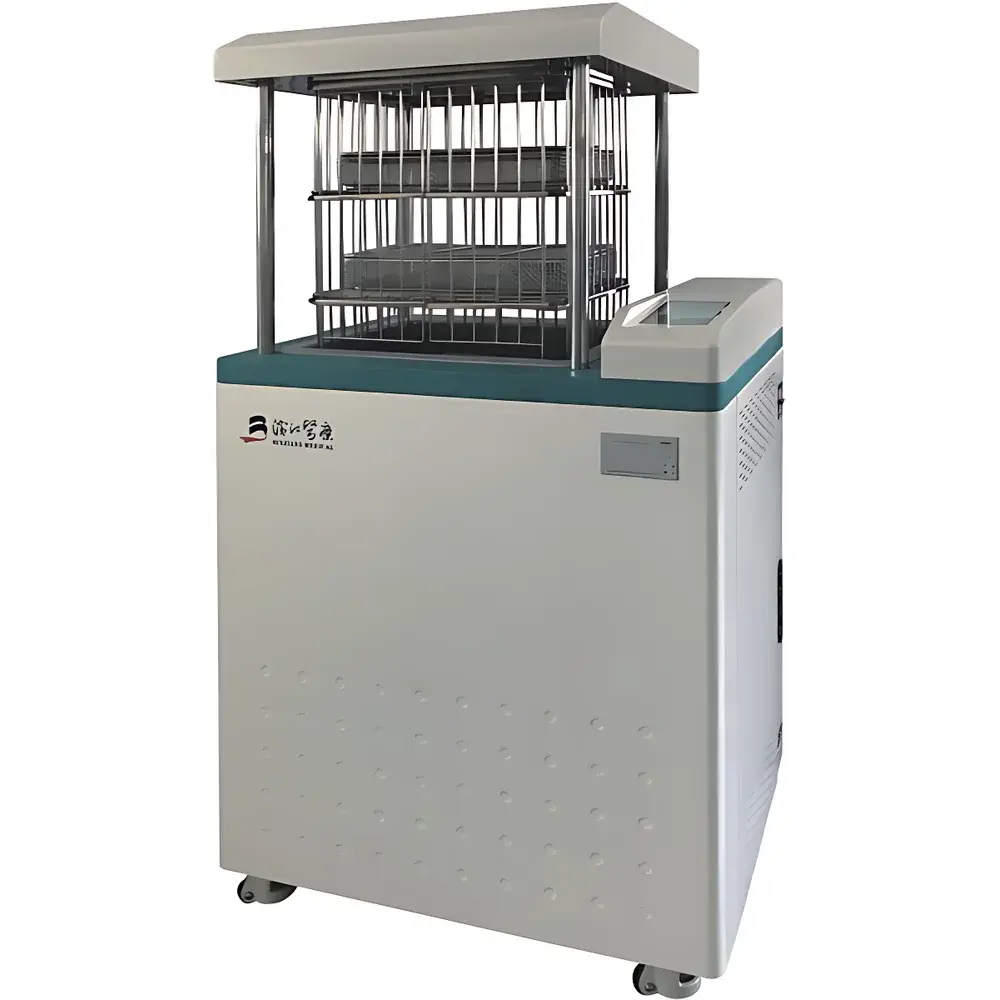
Heineu LS-120SV Vertical Pulsed-Vacuum Steam Sterilizer
| Brand | Heineu (Jihepu) |
|---|---|
| Origin | Shandong, China |
| Model | LS-120SV |
| Sterilizer Type | Vertical |
| Chamber Volume | 120 L |
| Max Operating Temperature | 134 °C |
| Max Working Pressure | 0.22 MPa |
| External Dimensions | 840 × 600 × 1060 mm |
| Net Weight | 295 kg |
| Gross Weight | 325 kg |
| Elevating Door Height (Raised) | 1565 mm |
| Temperature Uniformity | ≤ ±1 °C |
| Cycle Time Range | 0–99 min |
| Temperature Setpoint Range | 105–134 °C |
| Steam Generator Power | 3.6 kW |
| Drying Heater Power | 2.4 kW |
| Supply Voltage | AC 220 V, 50 Hz |
| Vacuum Limit | –0.080 MPa |
| Filter | Sartorius midisart® 2000, 0.20 µm hydrophobic membrane |
| PT/TT Test Port | Standard compliant |
| Steam Supply | Integrated electric steam generator |
| Air Replacement | Pulsed vacuum (downward exhaust with multi-cycle vacuum pulses) |
Overview
The Heineu LS-120SV is a vertically oriented, pulsed-vacuum steam sterilizer engineered for high-reliability terminal sterilization of heat-stable medical devices, laboratory glassware, culture media, surgical instruments, and porous loads in healthcare, pharmaceutical R&D, and academic research environments. It operates on the validated principle of saturated steam sterilization under controlled pressure and temperature—leveraging the microbicidal efficacy of moist heat at ≥121 °C (typically 121 °C or 134 °C) to achieve a sterility assurance level (SAL) of 10−6. Unlike gravity-displacement sterilizers, the LS-120SV employs a multi-pulse vacuum system to remove air from the chamber and load interstices prior to steam admission, ensuring complete steam penetration—even into lumened devices and wrapped packs. Its integrated electric steam generator delivers consistent, dry-saturated steam without external boiler dependency, minimizing oxidation risk to sensitive stainless-steel instruments and reducing thermal stress on agar-based media.
Key Features
- Vertical chamber design with motorized lift-and-lower door mechanism—reducing operator ergonomics strain and enabling unobstructed loading/unloading of tall or bulky items.
- 7-inch capacitive touchscreen HMI with preprogrammed cycle templates (e.g., unwrapped instruments, wrapped packs, liquids, porous loads) and customizable parameter sets (temperature, time, vacuum depth, drying duration).
- Pulsed vacuum system achieving ≤ –0.080 MPa absolute pressure across up to three vacuum pulses—validated per ISO 17665-1 for air removal efficiency and steam penetration uniformity.
- Integrated steam generator (3.6 kW) and independent drying heater (2.4 kW) support rapid chamber conditioning and post-sterilization vacuum drying—critical for moisture-sensitive loads.
- Internal steam–water recirculation architecture eliminates external steam venting, maintaining ambient lab humidity and complying with ISO 14644 cleanroom compatibility requirements.
- Standardized PT/TT (Process Temperature/Time) test port enables third-party validation using calibrated thermocouples or biological indicators—fully traceable to EN 285 and ANSI/AAMI ST79.
- Installed Sartorius midisart® 2000 hydrophobic filter (0.20 µm pore size) ensures sterile air re-entry during vacuum break cycles—preventing microbial ingress and meeting ISO 11140-4 filter integrity standards.
Sample Compatibility & Compliance
The LS-120SV accommodates a broad spectrum of sterilizable materials—including stainless-steel surgical trays, silicone tubing, cotton gauze packs, PETG containers, borosilicate glassware, and liquid-filled flasks (with pressure-relief venting). Its 120 L chamber volume supports Class B load configurations as defined in EN 13060. The unit conforms to key international regulatory frameworks: EN 285 (large steam sterilizers), EN 13060 (small steam sterilizers), ISO 17665-1 (moist heat sterilization process validation), and AAMI TIR36 (sterilization cycle development). All control logic, event logging, and parameter archiving are structured to support GLP/GMP documentation needs, including audit-ready cycle records with timestamps, operator IDs, and deviation flags.
Software & Data Management
The embedded control firmware provides real-time graphical monitoring of chamber pressure, temperature, vacuum level, and phase progression (conditioning → sterilization → drying). Cycle data—including all setpoints, actual values, alarms, and manual interventions—is automatically logged to internal flash memory (≥10,000 cycles retained) and exportable via USB interface in CSV format. Optional RS485/Modbus RTU output enables integration with centralized laboratory information management systems (LIMS) or building automation platforms. While not FDA 21 CFR Part 11–certified out-of-the-box, the system supports user-defined electronic signatures and password-protected access levels (operator, technician, administrator), laying groundwork for regulated environment deployment.
Applications
- Hospital central sterile supply departments (CSSD) processing reusable surgical kits and endoscopes.
- Pharmaceutical quality control labs sterilizing microbiological media, buffers, and component vials.
- Academic biosafety Level 2 (BSL-2) laboratories decontaminating centrifuge rotors, pipette tips, and waste containers.
- Veterinary clinics requiring validated sterilization of dental and orthopedic instruments.
- Biotech startups performing in-house media preparation and equipment validation under lean QA frameworks.
FAQ
What vacuum level does the LS-120SV achieve during pulsing?
The system performs up to three vacuum pulses, each reaching a minimum absolute pressure of –0.080 MPa, verified by factory-calibrated pressure transducers traceable to NIST standards.
Is the steam generator sufficient for continuous operation?
Yes—the 3.6 kW integrated generator maintains steady-state steam output for standard 134 °C cycles; recovery time between consecutive full-chamber cycles is ≤12 minutes under nominal ambient conditions.
Can the unit be validated for ISO 13485 compliance?
Absolutely—the presence of PT/TT ports, digital cycle logging, and adherence to EN 285/ISO 17665-1 enables IQ/OQ/PQ execution by qualified third-party vendors or in-house validation teams.
Does it support liquid cycle programming with slow-cool ramping?
Yes—dedicated liquid programs include programmable exhaust rate control and extended post-sterilization cooling phases to prevent boil-over and container rupture.
What maintenance intervals are recommended?
Daily: Chamber wipe-down and door gasket inspection. Quarterly: Vacuum pump oil change and filter replacement. Annually: Full calibration of temperature/pressure sensors and safety valve certification per local jurisdictional requirements.
Related Products



