
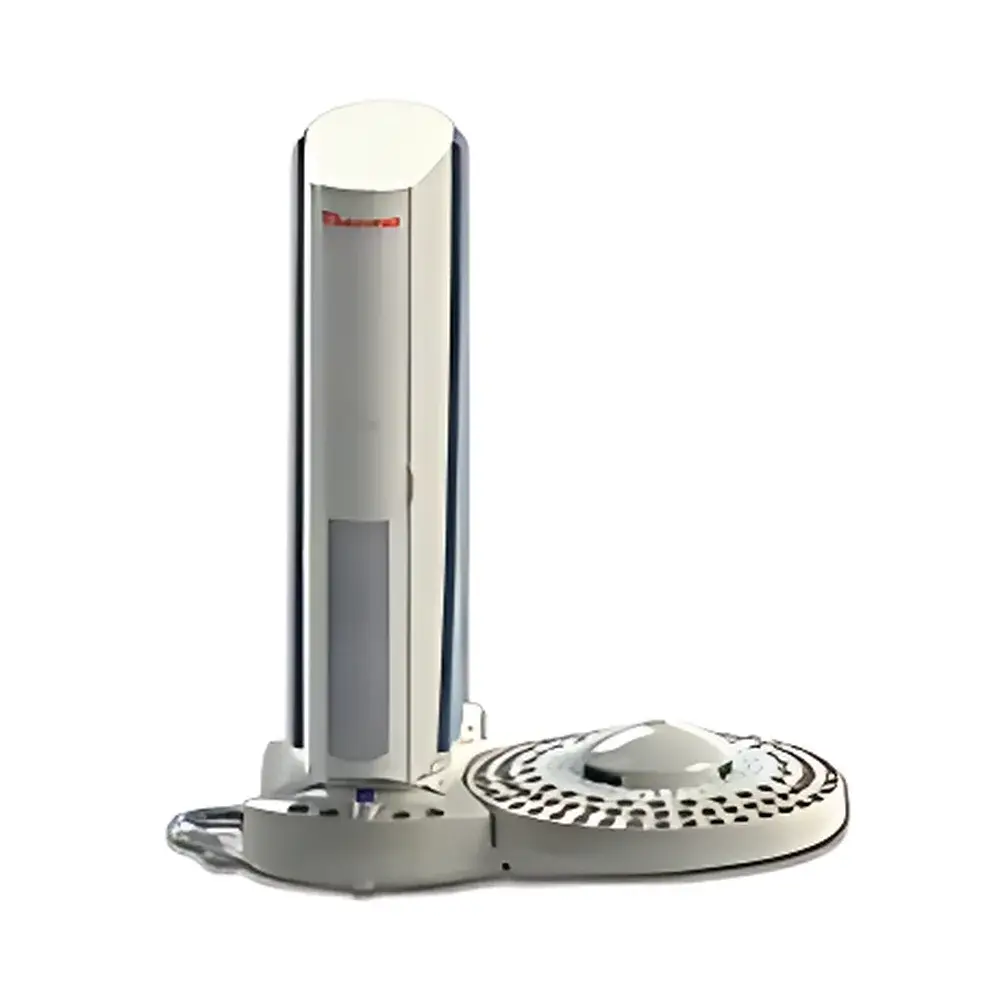
Thermo Fisher AI/AS 1310 Multifunctional Autosampler for Gas Chromatography
| Brand | Thermo Fisher |
|---|---|
| Origin | Italy |
| Manufacturer Type | Original Equipment Manufacturer (OEM) |
| Product Origin | Imported |
| Model | AI/AS 1310 |
| Instrument Type | Gas Chromatography Autosampler |
| Sample Capacity | 8-position (AI 1310) or 155-position (AS 1310) |
| Needle Wash Options | Single or dual-solvent (A/B/C/D, A+B, C+D) pre- and post-injection |
| Injection Modes | Minimum Needle Depth & Standard Needle Depth |
| Compatibility | Thermo Scientific GC systems (e.g., TRACE 1300/1600 series) |
| Upgrade Path | AI 1310 → AS 1310 |
| Optional Dual-Inlet Kit | AS 1310 Gemini Kit (enables simultaneous dual-port injection) |
Overview
The Thermo Fisher AI/AS 1310 Multifunctional Autosampler is an engineered solution for precise, reproducible, and high-throughput liquid sample introduction in gas chromatography (GC) workflows. Designed specifically for integration with Thermo Scientific TRACE GC platforms, the system operates on a robust electromechanical architecture that ensures positional repeatability within ±0.1 mm and injection volume accuracy traceable to NIST-certified standards. Its core functionality relies on syringe-based aspiration and dispense mechanics governed by closed-loop stepper motor control and optical end-point detection—eliminating reliance on pressure or time-based dispensing. The autosampler supports both cold-on-column and split/splitless inlet configurations, with thermal management of the needle assembly decoupled from the GC inlet temperature zone to prevent premature volatilization of low-boiling analytes (e.g., BTEX, chloromethanes, or light hydrocarbons). This design distinction is critical for maintaining quantitative integrity across volatile organic compound (VOC) analysis per EPA Method 8260D and ASTM D3699.
Key Features
- Two scalable configurations: compact 8-position AI 1310 for method development and QC labs; high-capacity 155-position AS 1310 for routine environmental or petrochemical screening.
- Dual-stage needle wash system with programmable solvent selection (up to four solvents, including binary mixtures), minimizing carryover to <0.01% for consecutive injections of high-concentration standards.
- Thermally isolated needle drive mechanism prevents heat transfer from GC inlet (up to 400 °C) to the syringe barrel—ensuring stable viscosity response and accurate metering of volatile samples.
- Two preset needle insertion depths: “Minimum Depth” mode reduces residence time in hot zones for thermally labile compounds; “Standard Depth” optimizes seal integrity for splitless injections.
- Tool-free, auto-aligning slide-in mounting interface eliminates mechanical calibration between sampler tower and GC inlet—reducing setup time and operator-induced variability.
- Modular sample carrier design: AI 1310 uses a removable 8-vial rack compatible with standard 12 × 32 mm GC vials; AS 1310 employs a motorized rotary carousel with indexed positioning and passive cooling retention for extended unattended operation.
Sample Compatibility & Compliance
The AI/AS 1310 accommodates standard 1.5–2.0 mL crimp-top or screw-cap GC vials (including Agilent, Thermo, and Waters formats) and supports direct integration with derivatization or dilution modules via optional I/O triggers. It complies with ISO/IEC 17025:2017 requirements for automated sampling systems when operated under documented SOPs. For regulated environments—including pharmaceutical stability testing (ICH Q5C) and contract environmental laboratories—the system supports audit-trail-enabled operation when paired with Chromeleon CDS v7.3 or later, satisfying FDA 21 CFR Part 11 electronic record and signature requirements. All firmware updates are version-controlled and validated per Thermo Fisher’s GxP-aligned software lifecycle management protocol.
Software & Data Management
Control is fully embedded within Thermo Scientific Chromeleon Chromatography Data System (CDS), enabling method-driven autosampler parameter definition—including vial position mapping, wash cycles, injection volume ramping, and sequence-dependent dwell times. Sequence files store full hardware configuration metadata (e.g., solvent valve states, needle depth settings), ensuring method portability across instruments. Raw injection logs—including timestamped actuator events, syringe pressure feedback, and error codes—are retained in the CDS audit database with immutable hashing. Remote diagnostics and predictive maintenance alerts (e.g., syringe wear estimation, carousel homing deviation) are accessible via Chromeleon’s integrated instrument health dashboard.
Applications
The AI/AS 1310 delivers consistent performance in applications demanding strict regulatory adherence and analytical rigor: residual solvent analysis in APIs (USP ), gasoline hydrocarbon profiling (ASTM D6730), wastewater VOC monitoring (EPA 524.4), flavor & fragrance headspace quantitation, and polymer additive screening. Its dual-inlet Gemini upgrade enables true parallel processing—doubling throughput without compromising inter-inject precision—making it suitable for high-volume contract testing labs operating under GLP conditions.
FAQ
Is the AI/AS 1310 compatible with non-Thermo GC systems?
The autosampler is mechanically and electrically optimized for Thermo Scientific TRACE GC platforms; third-party integration requires custom cabling and firmware-level handshake validation—not supported under standard warranty.
What is the maximum allowable syringe volume?
Standard configuration uses a 10 µL or 50 µL fixed-loop or variable-volume syringe; custom 100 µL options are available upon request with revised calibration documentation.
Can the AS 1310 carousel be operated at sub-ambient temperatures?
No built-in Peltier cooling is provided; however, the carousel housing is compatible with external chilled enclosures meeting IP20 environmental specifications.
Does the Gemini Kit require additional CDS licensing?
Yes—dual-inlet sequence execution requires Chromeleon CDS Multi-Channel License, included with Gemini Kit purchase.
How often does the syringe require recalibration?
Thermo recommends quarterly volumetric verification using gravimetric or coulometric traceable standards; full recalibration is triggered only after syringe replacement or mechanical impact event.





