
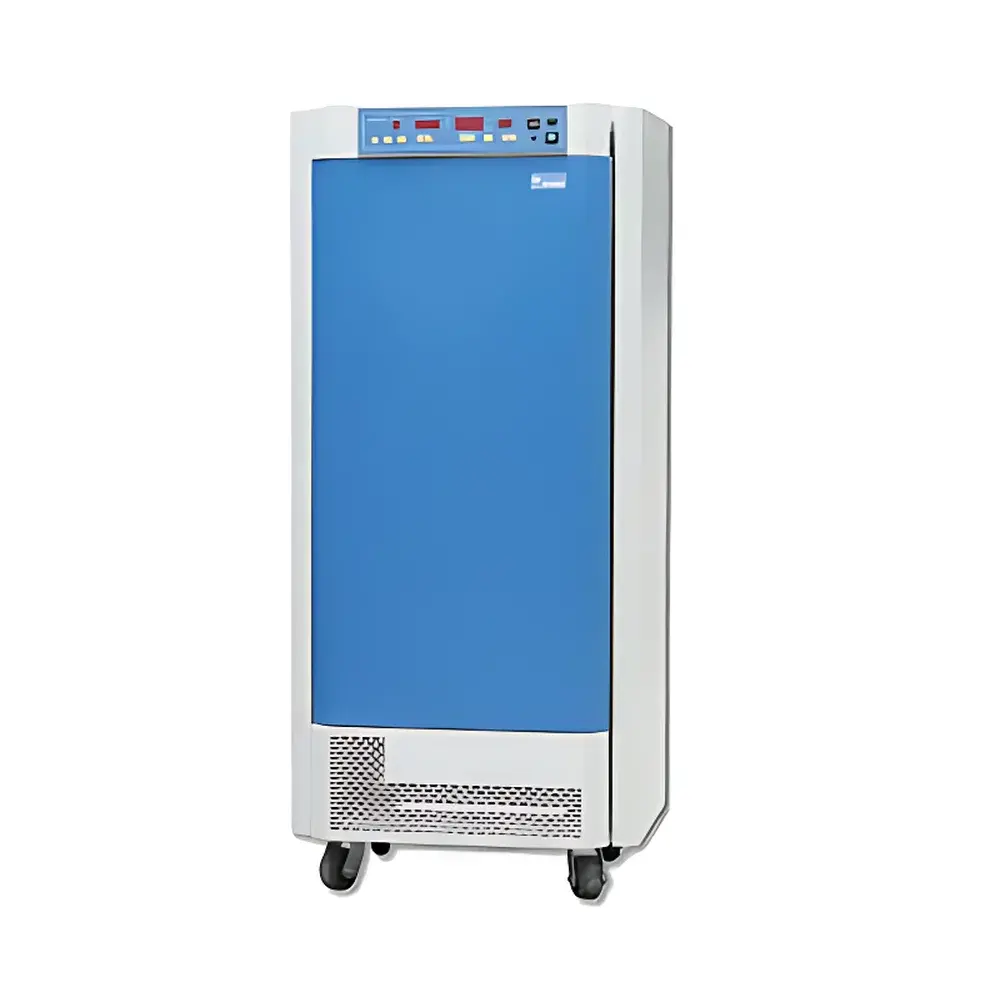
Hebei HOPU KRQ-300 Plant Growth Chamber
| Brand | Hebei HOPU |
|---|---|
| Origin | Shandong, China |
| Model | KRQ-300 |
| Temperature Range (with light) | 10°C to 50°C |
| Temperature Uniformity | ±2.0°C |
| Temperature Fluctuation | ±1.0°C |
| Temperature Resolution | 0.1°C |
| Humidity Range | 50–90% RH |
| Humidity Fluctuation | ±5% RH |
| Humidity Resolution | 1% RH |
| Illumination Levels | 0–20,000 lux (6-step adjustable) |
| Chamber Volume | 300 L |
| Inner Dimensions (W×D×H) | 520 × 670 × 1150 mm |
| Outer Dimensions (W×D×H) | 840 × 900 × 1850 mm |
| Power Supply | AC 220 V, 50 Hz |
| Lighting Configuration | Triple-side illumination |
| Program Control Capacity | 99 segments × 30 steps × 99 cycles |
| Standard Shelving | 4 adjustable stainless steel trays |
| Water Management | Drain-free integrated humidification system |
| Safety Features | Over-temperature alarm, independent temperature limiter, power failure memory |
Overview
The Hebei HOPU KRQ-300 Plant Growth Chamber is an engineered environmental simulation system designed for reproducible, long-term cultivation of photosynthetic organisms under tightly controlled photoperiodic, thermal, and hygric conditions. It operates on a dual-loop PID-controlled microprocessor architecture that independently regulates heating, refrigeration, humidity generation, and multi-level LED or fluorescent lighting—enabling precise emulation of diurnal cycles, seasonal transitions, and stress-response environments. Unlike standard incubators, the KRQ-300 integrates triple-side illumination geometry to ensure uniform photon flux distribution across sample zones—critical for quantitative phenotyping, photomorphogenesis studies, and standardized seed germination assays per ISO 20780 and OECD 208 guidelines. Its pressure-balanced refrigeration circuit maintains stable cooling performance across ambient temperatures up to 35°C without compressor cycling instability, supporting uninterrupted operation in core facility settings.
Key Features
- Triple-side illumination system delivering up to 20,000 lux with six discrete intensity levels—calibrated and traceable to NIST-traceable photometric standards;
- PID-based microprocessor controller (CPU-driven) with real-time logging of temperature, relative humidity, and light status—supporting GLP-compliant parameter verification;
- Integrated drain-free humidification module utilizing high-efficiency evaporative saturation and condensate recovery—eliminating manual water drainage and minimizing microbial reservoir risk;
- Independent over-temperature protection circuit with mechanical limiter, decoupled from primary control logic for fail-safe thermal containment;
- Power-failure memory function retaining setpoints, program sequences, and elapsed runtime—ensuring experimental continuity after grid interruption;
- Stainless steel interior chamber (304 grade) with rounded corners and seamless welds for ease of decontamination and compliance with ISO 14644-1 Class 7 cleanroom maintenance protocols;
- Refrigeration system employing R134a refrigerant with adaptive pressure balancing—optimized for energy efficiency (≤2.8 kW·h/24h at 25°C/60% RH steady state) and low acoustic emission (<52 dB(A)).
Sample Compatibility & Compliance
The KRQ-300 accommodates a broad range of biological specimens including Arabidopsis thaliana seedlings, rice callus cultures, fungal mycelia plates, tissue culture flasks (up to 500 mL), and multi-well assay trays. Its 300 L working volume and four-tier adjustable shelving support scalable replication across genotype × treatment matrices. The chamber meets structural and operational requirements outlined in ASTM E1826 (Standard Practice for Environmental Chambers Used in Biological Testing), supports validation per IQ/OQ/PQ protocols, and enables audit-ready documentation for FDA-regulated botanical extract stability testing (21 CFR Part 11 compliant when paired with validated data acquisition software). Humidity and temperature uniformity data are certified under empty-chamber test conditions per ICH Q5C Annex 3 (±2.0°C spatial deviation; ±5% RH spatial deviation).
Software & Data Management
While the KRQ-300 operates via embedded LCD interface, it features RS-485 communication port (Modbus RTU protocol) for integration into centralized laboratory monitoring systems (e.g., LabVantage, Siemens Desigo, or custom SCADA). Optional USB data logger firmware enables timestamped export of 10-parameter CSV files (T, RH, light level, stage, cycle, segment, alarm flags, compressor duty, heater duty, fan speed) at user-defined intervals (1–60 min). All logged datasets include CRC-16 checksums and support automated import into MATLAB, Python (Pandas), or JMP for longitudinal growth curve modeling and ANOVA-based treatment effect analysis.
Applications
- Controlled-environment phenotyping for CRISPR-edited crop lines under defined photothermal regimes;
- Standardized seed vigor and germination testing per ISTA Rules (International Seed Testing Association);
- Secondary metabolite induction studies in medicinal plants (e.g., taxol biosynthesis in Taxus cell cultures);
- Photoperiodic flowering time assays in model species under 16-h light / 8-h dark cycles;
- Pre-clinical stability assessment of plant-derived biologics under ICH Q1A(R3) long-term storage conditions;
- Microbial co-culture experiments requiring synchronized light-dark modulation of cyanobacterial partners.
FAQ
Does the KRQ-300 support external data logging without optional hardware?
No—real-time serial output requires either the factory-installed RS-485 interface (standard) or USB data logger module (optional). Standalone LCD display does not buffer historical data beyond current session.
What is the maximum load weight per shelf?
Each 304 stainless steel tray supports up to 15 kg uniformly distributed. Total payload capacity: 60 kg across four shelves.
Is UV-A or UV-B irradiation available as an upgrade?
Not natively—the standard lamp array emits 400–700 nm PAR spectrum only. UV supplementation requires third-party retrofitting and voids factory warranty.
Can the unit maintain 10°C with full illumination at 20,000 lux?
Yes—thermal load from lighting is compensated by the pressure-balanced refrigeration system; verified performance at 10°C/20,000 lux/60% RH in ambient 25°C lab environment.
Are calibration certificates provided with shipment?
Factory calibration reports (temperature, humidity, light) are included. NIST-traceable field recalibration services are available through authorized HOPU service centers in Germany, USA, and Singapore.
Related Products



