
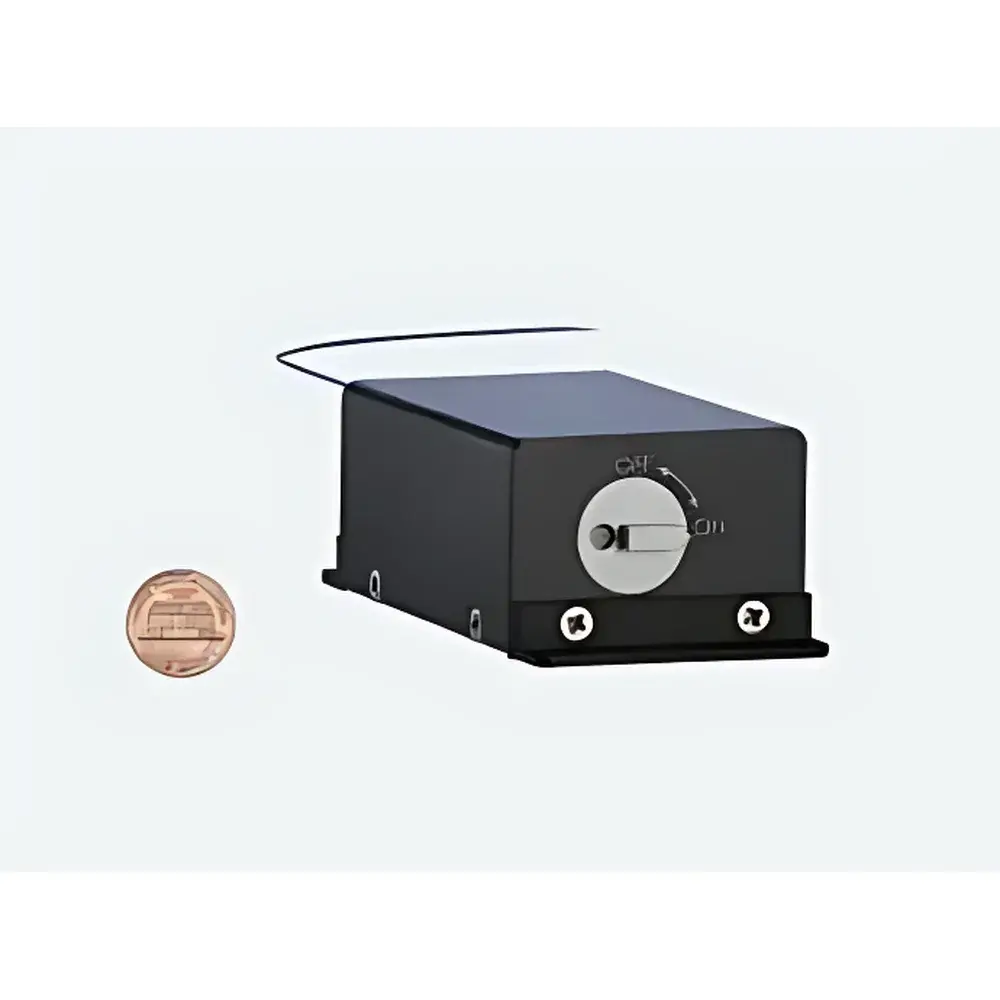
HCP+ 1×0 High Power Second Harmonic Generation (SHG) Mixer Module
| Brand | HCP (Longcai Technology) |
|---|---|
| Origin | Taiwan |
| Manufacturer Type | Authorized Distributor |
| Product Category | Domestic (Taiwan-made) |
| Model | 1×0 High Power SHG Mixer |
| Pricing | Upon Request |
| Input | Fiber-coupled (1064 nm, up to 5 W CW) |
| Output | Free-space 532 nm (green), single-channel |
| Conversion Efficiency | >65% (typical at 5 W input) |
| Beam Quality | M² < 1.2 |
| Polarization | Linear, vertical |
| Cooling | Conductive (fanless, thermally stabilized baseplate) |
| Dimensions | 85 × 55 × 32 mm |
| Weight | 280 g |
| Operating Temperature | 15–35 °C |
| Storage Temperature | –10–60 °C |
| Humidity | <80% RH (non-condensing) |
Overview
The HCP+ 1×0 High Power Second Harmonic Generation (SHG) Mixer Module is a compact, fiber-pigtailed nonlinear optical frequency converter engineered for robust and stable generation of high-brightness 532 nm green light from 1064 nm fundamental laser sources. Based on type-I critically phase-matched lithium triborate (LBO) or periodically poled potassium titanyl phosphate (PPKTP) crystals—selected per application requirements—the module operates under continuous-wave (CW) conditions with up to 5 W of fiber-coupled 1064 nm input power. Its design follows strict principles of thermal management and mechanical stability to maintain phase-matching alignment over extended operation periods, ensuring long-term output power consistency and spatial mode fidelity (M² < 1.2). Unlike bulk-optic SHG assemblies requiring active alignment and external optics, this module integrates collimation, focusing, harmonic separation, and thermal control into a monolithic, hermetically sealed housing—enabling deployment in OEM instrumentation, scientific laser systems, and industrial marking platforms where footprint, reliability, and hands-free integration are critical.
Key Features
- Fiber-to-free-space architecture: Accepts polarization-maintaining (PM) fiber input (FC/APC or FC/PC connector options) and delivers collimated, diffraction-limited 532 nm output in free-space configuration.
- High conversion efficiency: Achieves >65% average SHG efficiency at 5 W 1064 nm input under optimal thermal and alignment conditions—validated via ISO 11146-compliant beam profiling.
- Passive thermal stabilization: Utilizes conductive cooling via an integrated aluminum baseplate with precision-machined thermal interface; eliminates fans, vibration, and airflow dependency—ideal for vacuum-adjacent or low-noise environments.
- Plug-and-play compatibility: Pre-aligned and factory-optimized for common Nd:YAG and fiber laser sources operating at 1064 nm; requires no user calibration or realignment post-installation.
- Compact and ruggedized mechanical design: Housing dimensions of 85 × 55 × 32 mm and mass of 280 g support integration into space-constrained subsystems—including portable spectroscopy engines and handheld laser-induced breakdown spectroscopy (LIBS) probes.
- Single-output channel with built-in dichroic filtering: Integrated harmonic separation optics suppress residual 1064 nm content to <0.1% of total output power—meeting ISO 11146-2 spectral purity requirements for metrology-grade applications.
Sample Compatibility & Compliance
The 1×0 SHG Mixer is compatible with polarization-maintaining, single-mode fiber-coupled 1064 nm lasers delivering up to 5 W CW power, including but not limited to fiber lasers (e.g., IPG YLR series), diode-pumped solid-state (DPSS) Nd:YAG oscillators, and MOPA configurations. It supports input beam divergence ≤0.15 rad and core diameter ≤6 µm (SMF-28 equivalent). All optical coatings meet MIL-C-48497A durability standards; the housing conforms to IEC 60529 IP52 rating for dust resistance and limited water exposure. The module complies with RoHS 2011/65/EU and REACH (EC 1907/2006) material restrictions. For regulated environments—including clinical laser equipment development and GLP-compliant analytical instrument integration—it supports traceable calibration reports (NIST-traceable power meter verification) and optional audit-ready documentation packages aligned with ISO 9001:2015 manufacturing controls.
Software & Data Management
While the 1×0 SHG Mixer operates as a passive optical component without embedded firmware or digital interfaces, its performance integration is fully supported within industry-standard laser system control frameworks. HCP provides detailed LabVIEW™ VI libraries and Python-compatible API wrappers (via RS-232 or USB-to-serial emulation) for monitoring temperature sensor outputs (embedded 10 kΩ NTC thermistor) and logging thermal drift trends during qualification testing. Output power stability data (±1.5% RMS over 8 hours at constant ambient) can be exported in CSV or HDF5 format for statistical process control (SPC) analysis per ISO 22514-2. Full compliance with FDA 21 CFR Part 11 is achievable when deployed within validated host systems that implement electronic signatures, audit trails, and role-based access control for calibration parameter storage.
Applications
- Biomedical imaging: Pump source for confocal and multiphoton microscopy requiring stable 532 nm excitation with minimal thermal lensing.
- Flow cytometry: High-repetition-rate green illumination for fluorescent bead calibration and cell sorting validation.
- Laser spectroscopy: Seed source for tunable OPO systems or absorption spectroscopy in the visible range (e.g., iodine-stabilized frequency references).
- Industrial micromachining: Precision ablation of copper, gold, and transparent conductive oxides (TCOs) where 532 nm offers superior absorption vs. IR wavelengths.
- Quantum optics: Pumping of SPDC crystals for entangled photon pair generation—leveraging high spatial coherence and low pointing instability (<5 µrad RMS).
- OEM laser engine integration: Drop-in replacement for legacy SHG modules in portable Raman spectrometers and handheld LIBS analyzers.
FAQ
What is the maximum allowable input power for continuous operation?
The module is rated for up to 5 W of CW 1064 nm input power. Exceeding this limit may induce thermal dephasing or crystal damage and voids warranty.
Is polarization control required at the input fiber?
Yes—optimal conversion efficiency requires linearly polarized input aligned to the crystal’s extraordinary axis. PM fiber delivery is strongly recommended.
Can the output beam be fiber-coupled?
No—this is a free-space output module. Optional external coupling optics (e.g., aspheric lenses + SMF-28 patch cable) are available separately upon request.
Does the module include temperature monitoring capability?
Yes—an integrated NTC thermistor enables real-time thermal feedback; analog voltage output (0–5 V) correlates to 15–35 °C range with ±0.5 °C accuracy.
What documentation is provided with shipment?
Each unit ships with a Certificate of Conformance (CoC), optical power test report (measured at 5 W input), mechanical drawings (STEP and PDF), and safety-compliance summary per IEC 60825-1:2014 Class 3B laser product classification.



