
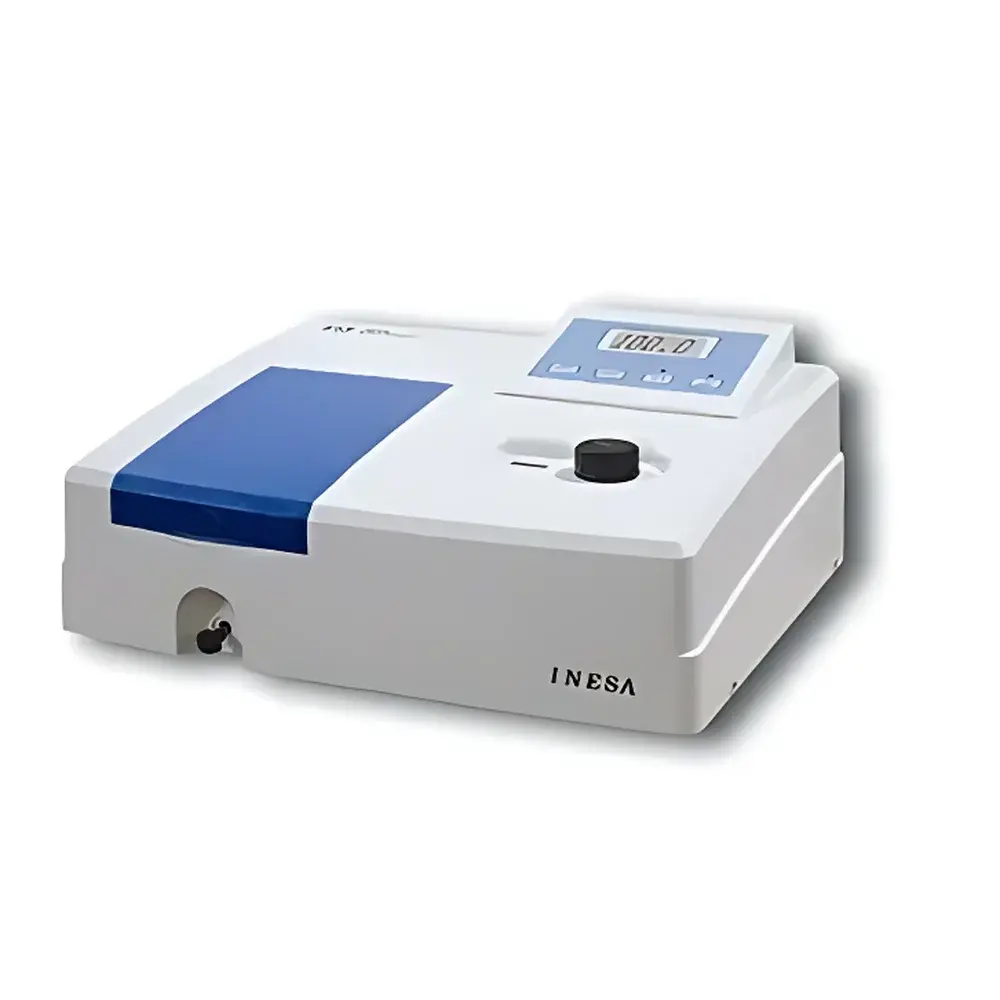
Jihepu 722G Visible Spectrophotometer
| Brand | Jihepu |
|---|---|
| Origin | Shandong, China |
| Model | 722G |
| Wavelength Range | 325–1000 nm |
| Wavelength Accuracy | ±2 nm |
| Wavelength Repeatability | ≤1 nm |
| Photometric Accuracy (Transmittance) | ±0.5% T |
| Photometric Repeatability | ≤0.2% T |
| Spectral Bandwidth | 5 nm |
| Stray Light | ≤0.5% T (at 360 nm, measured with NaNO₂) |
Overview
The Jihepu 722G Visible Spectrophotometer is a benchtop single-beam scanning spectrophotometer engineered for precision absorbance and transmittance measurements across the near-ultraviolet to visible spectrum (325–1000 nm). It operates on the fundamental principle of molecular absorption spectroscopy: analytes containing chromophores selectively absorb photons at characteristic wavelengths, enabling quantitative determination via the Beer–Lambert law. Designed for routine laboratory environments—including teaching labs, QC/QA units, environmental monitoring stations, and clinical chemistry workspaces—the 722G delivers reliable photometric performance without requiring complex optical alignment or high-maintenance components. Its Czerny–Turner monochromator architecture incorporates a holographic blazed grating, ensuring high wavelength fidelity, low stray light, and consistent spectral resolution—critical for reproducible calibration and inter-laboratory comparability.
Key Features
- Single-beam optical design with high-stability tungsten-halogen lamp source and silicon photodiode detector
- Holographic blazed grating in C-T monochromator configuration for improved wavelength accuracy (±2 nm) and reduced stray light (≤0.5% T at 360 nm)
- Backlit LCD display with intuitive menu navigation for direct readout of transmittance (%T), absorbance (A), concentration (C), and factor-adjusted values
- Microprocessor-controlled auto-zeroing (0% T) and auto-100% T calibration functions, minimizing operator-induced drift
- Integrated T–A conversion circuitry with photometric repeatability ≤0.2% T and linearity maintained over 0–100% T range
- Fixed 5 nm spectral bandwidth optimized for general-purpose visible analysis—balancing signal-to-noise ratio and spectral discrimination
- RS-232 serial interface supporting optional dot-matrix or thermal printers for GLP-compliant hardcopy output
Sample Compatibility & Compliance
The 722G accommodates standard 10 mm pathlength cuvettes (glass, quartz, or plastic), supporting both liquid-phase quantification (e.g., enzyme assays, dye concentration, nitrate/nitrite in water) and solid-sample reflectance measurements when used with optional integrating sphere accessories. Its measurement protocol aligns with core principles outlined in ISO 6425 (spectrophotometric performance verification), ASTM E275 (describing spectrophotometer terminology and practices), and USP (Ultraviolet-Visible Spectroscopy). While not inherently 21 CFR Part 11 compliant due to lack of electronic audit trail functionality, the instrument supports traceable manual documentation workflows suitable for ISO/IEC 17025-accredited laboratories conducting non-GMP testing. All photometric validations (wavelength accuracy, stray light, photometric linearity) are executable using NIST-traceable reference standards such as holmium oxide filters and potassium dichromate solutions.
Software & Data Management
The 722G operates independently via front-panel controls but interfaces with the optional UVWin7 software suite (sold separately) for extended data handling. UVWin7 enables spectral scanning, kinetic time-course acquisition, multi-wavelength quantitation, and calibration curve generation (linear, quadratic, or cubic fit) with residual error reporting. Raw data export is supported in CSV and TXT formats for downstream statistical analysis in Excel or R. Though the instrument itself does not store spectra internally, UVWin7 provides full audit trail logging—including user ID, timestamp, parameter settings, and calibration history—facilitating compliance with GLP documentation requirements. The RS-232 connection allows integration into centralized lab data management systems when paired with middleware protocols.
Applications
- Clinical diagnostics: Hemoglobin assay, bilirubin quantification, serum protein electrophoresis staining densitometry
- Environmental testing: COD, ammonia nitrogen, phosphate, and heavy metal (e.g., Cr⁶⁺, Cu²⁺) colorimetric determination per EPA methods
- Pharmaceutical QC: Assay of active ingredients in tablets and injections using compendial UV methods (e.g., USP monographs)
- Food & beverage: Color index (e.g., AOAC 972.30), antioxidant capacity (FRAP, DPPH), and preservative (sulfite, nitrite) analysis
- Academic instruction: Teaching Beer–Lambert law fundamentals, calibration curve construction, and method validation concepts
- Industrial process control: Monitoring dye bath concentrations in textile manufacturing or catalyst activity in fine chemical synthesis
FAQ
What is the maximum measurable absorbance value on the 722G?
The instrument provides accurate absorbance readings up to 3.0 A (corresponding to ~0.1% T); beyond this, photometric nonlinearity increases significantly due to detector saturation and stray light contribution.
Can the 722G be used with quartz cuvettes for UV measurements below 350 nm?
Yes—while classified as a “visible” spectrophotometer, its extended range down to 325 nm permits limited near-UV work with quartz cells; however, optimal UV performance (e.g., below 300 nm) requires a dedicated UV–Vis instrument with deuterium lamp source.
Is wavelength calibration traceable to national standards?
Wavelength accuracy verification can be performed using NIST-traceable holmium oxide or didymium filters; users are responsible for periodic recalibration according to internal SOPs or ISO/IEC 17025 requirements.
Does the 722G support kinetic or time-scan mode?
No—the 722G is a fixed-wavelength or manually scanned instrument; kinetic measurements require external timing and sequential manual readings or integration with UVWin7 software for automated interval sampling.
What maintenance is required to ensure long-term photometric stability?
Routine cleaning of the sample compartment and optical path, annual lamp replacement (tungsten-halogen, ~2000-hour lifespan), and quarterly verification of 0% T and 100% T settings using neutral density filters or blank solutions are recommended.
Related Products





